

Introduction:
Steel manufacturers are under increasing pressure to produce profiles faster, maintain tighter dimensional consistency, fulfil larger orders, and control operating costs. Conventional forming methods can still serve low-volume or specialised work, but their dependence on repeated measurements, manual handling, separate cutting operations, and operator judgement can make large-scale production difficult to standardise.
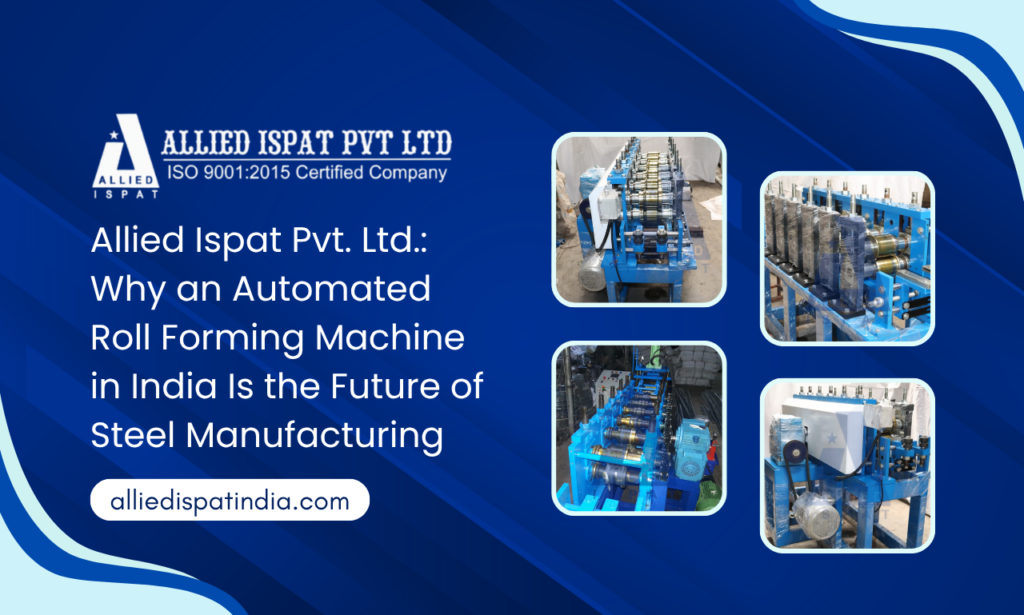
For manufacturers planning long-term expansion, investing in an Automated roll forming machine in India is becoming a strategic production decision rather than a simple machinery purchase. Automated systems combine material feeding, progressive forming, measurement, control, and cutting within a coordinated production line.
Allied Ispat Pvt. Ltd., a division of the Malik Group of Companies, manufactures manual, semi-automatic, and fully automatic cold roll forming machines for different industrial requirements. As a precision-focused Roll Forming Machine Manufacturer in India, the company develops robust machinery with PLC-based control options, hydraulic cutting systems, custom roll configurations, and profile-specific engineering support.
This article explains how automated roll forming supports productivity, accuracy, scalability, material efficiency, and safer manufacturing and why it is likely to play a central role in the future of steel profile production.
What Is an Automated Roll Forming Machine?
An automated roll forming machine is an industrial production system that continuously converts a flat metal coil or strip into a defined profile. Instead of forming the complete shape
in a single operation, the material passes through a sequence of roller stations. Each station makes a controlled, progressive bend until the required cross-section is achieved.
The production process generally follows these stages:
- A steel coil or pre-cut strip is loaded into the feeding arrangement.
- The material enters the machine at a controlled rate.
- Multiple forming stations progressively shape the steel.
- The control system monitors production parameters such as length and quantity.
- A cutting system separates the finished profile at the programmed measurement.
- The completed section is collected for inspection, packing, or further processing.
Roll forming is particularly suitable for producing long sections with a constant cross-sectional shape. It can be used for channels, tracks, shutter components, roofing profiles, ceiling sections, framing members, and many other industrial products.
Manual, semi-automatic and fully automatic configurations
A manual machine usually requires greater operator involvement in settings, feeding, measurement, or cutting. It can be practical for limited production, basic profiles, or businesses entering a new product segment.
A semi-automatic configuration automates selected production stages while retaining some manual control. It provides a balance between investment level, flexibility, and output.
A fully automatic machine coordinates feeding, forming, measurement, quantity programming, and cutting through an integrated control system. Allied Ispat India states that its fully automatic models can include PLC-based systems and hydraulic cutters to support faster production, labour efficiency, and consistent high-volume output.
Why Is the Steel Manufacturing Industry Moving Towards Automation?
The industry is moving towards automation because customers increasingly expect repeatable dimensions, dependable delivery schedules, competitive pricing, and consistent product performance.
Increasing production requirements
Construction component manufacturers, OEMs, rolling shutter producers, and steel fabricators often need to fulfil larger orders within shorter timeframes. A process that depends heavily on individual operators may become difficult to scale when order volumes rise.
An automated production line can maintain a controlled sequence over extended production runs. This gives manufacturers a stronger foundation for planning daily output, labour allocation, raw material consumption, and delivery schedules.
Rising labour and operating costs
Automation does not remove the need for skilled workers. It changes where their skills are used. Instead of repeatedly measuring, handling, and cutting every profile, trained operators can supervise machine settings, monitor quality, manage tooling, and perform preventive maintenance.
This helps businesses use their workforce more productively while reducing dependence on repetitive manual activities.
Greater demand for dimensional consistency
Variations in profile width, angle, bend radius, or cut length can create problems during assembly and installation. Buyers therefore expect steel sections from the first batch and the hundredth batch to fit the same drawings.
Automatic roll forming technology supports repeatability by using fixed tooling arrangements, controlled feeding, programmed length settings, and coordinated cutting.
Shorter delivery timelines
Manufacturers frequently compete not only on price but also on their ability to fulfil orders reliably. Automated roll forming can reduce pauses between separate forming, measuring, and cutting stages, creating a more continuous workflow.
Need for customised products
Different industries require different shapes, dimensions, materials, thicknesses, and production speeds. Modern machinery is therefore becoming more configurable.
A capable manufacturer can engineer the roller design, forming sequence, cutting arrangement, controls, and machine layout around the intended finished profile rather than forcing every buyer to use a standard configuration.
How Do Automated Roll Forming Machines Improve Production Efficiency?
An automated system improves production efficiency by coordinating multiple operations within one controlled line. The main advantage is not simply that the machine runs faster; it is that feeding, forming, measurement, and cutting work together.
Continuous production flow
Once the material, tooling, and control settings are prepared, the steel strip can travel continuously through the forming stations. This avoids repeated stopping, manual repositioning, and separate movement between independent workstations.
For example, a rolling shutter component manufacturer may need hundreds of profiles of the same design and length. In a conventional process, workers may form, measure, mark, and cut each section through separate activities. An automated line can produce the same profile in a coordinated sequence with considerably less manual interruption.
Faster production adjustments
PLC-controlled systems allow authorised operators to enter production requirements such as profile length and required quantity. This can simplify adjustments between orders without relying entirely on manual measurement.
The time required for a complete changeover still depends on tooling, profile complexity, material characteristics, and machine design. However, digital production controls can make routine parameter changes more organised and repeatable.
Reduced production bottlenecks
A bottleneck develops when one stage operates more slowly than the rest of the production line. When feeding, forming, and cutting are properly matched, manufacturers can reduce unnecessary material waiting between processes.
An Automated roll forming machine in India can be particularly useful for businesses that already have strong market demand but struggle to fulfil larger orders because their existing production process involves excessive manual handling.
Better performance during extended shifts
Automated machinery can support consistent process control over longer production runs, provided that operators follow correct settings, material loading, lubrication, inspection, and maintenance procedures.
The result is a more predictable manufacturing workflow. Predictability helps factory owners estimate production capacity, raw material requirements, labour deployment, and order completion timelines more accurately.
How Does Automation Improve Accuracy and Product Consistency?
Automation improves consistency by controlling how material enters the machine, how it passes through each forming station, and where the completed profile is cut.
Progressive and repeatable forming
Each roller station performs a specific part of the forming sequence. The gradual development of the profile helps control the material as it moves from a flat strip to the final shape.
The design, machining, alignment, and condition of the rollers are critical. Poorly designed or worn tooling can cause twisting, bowing, surface damage, incorrect angles, or dimensional variation. High-precision tools and a rigid machine structure therefore have a direct influence on product quality.
Consistent profile geometry
Repeatable profile dimensions are important when products must fit into a larger assembly. Drywall tracks must receive compatible studs. Rolling shutter parts must align with adjoining components. Roofing and framing sections must match fastening points and installation drawings.
When the machine is correctly designed, adjusted, and maintained, the same forming sequence is applied to every section in the production run.
Controlled cut length
Manual measuring and marking can introduce variation, particularly during repetitive,
high-volume work. A programmed cutting system provides more consistent lengths and helps production teams organise bundles, packaging, site installation, and inventory.
Better surface quality
Surface finish matters when processing galvanised, pre-painted, colour-coated, or decorative steel. Improper roller surfaces, misalignment, contamination, or uncontrolled handling can scratch or mark the material.
Allied Ispat Pvt. Ltd. highlights precision tooling and smooth, scratch-free output as important design priorities for applications involving colour-coated and decorative metal.
Can Automated Roll Forming Reduce Material Waste?
Yes. Automated roll forming can help reduce avoidable waste by improving feed control, profile consistency, cutting accuracy, and repeatability. It cannot guarantee zero waste, because losses can still result from coil ends, setup trials, defective raw material, tooling errors, incorrect settings, and quality rejection.
Fewer incorrectly formed profiles
A stable machine setup reduces variation between sections. When the roller arrangement, material properties, and feed settings remain controlled, manufacturers are less likely to produce large quantities before discovering a repeated dimensional error.
More accurate cut lengths
Cutting profiles longer than required wastes material. Cutting them too short creates rejected products. Programmed length control can reduce these inconsistencies and improve raw material utilisation.
Reduced trial-and-error production
Documented machine settings and repeatable controls help experienced operators reproduce approved production conditions. This can reduce excessive adjustment during repeat orders.
Lower rejection and rework
Reworking incorrectly formed steel consumes labour, machine time, electricity, and sometimes additional material. In many cases, a severely distorted profile cannot be corrected economically.
An Automated roll forming machine in India can improve material planning by giving production teams clearer control over quantity, finished length, batch output, and rejection monitoring.
What Role Do PLC Controls and Hydraulic Cutting Systems Play?
PLC control and hydraulic cutting support coordinated, repeatable production. Their value lies in making the line easier to manage, monitor, and adjust.
PLC-based machine control
A programmable logic controller manages defined machine operations according to entered instructions. Depending on the machine configuration, operators may be able to set:
- Required profile length
- Number of pieces
- Production sequence
- Start and stop commands
- Cutting cycles
- Selected operating parameters
- Emergency or fault responses
For a factory owner, the main benefit is greater process consistency. The production requirement can be entered digitally rather than relying only on manual measuring and repeated operator decisions.
PLC systems also make it easier to standardise operating procedures. However, they must be used by trained personnel, protected from unsuitable environmental conditions, and maintained by qualified technicians.
Hydraulic cutting systems
A hydraulic cutter uses controlled hydraulic force to separate the finished section. The cutting tool must be designed around the profile shape, material properties, thickness, and required edge condition.
When properly matched with machine speed and profile movement, hydraulic cutting can provide repeatable lengths and cleaner production flow. The cutting system must also be correctly aligned and maintained to avoid deformation, burrs, incomplete cuts, or unnecessary tool wear.
Allied Ispat’s fully automatic machine options combine PLC-based control with hydraulic cutting to support efficient and consistent production.
How Do Automated Machines Support Safer Manufacturing Operations?
Automated machines can reduce unnecessary manual interaction with moving steel, repetitive measurement, and separate cutting activities. However, automation does not remove industrial risk. Safe operation still depends on proper machine design, guarding, training, supervision, maintenance, and adherence to operating procedures.
Important safety practices include:
- Using suitable guards around moving rollers and transmission systems
- Providing accessible emergency stop controls
- Establishing safe coil-loading procedures
- Preventing loose clothing or hands from approaching moving machinery
- Training operators before independent machine use
- Following lockout and isolation procedures during maintenance
- Inspecting electrical, hydraulic, and mechanical components
- Keeping the operating area clean and organised
- Using suitable personal protective equipment
- Restricting unauthorised access to machine controls
Automation can make material movement more controlled, but a production line should only operate within its designed material, thickness, speed, and loading limits.
Why Is Customisation Important in Roll Forming Machinery?
Customisation is essential because the machine must be engineered around the product it will manufacture. Two profiles that appear similar may require different roller designs, station sequences, cutting dies, motor capacities, and control arrangements.
Before finalising a machine, the manufacturer should understand:
- Final profile drawing
- Cross-sectional dimensions
- Bend angles and radii
- Strip width
- Material thickness range
- Steel grade or material type
- Coating or surface sensitivity
- Required length
- Expected production volume
- Desired operating speed
- Cutting method
- Factory electrical supply
- Available floor space
- Future product plans
Profile and roller design
The roller arrangement determines how the flat strip gradually develops into the finished section. Complex profiles may require more forming stages to control material movement and avoid distortion.
Material thickness and grade
A machine designed for light-gauge galvanised steel may not be suitable for a considerably thicker or stronger material. Tooling loads, motor requirements, shaft design, frame strength, and cutting force must be evaluated.
Factory layout
The complete line may include a decoiler, feeding section, forming mill, cutting system, control panel, output table, and material-handling space. Buyers should evaluate usable floor area rather than considering only the main machine body.
Allied Ispat India offers customised roller and machine configurations according to the buyer’s product profile and strip requirements.
Businesses planning an Automated roll forming machine in India should share approved drawings, physical samples where available, raw material details, desired output, and operational requirements with the technical team before a final configuration is recommended.
Which Industries Can Benefit from Automated Roll Forming Machines?
Roll forming supports industries that require long metal sections with consistent cross-sectional geometry.
Rolling shutter manufacturing
Roll forming machinery can produce shutter slats, guides, channels, and other profile-based components. Machine design depends on the exact shutter system and material specification.
Roofing and cladding
Roofing sheets and related building profiles often require continuous lengths, repeatable geometry, and controlled surface handling.
False ceilings and drywall partitions
Ceiling channels, perimeter sections, studs, and tracks require consistent dimensions so adjoining components fit correctly during installation.
Cable management
Cable trays, raceways, and support profiles can be manufactured through customised forming lines designed around required widths, bends, slots, and material thicknesses.
Solar mounting structures
Solar projects use metal sections for module support and structural mounting. The machinery must be configured according to the final structural profile and project specification.
Storage and racking systems
Racking uprights, beams, shelves, and supporting profiles may be produced using
profile-specific roll forming equipment, sometimes combined with punching or additional processing.
Automotive and engineering components
Automotive and general engineering manufacturers use roll-formed sections where continuous profiles, controlled geometry, and repeatability are required.
Other applications include door and window sections, electrical enclosures, construction framing systems, furniture profiles, fencing components, and customised industrial sections.
The machine must always be selected according to the final profile, raw material, required tolerance, production volume, and downstream application.
Automated Roll Forming vs Conventional Manufacturing Methods
| Comparison Factor | Conventional or Manual Process | Automated Roll Forming |
| Production workflow | May involve separate forming, measuring, handling, and cutting stages | Coordinates feeding, forming, measurement, and cutting in one line |
| Output consistency | More dependent on operator judgement and repeated manual activity | Uses repeatable tooling positions and programmed controls |
| Labour involvement | Higher involvement in routine handling and measurement | Greater focus on setup, monitoring, quality, and maintenance |
| Dimensional accuracy | Can be suitable for low-volume work but may vary between operators | Better suited to repeated profile dimensions over larger batches |
| Production speed | Appropriate for limited or specialised production | Supports continuous production and higher-volume requirements |
| Material handling | More movement may be required between separate operations | Material progresses through a coordinated production sequence |
| Scalability | Capacity expansion may require additional labour and workstations | Can support larger volumes when correctly specified |
| Custom profile production | Flexible for prototypes and one-off fabrication | Requires dedicated or adjustable tooling and proper setup |
| Ǫuality control | Often depends on frequent manual checks | Supports standard settings but still requires regular inspection |
| Long-term operational efficiency | Can be economical for low output or varied one-off jobs | Can offer stronger value for repeat and high-volume production |
Automation is not automatically the correct answer for every business. A company producing highly varied, extremely low-volume, or one-off profiles may prefer a more flexible fabrication process. The decision should be based on product demand, repeatability, investment capacity, and future production strategy.
How Can Automation Help Steel Manufacturers Scale Their Business?
Automation supports growth by creating a more predictable production platform. When a business understands its realistic output, material consumption, tooling requirements, and maintenance schedule, it can accept larger orders with greater confidence.
Handling larger order volumes
A coordinated line can support bulk production without requiring manual activity to increase at the same rate as output. Skilled workers remain essential, but their roles become more focused on setup, quality control, planning, and machine supervision.
Improving delivery planning
Repeatable cycle times make it easier to estimate when an order will be completed. Better production planning can improve communication with distributors, contractors, OEM buyers, and project customers.
Entering new product segments
A custom roll forming machine can help a manufacturer introduce new profiles for construction, infrastructure, solar, storage, shutter, ceiling, or engineering applications.
Manufacturers evaluating an Automated roll forming machine in India should consider not only present orders but also realistic future demand. A machine selected only for current minimum requirements may restrict expansion, while an unnecessarily complex machine may create an avoidable financial burden.
Scaling also depends on reliable coil supply, trained operators, tooling management, maintenance discipline, quality systems, factory utilities, sales demand, and working capital.
What Should Buyers Check Before Purchasing an Automated Roll Forming Machine?
A buyer should evaluate the complete production requirement rather than comparing machines only by price.
Product and material checklist
- What is the exact finished profile?
- Is an approved technical drawing available?
- Which material will be processed?
- What are the minimum and maximum thicknesses?
- What is the required strip or coil width?
- Is the material galvanised, cold rolled, colour-coated, stainless, or another grade?
- Is the surface vulnerable to scratching?
Production checklist
- What is the expected daily or monthly volume?
- Which profile lengths are required?
- How frequently will settings or products change?
- Is manual, semi-automatic, or fully automatic operation appropriate?
- Is future capacity expansion expected?
- Are punching, notching, embossing, or additional operations required?
Machine engineering checklist
- How many forming stations are proposed?
- What materials and heat treatment are used for the rollers?
- Is the frame suitable for expected operating loads?
- Which motor and drive arrangement is required?
- How will the material be fed?
- Which cutting mechanism is recommended?
- Does the PLC provide practical production controls?
- Is the electrical system compatible with the factory supply?
- How easy is tooling access for adjustment and maintenance?
Supplier support checklist
- Does the manufacturer understand the intended profile application?
- Can the machine be customised?
- Will installation assistance be available?
- Is operator training included or available?
- How are spare parts handled?
- What preventive maintenance is required?
- Is technical support available after commissioning?
- How is the machine tested before dispatch?
- Are trial profiles inspected against the approved drawing?
Before purchasing an Automated roll forming machine in India, share your profile drawing, strip width, material thickness, steel grade, target output, available factory space, and power requirements with Allied Ispat Pvt. Ltd. This allows the technical team to discuss a configuration suited to the actual production process.
Why Choose Allied Ispat Pvt. Ltd. as a Roll Forming Machine Manufacturer in India?
Allied Ispat Pvt. Ltd. brings long-standing experience in steel products and metal-forming applications to its machinery solutions. The company’s official website identifies it as a manufacturer of roll forming machines, rolling shutter parts, POP and drywall components, and a supplier of multiple steel coil categories.
Precision-focused machine engineering
Allied Ispat India develops cold roll forming machines for continuous industrial production. Its machinery positioning focuses on precision tooling, consistent output, robust construction, and reduced maintenance requirements.
Heavy-duty construction
A rigid structure helps maintain roller and shaft alignment under operating loads. Allied Ispat highlights heavy-duty frames and quality-tested components for machinery intended for continuous industrial use.
Manual to fully automatic options
Different businesses have different production volumes and investment priorities. Allied Ispat provides manual, semi-automatic, and fully automatic machine options, allowing buyers to discuss a configuration aligned with their operations.
PLC controls and hydraulic cutting
Fully automatic options can include PLC-based systems and hydraulic cutters. These features support programmed production, repeatable lengths, coordinated machine operation, and reduced routine manual intervention.
Customised roll configurations
Allied Ispat Pvt. Ltd. can customise machine and roller configurations according to the required profile, strip size, material, output expectations, and production application.
Installation and operator support
The company’s machine-related content describes support for machine selection, installation, operator guidance, and after-sales technical assistance. This is valuable because even
well-engineered industrial equipment requires correct commissioning, training, adjustment, and maintenance.
For companies searching for a Roll Forming Machine Manufacturer in Mumbai, Allied Ispat India combines its Mumbai presence with manufacturing operations in the Taloja industrial area. Its experience across steel coils, formed sections, shutter components, and industrial machinery gives the team practical familiarity with both raw materials and finished profile applications.
As a Roll Forming Machine Supplier in India, the company serves businesses seeking customised equipment for productivity, durability, consistent forming, and long-term production development.
Are Automated Roll Forming Machines the Right Investment for Every Manufacturer?
Automated machinery is most valuable when the business has repeatable products, sufficient order demand, and a clear production plan. It may not be the most economical choice for every low-volume or frequently changing application.
Decision-makers should assess:
- Present production volume
- Expected order growth
- Frequency of product changes
- Standardisation of profile dimensions
- Current rejection and rework levels
- Labour availability
- Factory space
- Electrical and utility requirements
- Tooling and maintenance capability
- Availability of trained operators
- Capital budget
- Expected equipment utilisation
- Long-term product strategy
The purchase price is only one part of the evaluation. Buyers should also consider tooling life, setup time, energy usage, labour deployment, maintenance, raw material losses, product quality, output capacity, service support, and potential revenue from additional orders.
An Automated roll forming machine in India may offer strong long-term value when it solves a genuine production constraint. The investment should be based on realistic order data and operational requirements rather than automation alone.
The Future of Automated Roll Forming in Steel Manufacturing
Roll forming machinery is likely to become more connected, measurable, and adaptable as manufacturers demand greater control over production performance.
Greater production intelligence
Control systems may increasingly record production quantities, operating status, stoppages, and quality-related data. This can help production teams identify recurring losses and improve planning.
Better machine monitoring
Sensors and connected systems are expected to support condition monitoring for selected mechanical, electrical, or hydraulic components. This may allow maintenance teams to identify changes before they become major failures.
Faster setup and changeovers
Future machinery is likely to place greater emphasis on adjustable tooling, recipe-based settings, modular systems, and simplified changeover procedures. These improvements can help manufacturers serve more product variants without excessive downtime.
Predictive maintenance
Maintenance decisions may increasingly use operating hours, load patterns, vibration, temperature, and fault histories. Predictive approaches will not replace routine inspection, but they may help maintenance teams plan interventions more effectively.
Data-supported quality control
Digital measurement and inspection technologies may allow manufacturers to detect dimensional variation earlier in the production process. Earlier detection can reduce the risk of producing a large defective batch.
Energy-conscious production
Machine builders and users are expected to pay greater attention to efficient motors, controlled drives, appropriate machine sizing, reduced idle operation, and responsible use of hydraulic systems.
Connected manufacturing systems
Roll forming equipment may increasingly exchange production information with planning, inventory, quality, and maintenance systems. The level of integration will depend on factory size, budget, cybersecurity, process complexity, and workforce capability.
Demand for customised steel sections is also likely to grow as construction, solar, storage, infrastructure, transport, and industrial engineering applications develop. Manufacturers that invest in suitable equipment, skilled operators, quality systems, and tooling knowledge will be better positioned to respond.
Frequently Asked Ǫuestions
1. What is an automated roll forming machine?
An automated roll forming machine continuously shapes steel coils or strips through multiple roller stations and cuts the completed profile to a programmed length. Allied Ispat Pvt. Ltd. offers customised machine options for different profiles, materials, and production requirements.
2. How does an automatic roll forming machine work?
The machine feeds a metal strip through a sequence of precision rollers, with each station gradually forming part of the final shape. Allied Ispat India can integrate PLC controls and hydraulic cutting into fully automatic configurations for coordinated production.
3. What is the difference between semi-automatic and fully automatic roll forming machines?
A semi-automatic machine automates selected operations while retaining more operator involvement. A fully automatic system coordinates functions such as feeding, length setting, quantity control, forming, and cutting. Allied Ispat Pvt. Ltd. helps buyers select the suitable automation level.
4. Can a roll forming machine be customised for a specific steel profile?
Yes. Roller design, forming stations, cutting tools, controls, motor capacity, and feeding systems can be engineered around a defined product. Allied Ispat India requests profile drawings, material details, strip dimensions, and output expectations before recommending a machine.
5. Which materials can be processed using a roll forming machine?
Roll forming machines can process materials such as galvanised steel, cold rolled steel,
pre-painted steel, stainless steel, and other compatible metals. The exact capability depends on material grade, thickness, width, tooling, and machine design specified by Allied Ispat Pvt. Ltd.
6. Does automation improve the accuracy of steel profiles?
Automation supports accuracy through controlled feeding, repeatable roller positions, consistent forming stages, and programmed cutting. Allied Ispat India also emphasises precision tooling and robust machine construction to support consistent profile geometry and surface quality.
7. How can an automated roll forming machine reduce labour requirements?
It reduces repetitive manual work related to measuring, marking, material movement, and separate cutting. Skilled operators are still required for setup, monitoring, inspection, and maintenance. Allied Ispat Pvt. Ltd. provides operator guidance for correct machine use.
8. What factors affect the cost of a roll forming machine in India?
Cost depends on profile complexity, material thickness, number of forming stations, automation level, roller design, cutting mechanism, motor requirements, controls, and additional
operations. Allied Ispat India evaluates the actual production requirement before proposing a suitable configuration.
9. What information should I provide when requesting a customised machine?
Provide the profile drawing, sample if available, material grade, thickness range, strip width, required lengths, target output, electrical supply, factory space, and automation preference. This helps Allied Ispat Pvt. Ltd. understand the machine’s intended production conditions.
10. How do I choose a reliable Roll Forming Machine Manufacturer in India?
Evaluate the manufacturer’s engineering experience, customisation ability, tooling quality, testing process, installation support, operator training, spare parts, and after-sales service. Allied Ispat Pvt. Ltd. combines steel industry knowledge with profile-specific roll forming machine development.
11. Does Allied Ispat provide installation and operator training?
Allied Ispat India’s machine-related information highlights installation assistance, operator guidance, and technical support. Buyers should confirm the exact commissioning, training, service, and commercial scope for their selected machine configuration before placing an order.
12. Where can I find a Roll Forming Machine Manufacturer in Mumbai?
Allied Ispat Pvt. Ltd. has a Mumbai office and manufacturing operations in the Taloja industrial area. Businesses can contact Allied Ispat India to discuss customised manual, semi-automatic, or fully automatic roll forming machinery.
Conclusion
Automated roll forming is shaping the future of steel manufacturing because it brings feeding, progressive forming, measurement, control, and cutting into a coordinated production process. For businesses producing repeatable metal profiles, this can support higher output, more consistent dimensions, controlled cut lengths, reduced manual handling, improved material utilisation, and stronger production planning.
The right machine must still be selected carefully. Profile geometry, raw material, thickness, production volume, tooling, factory layout, operator capability, maintenance support, and future expansion should guide the investment.
Allied Ispat Pvt. Ltd. combines steel industry experience with customised machine engineering, robust construction, precision tooling, PLC-controlled options, hydraulic cutting, installation guidance, and operator support. This makes the company a practical choice for businesses evaluating a dependable Roll Forming Machine Manufacturer in India.
Discuss your required profile with Allied Ispat India. Share the technical drawing, strip dimensions, material grade, thickness range, target output, and factory requirements to explore an Automated roll forming machine in India configured around your manufacturing process.
Allied Ispat Mumbai Central
Address: Shop 69, Maulana Shaukat Ali Road, Chhota Sonapur, Siddharth Nagar, Mumbai Central, Mumbai, Maharashtra 400008
Phone: 098211 77009
Get Directions: https://maps.app.goo.gl/gyEqxBGcw9jLsYm26
Allied Ispat Works:
Plot no. C-17 9, MIDC Road behind Bank of Baroda Bank Taloja Panvel, Maharashtra 410208 India
Get Directions: https://maps.app.goo.gl/6ujLCuHpǪLu1Uy3r8
Phone: 087790 51606
Email: info@alliedispatindia.com | sales@alliedispatindia.com
Website: www.alliedispatindia.com