Introduction
Modern false ceilings and drywall partitions depend on the quality of the steel framework hidden beneath the finished surface. Even minor variations in channel width, thickness, or profile shape can lead to installation issues, poor alignment, and reduced structural stability. As construction projects demand faster execution and consistent quality, manufacturers need precise and efficient production methods rather than relying on conventional fabrication techniques.
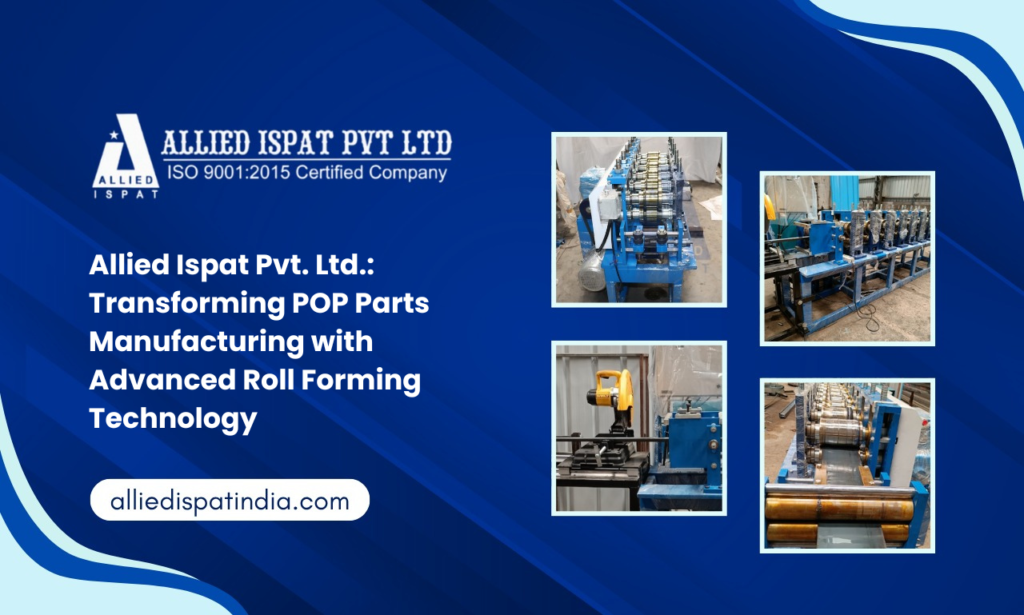
Advanced roll forming technology has transformed the production of POP frame components by continuously converting galvanized steel coils into accurately shaped ceiling and partition sections. The process combines controlled feeding, sequential profile formation, automated cutting, and repeatable production settings to manufacture durable steel profiles with high dimensional accuracy and consistency.
Allied Ispat Pvt. Ltd., a leading GI POP Frame Manufacturer in India, uses advanced roll forming technology to manufacture premium-quality ceiling sections, partition sections, C-studs, floor tracks, perimeter channels, angles, and intermediate channels. Based in Mumbai with a modern production facility in Navi Mumbai, the company supplies architects, contractors, builders, dealers, and infrastructure companies across India with reliable POP frame solutions designed for residential, commercial, and industrial projects.
What Is Roll Forming Technology?
Roll forming is a continuous metal forming process in which a galvanized steel strip passes through multiple precision-engineered roller stations. Instead of bending the steel in one step, each roller gradually shapes a small portion until the required cross-sectional profile is achieved.
Unlike traditional press braking, which processes individual metal sheets one at a time, roll forming works continuously from steel coils, making it ideal for manufacturing ceiling channels, perimeter channels, C-studs, floor tracks, intermediate channels, and other long steel profiles required in modern construction.
The manufacturing process typically includes:
- Loading a galvanized steel coil onto a decoiler
- Feeding the strip into the roll forming machine
- Maintaining controlled strip movement
- Passing the steel through multiple roller stations
- Adding optional punching, embossing, or knurling where required
- Cutting profiles to predetermined lengths
- Inspecting, bundling, and preparing finished products for dispatch
Since the steel is formed gradually without heating, the process offers better dimensional accuracy, reduced material stress, efficient steel utilization, and faster production speeds. This makes roll forming the preferred manufacturing method for lightweight steel framing systems and false ceiling components.
Why Roll Forming Has Become Essential for POP Parts Manufacturing
The demand for false ceilings and drywall partition systems continues to grow across apartments, offices, hospitals, hotels, educational institutions, factories, and infrastructure projects. These projects require thousands of identical steel sections that fit together perfectly during installation.
Manual fabrication may be suitable for small production runs, but maintaining consistency becomes difficult when manufacturing in bulk. Advanced roll forming addresses four critical manufacturing requirements:
- High production volume
- Consistent quality
- Faster manufacturing
- Automated production control
Growing Demand for Lightweight Construction
Modern construction increasingly depends on lightweight steel framing because it allows faster installation, flexible interior layouts, and improved project efficiency. Every ceiling channel, C-stud, and floor track must maintain consistent dimensions throughout production to ensure smooth installation.
Roll forming enables manufacturers to produce identical profiles across large batches without compromising quality.
Consistency in Bulk Orders
Manual bending often results in slight dimensional variations, especially during large production runs. In contrast, advanced roll forming machines operate with predefined settings for roller geometry, feed speed, and cutting length.
Once properly configured, every profile follows the same manufacturing sequence, resulting in uniform products throughout the batch.
Faster Production
Unlike conventional fabrication, roll forming combines feeding, forming, and cutting into one continuous process. Since steel does not need to be repeatedly repositioned between different workstations, production becomes faster and more efficient.
Allied Ispat Pvt. Ltd. operates an automated manufacturing facility capable of producing over 3,000 POP frame units per day, helping contractors meet demanding project schedules.
Improved Automation
Modern roll forming machines integrate PLC-based controls, automatic feeding systems, and hydraulic cutting. Automation ensures consistent dimensions while allowing operators to focus on machine setup, quality inspection, and preventive maintenance rather than repetitive manual measurements.
How Advanced Roll Forming Improves POP Parts Quality
The biggest advantage of advanced roll forming is not only higher production speed but also consistent product quality.
Improved Dimensional Accuracy
False ceiling systems consist of multiple interconnected components. If one channel differs slightly in width or depth, it can create fitting issues throughout the entire framework.
Precision roll forming gradually develops the profile using engineered roller stations, producing channels with consistent dimensions, flange shapes, and edge geometry.
Accurate profiles help:
- Improve component compatibility
- Reduce forced fitting
- Maintain ceiling alignment
- Support uniform spacing
- Simplify board installation
- Minimize corrective work during installation
Consistent Profile Geometry
Each ceiling section should maintain the same cross-section throughout its length. Uneven profiles can weaken connections and affect structural stability.
By distributing the bending process across multiple roller stations, advanced roll forming maintains uniform geometry from start to finish.
Better Surface Finish
Properly maintained rollers allow galvanized steel to move smoothly through the machine without damaging the protective coating. Regular maintenance, alignment, and cleaning of tooling are essential for maintaining high-quality surface finishes.
Safer Folded Edges
Sharp steel edges can create safety risks during transportation and installation. Roll forming allows manufacturers to create folded edges as part of the profile design.
Allied Ispat’s GypsPlus Xpert-Plus range incorporates folded edges to improve handling safety and installation convenience.
Cleaner Cutting
Automated hydraulic cutting systems produce consistent section lengths while reducing manual measurement errors. Proper blade maintenance also minimizes burr formation and ensures cleaner cuts.
Reduced Manufacturing Defects
Advanced roll forming helps reduce common defects such as:
- Twisting
- Bowing
- Uneven bends
- Flare
- Dimensional variation
This is achieved through controlled strip feeding, accurate tooling, stable operating speeds, proper guide alignment, quality raw materials, and regular inspections. As a result, contractors receive more consistent products with fewer rejected components.
POP Parts Manufactured Using Roll Forming Technology
Roll forming is widely used to manufacture various false ceiling and drywall partition components. Allied Ispat Pvt. Ltd. produces a complete range of galvanized POP frame products suitable for residential, commercial, and industrial applications.
The product range includes:
- Ceiling Channels
- Intermediate Channels
- Perimeter Channels
- Angle Sections
- C-Studs
- Floor Tracks
- Partition Sections
- Ceiling Sections
Each component is manufactured with precise dimensions to ensure compatibility during installation. Ceiling channels support suspended ceilings, intermediate channels distribute structural loads, perimeter channels define ceiling boundaries, C-studs form drywall walls, and floor tracks secure partition systems. Allied Ispat also offers customizable lengths and thicknesses to meet different project requirements.
How Automation Improves Manufacturing Efficiency
Automation has become a key driver of modern POP parts manufacturing by improving production speed, accuracy, and consistency. Instead of relying on manual operations, advanced roll forming systems integrate material feeding, profile forming, cutting, and monitoring into a continuous workflow.
PLC-Based Machine Control
Programmable Logic Controllers (PLCs) allow operators to enter production settings such as profile length, quantity, and machine sequence. This coordination ensures feeding and cutting occur accurately while reducing manual calculations and maintaining consistent production quality.
Automatic Material Feeding
Stable material feeding is essential for maintaining profile accuracy. Automated feeding systems ensure galvanized steel enters the roller stations at the correct speed and alignment, preventing twisting and dimensional variation.
Hydraulic Cutting
Integrated hydraulic cutting systems automatically cut profiles to programmed lengths, providing:
- Consistent section lengths
- Faster cutting cycles
- Reduced manual measurement
- Improved batch uniformity
- Lower material handling
Continuous Production Flow
Unlike traditional fabrication, where materials move between several workstations, roll forming combines feeding, shaping, and cutting into one streamlined process. This reduces handling time, improves efficiency, and supports high-volume production.
Higher Productivity with Quality
High production output is valuable only when products meet quality standards. Automated roll forming enables manufacturers to achieve both speed and precision, ensuring consistent profiles across every production batch.
Traditional Manufacturing vs Advanced Roll Forming
Compared to conventional fabrication, advanced roll forming offers several advantages:
- Faster production for medium and high-volume manufacturing.
- Better dimensional accuracy through precision tooling and programmed controls.
- Reduced material waste with continuous coil processing.
- Uniform profile geometry across large production batches.
- Integrated feeding, forming, and cutting operations.
- Lower manual handling and improved labour efficiency.
- Better scalability for growing production requirements.
- Consistent surface finish and accurate cut lengths.
- Easier production of customized steel profiles after tooling setup.
Although manual fabrication remains useful for limited or irregular profiles, roll forming is the preferred solution for repetitive ceiling channels and drywall components requiring accuracy and consistency.
Benefits of Precision Roll Forming for Construction Projects
Precision manufacturing benefits every stage of a construction project by providing reliable framing components that simplify installation and improve overall project quality.
Faster Installation
Uniform ceiling channels and partition sections fit together correctly, reducing adjustments, rework, and installation time.
Consistent System Quality
Accurate profiles maintain proper alignment between channels, studs, tracks, and supporting members, creating a dependable framing system.
Corrosion Protection
Roll forming itself does not provide corrosion resistance; however, using prime-grade galvanized steel helps improve durability and performance in residential, commercial, industrial, and high-humidity environments.
Lightweight Construction
Galvanized steel framing offers strong structural support while remaining lightweight, making transportation, handling, and installation easier.
Reduced Material Waste
Controlled coil feeding and programmed cutting minimise unnecessary trimming, improving steel utilisation and reducing on-site waste.
Long-Term Performance
Consistent profile geometry, proper material selection, and quality manufacturing contribute to reliable long-term performance.
Better Planning for Large Projects
Manufacturers with automated production facilities can supply bulk orders efficiently while supporting phased deliveries for large infrastructure and commercial developments.
Why Contractors Prefer High-Quality POP Parts
Contractors evaluate POP parts based on installation performance rather than appearance alone. High-quality roll-formed sections provide several practical advantages:
- Reliable fitting between studs, tracks, and channels.
- Safer handling with smooth folded edges.
- Better control over project timelines.
- Reduced rework caused by dimensional variations.
- Lower labour, replacement, and maintenance costs.
Choosing a dependable GI POP Frame Manufacturer in India helps contractors complete projects more efficiently while maintaining installation quality.
Common Applications of Roll-Formed POP Parts
Roll-formed POP components are widely used across different construction sectors, including:
- Residential apartments and villas
- Commercial offices and retail spaces
- Hospitals
- Hotels
- Airports
- Shopping malls
- Industrial facilities
- Warehouses
- Educational institutions
- Modern office interiors
These applications require lightweight, durable, and precisely manufactured framing systems that support fast and reliable installation.
Allied Ispat’s POP Frame Solutions
Allied Ispat Pvt. Ltd. offers two specialised POP frame product ranges to meet different construction requirements.
GypsPlus Premium
Designed for industrial and commercial applications, GypsPlus Premium features:
- Prime-grade GI steel
- Thickness options from 0.5 mm to 0.7 mm
- Knurled surfaces
- Work-hardened steel
- Cold-rolled manufacturing
- Suitable for factories, hospitals, and high-humidity environments
GypsPlus Xpert-Plus
Developed for lightweight interior applications, this range includes:
- Prime-grade GI steel
- Thickness options from 0.40 mm to 0.45 mm
- Folded edges for safer handling
- Customizable 8-foot and 12-foot lengths
- Suitable for apartments, offices, and decorative ceiling projects
These product ranges allow contractors to select framing components based on structural and project requirements rather than using a single solution for every application.
How Allied Ispat Maintains Manufacturing Excellence
Allied Ispat combines advanced manufacturing technology with strict quality standards to ensure reliable product performance.
Its manufacturing process includes:
- Careful inspection of incoming galvanized steel coils.
- Modern roll forming machines for precise profile production.
- Daily manufacturing capacity exceeding 3,000 POP frame units.
- Quality checks covering thickness, coating, dimensions, straightness, edge condition, surface finish, and packaging.
- ISO 9001:2015 quality management practices.
- Customization of lengths, thicknesses, and profiles based on project specifications.
- Technical support to help customers choose suitable framing systems.
As both a POP frame manufacturer and a roll forming machine manufacturer in India , Allied Ispat brings extensive technical expertise to every stage of production.
Choosing the Right POP Parts Manufacturer
Selecting a POP parts manufacturer involves more than comparing prices. Buyers should consider:
- Product consistency across different batches.
- Technical knowledge of steel profiles and applications.
- Manufacturing capacity for bulk orders.
- Availability of customized sizes.
- Quality-control procedures.
- Delivery planning and logistics.
- A complete product range for ceiling and partition systems.
With its Mumbai-based operations, Navi Mumbai manufacturing facility, and nationwide supply network, Allied Ispat supports residential, commercial, and infrastructure projects across India.
The Future of Roll Forming Technology
The future of roll forming is focused on greater automation, digital manufacturing, and improved production efficiency.
Key industry developments include:
- Smart manufacturing with real-time production monitoring.
- Industry 4.0 integration for connected manufacturing systems.
- Automated coil changing and servo-controlled adjustments.
- AI-assisted quality inspection for detecting profile defects.
- Energy-efficient manufacturing processes.
- Sustainable material utilisation with reduced waste.
- Digital production records for improved traceability.
- Flexible roll forming systems capable of producing multiple profile sizes with shorter changeover times.
These advancements will help manufacturers improve productivity while meeting the growing demands of modern construction.
Frequently Asked Questions
What is roll forming technology?
Roll forming is a continuous manufacturing process that gradually shapes galvanized steel into ceiling channels, partition sections, C-studs, floor tracks, and other steel profiles with high precision.
Why are galvanized POP parts preferred?
Galvanized steel provides improved corrosion resistance, making it suitable for residential, commercial, industrial, and high-humidity applications.
What products does Allied Ispat manufacture?
The company manufactures ceiling channels, intermediate channels, perimeter channels, angle sections, C-studs, floor tracks, partition systems, and complete POP frame solutions.
Why is precision important?
Accurate profiles improve installation, reduce alignment issues, minimise material waste, and ensure compatibility between framing components.
Where are POP frames commonly used?
POP frames are widely used in apartments, offices, hospitals, hotels, shopping malls, airports, factories, schools, warehouses, and infrastructure projects.
Conclusion
Advanced roll forming technology has transformed POP parts manufacturing by combining precision, speed, and repeatability into a continuous production process. It enables galvanized steel coils to be converted into accurately formed ceiling channels, partition sections, C-studs, floor tracks, and other framing components with consistent dimensions and high production efficiency.
These improvements help contractors achieve faster installation, reduced corrective work, and more predictable project execution while enabling architects and consultants to specify reliable framing systems with confidence.
Allied Ispat Pvt. Ltd. combines advanced roll forming expertise with a comprehensive range of galvanized POP frame products to meet the needs of residential, commercial, industrial, and infrastructure projects. Through its GypsPlus Premium and GypsPlus Xpert-Plus product ranges, the company delivers durable, high-quality framing solutions backed by modern manufacturing, strict quality control, and dependable nationwide supply.
Allied Ispat Mumbai Central
Address: Shop 69, Maulana Shaukat Ali Road, Chhota Sonapur, Siddharth Nagar, Mumbai Central, Mumbai, Maharashtra 400008
Phone: 098211 77009
Get Directions: https://maps.app.goo.gl/gyEqxBGcw9jLsYm26
Allied Ispat Works:
Plot no. C-17 9, MIDC Road behind Bank of Baroda Bank Taloja Panvel, Maharashtra 410208 India
Get Directions: https://maps.app.goo.gl/6ujLCuHpǪLu1Uy3r8
Phone: 087790 51606
Email: info@alliedispatindia.com | sales@alliedispatindia.com
Website: www.alliedispatindia.com