

Introduction:
A finished false ceiling may appear to be a simple, clean surface, but much of its performance depends on what cannot be seen after installation—the metal framework above it. Uneven sections, inconsistent profile dimensions, unsuitable material thickness, poor connections or corrosion can contribute to visible waviness, alignment problems, repeated site adjustments and localized deformation. Material quality is not the only factor behind these issues, but it forms an important part of a dependable ceiling system.
For contractors, architects and project teams, selecting the right framing components therefore requires more consideration than simply comparing the price of metal sections. Steel grade, profile geometry, thickness, dimensional consistency, coating, section compatibility and manufacturing repeatability can all influence how efficiently a ceiling grid is assembled and how consistently it performs after installation.
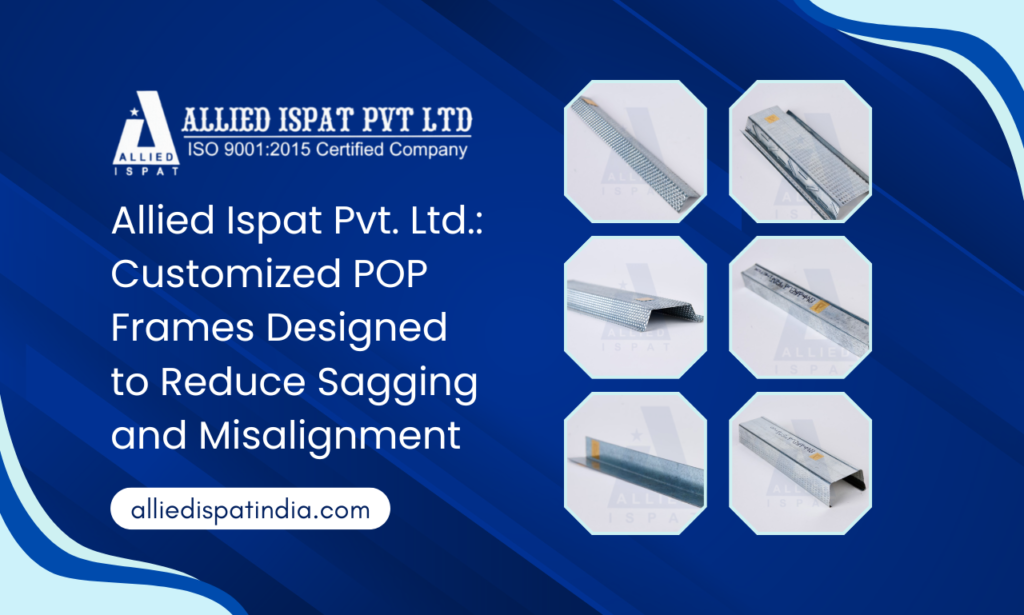
Allied Ispat Pvt. Ltd., a POP Parts Manufacturer in India, manufactures galvanized steel components for false ceiling and drywall partition applications. Headquartered in Mumbai with manufacturing operations in Navi Mumbai, the company supplies contractors with standard as well as customized framing sections for residential, commercial and industrial requirements. Its false ceiling portfolio includes ceiling, intermediate, perimeter, angle, C-Stud and floor sections, together with the GypsPlus Premium and GypsPlus Xpert-Plus ranges.
As a POP Frame Manufacturer in Mumbai, Allied Ispat focuses on precision manufacturing, customization and repeatable profile production—three factors that become increasingly important when contractors are managing larger ceilings, complex layouts or bulk project requirements.
It is also important to distinguish a POP framing system from POP plaster itself. In this context, POP parts refer primarily to the galvanized steel profiles used to form the supporting framework for false ceilings, gypsum board systems and drywall partitions. The quality of these concealed components can directly affect installation accuracy, framework rigidity and the final appearance of the finished surface.
Why Ceiling Sagging and Misalignment Occur in False Ceiling Systems
Ceiling sagging and misalignment rarely result from one isolated cause. A false ceiling behaves as a complete system in which framing sections, suspension members, fasteners, boards, spacing, loads, site conditions and workmanship must work together.
If the steel section is too light for the intended configuration, incorrectly spaced or poorly supported, the framework may not provide the rigidity expected by the design. Similarly, inconsistent ceiling channels can create variations in the grid before the board installation even begins. Once those dimensional differences accumulate across a larger ceiling area, contractors may need additional leveling and correction work.
Improper hanger spacing, unsuitable fixing methods, excessive service loads, inaccurate installation and inadequate coordination with lighting, HVAC or other building services can also affect ceiling performance. Moisture exposure and corrosion may further weaken or distort metal components over time.
For this reason, quality POP ceiling sections should be viewed as one important part of a correctly designed and installed system. Better material cannot compensate for poor engineering or installation, but accurate and appropriately specified profiles provide contractors with a more reliable starting point.
How Quality POP Parts Contribute to a Stable Ceiling Framework
Quality POP parts help create a stable ceiling by providing consistent geometry, predictable connections and suitable structural support for the intended application. When sections remain straight and dimensions are repeated consistently, contractors can form a more uniform false ceiling framework with fewer unexpected variations from one profile to another.
Consistent profiles also help boards sit against the supporting grid more evenly. This can reduce localized discrepancies that otherwise require packing, adjustment or correction during installation. Properly formed edges and compatible channels can further simplify joining and alignment.
A well-manufactured galvanized POP frame therefore contributes to several practical contractor benefits: more predictable installation, better grid alignment, improved board support and less time spent correcting profile-related inconsistencies.
The final performance still depends on correct spacing, suspension, fasteners, board installation and load calculations. The purpose of quality framing is not to replace those requirements but to support them.
Why Dimensional Accuracy Matters in POP Ceiling Sections
Small variations in profile geometry can become significant when hundreds or thousands of metres of framing are installed across a project. Width, depth, flange dimensions, material thickness, section straightness and overall length all influence how one component interfaces with another.
If channels vary noticeably between batches, installers may find that connections fit differently, ceiling levels require repeated adjustment or adjoining profiles do not sit as expected. On large commercial floors, even minor inconsistencies can multiply across the grid.
Repeatable roll forming helps address this issue by forming continuous steel strip through controlled tooling to produce a consistent profile. Allied Ispat highlights precision manufacturing through roll-forming technology and customization in dimensions and thickness among its manufacturing capabilities.
This is particularly relevant when evaluating a POP Frame Manufacturer in Mumbai for large-scale projects. Contractors require not only an acceptable sample but dependable dimensional consistency across the full quantity supplied.
For buyers comparing a false ceiling section manufacturer, dimensional repeatability should therefore be considered alongside price, material specification and availability.
The Relationship Between Steel Thickness and Ceiling Stability
Section thickness influences stiffness and load behaviour, but thicker steel is not automatically the correct choice for every ceiling. Material selection should correspond to the ceiling configuration, span, framing arrangement, design load, suspension layout and intended application.
Heavy commercial or industrial applications may require a different framing specification from a decorative apartment ceiling. Conversely, unnecessarily heavy sections can add cost and may not provide a meaningful project benefit where a lighter correctly engineered system is adequate.
Allied Ispat Pvt. Ltd. GypsPlus Premium range uses prime-grade GI steel in an approximately 0.5–0.7 mm thickness range and is positioned for heavier commercial and industrial requirements. GypsPlus Xpert-Plus uses approximately 0.40–0.45 mm GI steel and is intended for precision-oriented modern interiors.
A competent ceiling channel manufacturer or GI channel manufacturer should therefore support specification according to application rather than promote one thickness as suitable for every project.
How Galvanized Steel Helps Protect False Ceiling Frameworks
False ceiling framing is concealed after installation, which makes material protection particularly important. Once boards, finishes and building services are in place, inspecting or replacing corroded profiles becomes considerably more disruptive.
Galvanized steel uses a protective zinc coating that helps reduce the rate at which the underlying steel is exposed to corrosive conditions. This can be valuable in humid interiors, coastal environments, service areas and buildings where moisture exposure is more demanding than in ordinary dry indoor spaces.
Mumbai and many other coastal markets create particular reasons for contractors to consider corrosion resistance when specifying galvanized steel ceiling profiles. Allied Ispat positions its POP systems for applications including coastal and high-humidity environments and lists zinc-coated, colour-coated and anti-corrosion options within its false ceiling offering.
Galvanization should not, however, be interpreted as complete immunity to corrosion. Coating condition, installation environment, exposure, storage and maintenance practices remain relevant.
How Poor-Quality POP Sections Can Increase Contractor Rework
Inconsistent profiles often create problems before the ceiling has even been boarded. A channel that twists, varies in dimension or does not align properly with adjoining components can require installers to spend additional time correcting the framework.
Typical consequences can include repeated leveling, difficult connections, unnecessary cutting, localized modifications and increased material wastage. These may appear minor on a small installation, but across a large office, hospital, retail project or industrial facility, repetitive adjustments can influence labour productivity and project scheduling.
The concern is therefore not simply whether a section can be installed. Contractors should consider how easily it can be installed repeatedly and consistently across the complete project.
For this reason, choosing an experienced POP ceiling frame manufacturer can influence installation efficiency as well as material quality.
Allied Ispat Pvt. Ltd.’s Precision Manufacturing Approach
Manufacturing repeatability becomes increasingly important as project quantities increase. Allied Ispat uses roll-forming technology for steel profiles and describes its process as including raw-material selection, automated forming and quality-control stages. The company also states a production capability of more than 3,000 POP frame units per day for bulk requirements.
Automated forming helps maintain profile geometry when production parameters and tooling are properly controlled. Consistent raw material, calibrated tooling and inspection of finished sections can help reduce variation between profiles manufactured at different points in a production run.
For contractors, the practical benefit is predictability. A POP Frame Manufacturer in Mumbai capable of repeatable bulk production can help project teams procure large quantities without treating every new bundle as a different installation condition.
This capability is particularly relevant to construction companies requiring commercial ceiling sections, drywall components and other profiles in coordinated quantities.
Customized POP Frames for Project-Specific Requirements
False ceiling and partition projects are rarely identical. Ceiling height, architectural detailing, room dimensions, board layout, service coordination, partition height and decorative features can create different framing requirements from one project to another.
Standard profiles may be appropriate for many installations, but specialized layouts sometimes require different dimensions, thicknesses, coatings or lengths. Allied Ispat states that its ceiling and drywall products can be customized by dimensions and thickness and that GI channels are available in 8 ft and 12 ft lengths.
This ability to manufacture customized POP frames allows contractors to plan material selection around the application rather than forcing every project into one fixed section configuration.
For contractors sourcing from a POP Parts Manufacturer in Mumbai, customization can also help address practical concerns such as cutting wastage, handling requirements, ceiling geometry and compatibility with project-specific layouts.
A POP Frame Manufacturer in Mumbai that combines standard production with project-oriented customization can therefore function as a manufacturing partner rather than merely a stock supplier.
Understanding Allied Ispat’s POP Frame Components
A complete false ceiling or partition system relies on several profiles working together. Allied Ispat lists ceiling, intermediate, perimeter, angle, C-Stud and floor components in its POP and drywall range.
Ceiling Sections
Ceiling sections form an important part of the supporting grid below the suspension structure and provide a base to which compatible ceiling boards can be fixed. Straightness and uniform section geometry matter because variation can translate into irregular board support or increased leveling work.
A dependable ceiling section manufacturer should therefore focus on repeatable dimensions and suitable steel specification rather than appearance alone.
Intermediate Sections
Intermediate sections form part of the supporting arrangement within compatible ceiling systems. Their function is closely linked to distributing and connecting the framework according to the chosen ceiling design.
Consistent depth and profile shape help adjoining members sit more predictably, improving overall grid organization.
Perimeter Sections
Perimeter sections establish the ceiling framework along wall boundaries and help define the level at the edges of a room. Because these profiles create an important reference line, dimensional consistency and straightness can influence the quality of the final boundary alignment.
A reliable false ceiling channel manufacturer must therefore consider installation compatibility across perimeter and internal framing components.
Angle Sections
Angle sections may be used for supporting, edging or connecting functions depending on the ceiling configuration. Accurate bends, straight edges and consistent dimensions make them easier to integrate with adjoining framing.
These details become particularly important in ceilings with multiple levels, corners or architectural features.
C-Stud Sections
C-Studs are primarily associated with drywall partition framing. They form vertical framing members that support board systems and help establish straight, consistent partition lines.
For anyone evaluating a C-stud manufacturer, profile straightness and compatibility with complementary floor or track sections are important considerations because dimensional inconsistency can complicate wall alignment.
Floor Sections
Floor sections or compatible track-type components help establish the base position of partition framing. Their dimensions influence how vertical studs fit and remain aligned within the wall system.
This makes profile compatibility important when selecting a partition section manufacturer for complete drywall applications.
GypsPlus Premium for Heavy-Duty Ceiling Requirements
GypsPlus Premium is Allied Ispat’s heavier-duty framing range for industrial and commercial ceiling requirements. According to the manufacturer’s current product information, the range uses prime-grade GI steel in approximately 0.5–0.7 mm thickness, with a knurled surface, work-hardened construction and a stated load capacity of 50 kg/m².
The product is positioned for demanding environments including factories, hospitals and coastal or high-humidity locations. These applications can require greater attention to section rigidity, durability and corrosion protection than lighter decorative ceiling applications.
Rather than describing the system as universally sag-proof, it is more technically appropriate to say that its heavier section specification is designed to improve resistance to deformation when the system is correctly designed, supported and installed.
For contractors seeking industrial ceiling framing, GypsPlus Premium provides an option intended specifically for heavier commercial and industrial conditions.
The value of working with a POP Frame Manufacturer in Mumbai in this context lies in matching the profile specification to the actual project requirement instead of treating all ceiling channels as interchangeable products.
GypsPlus Xpert-Plus for Modern Interior Fit-Outs
GypsPlus Xpert-Plus addresses a different requirement: lightweight precision for contemporary interior applications. Allied Ispat specifies prime-grade GI steel in approximately 0.40–0.45 mm thickness, folded edges and customizable 8 ft and 12 ft length options.
The range is positioned for apartments, offices and 3D decorative ceilings, where precise layout, installation convenience and design flexibility can be important.
Folded-edge design can support safer material handling during installation, while consistent dimensions help contractors assemble detailed ceiling geometries more predictably. This makes the range relevant to office fit-outs, residential interiors, retail environments, hospitality projects and decorative ceiling configurations.
For an interior contractor evaluating GI ceiling sections, the objective should be to choose profiles appropriate to the design rather than automatically specifying the heaviest available section.
GypsPlus Premium vs. GypsPlus Xpert-Plus: Choosing the Right Solution
GypsPlus Premium and GypsPlus Xpert-Plus are intended to address different construction needs rather than compete as interchangeable grades.
GypsPlus Premium uses approximately 0.5–0.7 mm GI steel and is positioned for heavier commercial and industrial framing. GypsPlus Xpert-Plus uses approximately 0.40–0.45 mm GI steel and focuses on lightweight, precision-oriented interior applications. Both belong to Allied Ispat’s false ceiling and partition portfolio.
The correct selection should consider the project design, anticipated loads, suspension arrangement, ceiling geometry, environment and installation requirements. Architects and contractors should refer to applicable project specifications and technical guidance rather than deciding solely on thickness.
This application-based approach is what buyers should expect from a capable POP frame manufacturer in India.
How Allied Ispat Supports False Ceiling Contractors Beyond Standard Supply
Contractors frequently need more than material availability. They need consistent dimensions across repeat orders, suitable quantities for project phases and the ability to obtain profiles that match actual site requirements.
Allied Ispat combines customization with bulk manufacturing and states that its products can be supplied in different dimensions, thicknesses, coatings and finishes depending on project requirements. Its product information also identifies pan-India logistics and bulk-order capability.
For a contractor managing multiple ceiling zones, sourcing related drywall partition sections, ceiling profiles and customized components from one manufacturing source can simplify procurement coordination.
This is also where the difference between a general false ceiling materials supplier and a project-oriented manufacturer becomes important. Manufacturing capability allows specifications to be discussed earlier rather than relying exclusively on whatever standard stock is available.
Why Profile Compatibility Matters in a Complete False Ceiling System
A ceiling section cannot be assessed in isolation. Intermediate channels, perimeter profiles, angles, hangers, fasteners, boards and other components must connect correctly to create a stable system.
If dimensions between adjoining members are inconsistent, installation tolerances may become difficult to maintain. Installers may compensate through extra cutting, bending or adjustment, but those corrections add unnecessary complexity.
Compatible profiles help create more predictable connections and more consistent grid geometry. This is particularly useful for larger installations where the same connection may be repeated hundreds of times.
For this reason, working with a POP Frame Manufacturer in Mumbai that produces multiple related framing components can help contractors approach the ceiling as an integrated system rather than as unrelated individual sections.
POP Frames for High-Humidity and Coastal Construction Environments
Humidity deserves additional consideration in Mumbai, other coastal areas of Maharashtra and similar construction environments. Concealed metal framing can be exposed to moisture through site conditions, condensation, building services or long-term environmental humidity.
Using appropriately coated galvanized steel can help slow corrosion and protect the integrity of the framing. Allied Ispat specifically positions its galvanized POP frames for high-humidity and coastal applications.
Such protection may be relevant for hospitals, industrial facilities, certain service spaces, commercial projects and humid interiors. However, specification should still account for the actual exposure category, building design and environmental conditions.
A professional POP frame supplier in India should therefore be able to discuss material and coating requirements rather than assuming one specification suits every environment.
What Contractors Should Check Before Buying POP Parts
Contractors comparing a POP Parts Manufacturer in India or POP parts supplier in Mumbai should evaluate more than quotation price. A useful procurement checklist includes:
- Material grade: Confirm what steel is being supplied and whether it matches the project specification.
- Section thickness: Check that the thickness suits the intended ceiling or partition application.
- Profile dimensions: Review width, depth, flange dimensions and compatibility with adjoining sections.
- Straightness: Profiles should be suitable for creating consistent framework lines.
- GI coating: Consider the installation environment and required level of corrosion protection.
- Edge quality: Properly formed edges can improve handling and installation.
- Length consistency: Confirm standard or customized lengths and applicable tolerances.
- Load requirement: Match the framing system to design and application loads.
- Component compatibility: Evaluate how ceiling channels, perimeter sections, intermediate sections and accessories work together.
- Manufacturing capability: Determine whether the supplier manufactures consistently at the quantity your project requires.
- Quality control: Ask how incoming steel, forming and finished profiles are checked.
- Customization: Confirm whether dimensions, thicknesses or lengths can be adapted to the project.
- Bulk supply capability: Large projects require production consistency as well as capacity.
- Technical documentation: Request appropriate product information and specification guidance.
- Delivery coordination: Ensure material supply can align with the project programme.
When selecting a POP Frame Manufacturer in Mumbai, this broader evaluation provides a better basis for procurement than simply choosing the lowest per-piece rate.
Why Contractors Across India Choose Allied Ispat Pvt. Ltd.
Allied Ispat’s positioning is based on manufacturing capability, product breadth and project customization. The company states that it operates under ISO 9001:2015 quality management, has manufacturing operations in Navi Mumbai, uses precision roll-forming technology and provides customized steel profiles for different application requirements.
Its false ceiling range includes both heavier GypsPlus Premium sections and lighter GypsPlus Xpert-Plus profiles, allowing contractors to consider different solutions for industrial, commercial and interior applications.
The company’s stated production capability of more than 3,000 POP frame units daily is particularly relevant to bulk procurement because capacity must be combined with repeatability when supplying large projects.
For contractors comparing a POP Frame Manufacturer in Mumbai, these capabilities can be important when a project requires customized dimensions, coordinated quantities and consistent profile specifications.
Frequently Asked Questions
1. What is a POP frame used for in a false ceiling?
A POP frame creates the metal supporting structure behind gypsum board and false ceiling finishes. Allied Ispat Pvt. Ltd. manufactures precision-formed GI POP sections designed for residential, commercial, and industrial ceiling applications.
2. Which material is best for false ceiling framing?
Galvanized steel is widely preferred for false ceiling framing because it combines strength, dimensional consistency, and corrosion resistance. Allied Ispat Pvt. Ltd. manufactures GI ceiling sections for different false ceiling and drywall requirements.
3. What thickness is used for POP ceiling frames?
POP frame thickness depends on the ceiling design, load requirement, spacing, and application. Allied Ispat Pvt. Ltd. offers GypsPlus Xpert-Plus in approximately 0.40–0.45 mm and GypsPlus Premium in approximately 0.5–0.7 mm GI steel.
4. Can poor-quality POP frames cause ceiling sagging?
Poor-quality or incorrectly specified framing can contribute to deformation and uneven ceiling levels, although installation, spacing, loading, and workmanship also matter. Allied Ispat Pvt. Ltd. focuses on consistent profile geometry and suitable section specifications.
5. Why are GI POP frames used for false ceilings?
GI POP frames use galvanized steel with a zinc coating that helps protect the base metal against corrosion. Allied Ispat Pvt. Ltd. manufactures galvanized POP frames suitable for false ceilings, drywall partitions, and demanding interior environments.
6. Can POP frames be customized according to project requirements?
Yes. POP framing can be customized for dimensions, thickness, length, and specific construction requirements. Allied Ispat Pvt. Ltd. provides customizable GI channels, including 8 ft and 12 ft options for different project applications.
7. Which POP frames are suitable for commercial and industrial ceilings?
Heavy-duty ceiling projects require framing selected according to load, span, suspension, and project specifications. Allied Ispat Pvt. Ltd. offers GypsPlus Premium, a heavier GI framing range developed for commercial and industrial ceiling applications.
8. What sections are required for a false ceiling system?
A false ceiling framework can include ceiling sections, intermediate sections, perimeter channels, angles, and related supporting components. Allied Ispat Pvt. Ltd. manufactures these profiles along with C-Stud and floor sections for drywall partition systems.
9. How do I choose a POP Parts Manufacturer in India?
Check steel quality, section thickness, dimensional accuracy, galvanization, customization capability, production consistency, and bulk supply support. Allied Ispat Pvt. Ltd. is a POP Parts Manufacturer in India serving contractors and construction projects with precision-manufactured GI profiles.
10. Who is a POP Frame Manufacturer in Mumbai for customized GI sections?
Allied Ispat Pvt. Ltd. is a POP Frame Manufacturer in Mumbai with manufacturing operations in Navi Mumbai. The company manufactures customized GI ceiling and partition sections for contractors, builders, architects, and commercial and industrial construction projects.
Allied Ispat Pvt. Ltd. – A Reliable POP Parts Manufacturer in India
A reliable ceiling begins long before gypsum board, POP finish or decorative treatment is applied. It begins with correct design, suitable steel sections, accurate suspension, compatible profiles and disciplined installation.
As a POP Parts Manufacturer in India, Allied Ispat Pvt. Ltd. supports false ceiling contractors, drywall specialists, architects, developers and procurement teams with galvanized steel profiles manufactured for residential, commercial and industrial applications. For buyers seeking a POP Parts Manufacturer in Mumbai, its local manufacturing ecosystem and customization capability provide access to project-specific sections as well as standard framing requirements.
The company’s role as a POP Frame Manufacturer in Mumbai extends beyond supplying individual metal channels. Precision roll forming, material consistency, customizable specifications and bulk production can help contractors establish more predictable framing conditions on site.
Ultimately, accurate POP framing is not simply about purchasing metal sections. It is about selecting appropriately engineered components that support grid alignment, efficient installation, board stability, corrosion resistance and reliable long-term ceiling performance when correctly specified and installed.
Contractors, architects, builders, developers, distributors and project procurement teams can connect with Allied Ispat Pvt. Ltd. to discuss false ceiling, drywall partition and customized POP frame requirements for projects across Mumbai, Maharashtra and India.
Allied Ispat’s Complete Steel Manufacturing Product Range
Beyond false ceiling and POP framing solutions, Allied Ispat Pvt. Ltd. supports multiple steel-processing and construction industries through precision machinery, rolling shutter components and steel coils. Its integrated product portfolio helps fabricators, contractors, manufacturers and industrial buyers source engineered steel solutions from an experienced manufacturing partner.
Roll Forming Machines for Precision Steel Profile Production
As a trusted Roll Forming Machine Manufacturer in India, Allied Ispat Pvt. Ltd. develops machines for continuous and accurate production of steel profiles used across construction and fabrication industries. The machines are engineered to support consistent forming, dimensional accuracy and efficient production of different section designs. As a Roll Forming Machine Manufacturer in Mumbai, Allied Ispat also supports customized machinery requirements according to profile shape, material thickness and production needs.
Rolling Shutter Parts for Reliable Shutter Systems
Allied Ispat Pvt. Ltd. is an experienced Rolling Shutter Parts Manufacturer in India, supplying precision-formed components used in commercial, industrial and infrastructure shutter systems. Its range supports shutter fabricators with components designed for dimensional consistency, dependable fitting and efficient assembly. As a Rolling Shutter Parts Manufacturer in Mumbai, Allied Ispat serves contractors, fabricators, dealers and project buyers requiring standard as well as customized shutter components.
Trading Coils for Manufacturing and Fabrication Requirements
Allied Ispat Pvt. Ltd. supplies steel coils for roll forming, fabrication and various industrial processing applications. As a reliable Trading Coil Supplier in India, the company supports manufacturers requiring GI, CR and HR coil materials for different production requirements. Buyers looking for a Trading Coil Supplier in Mumbai can source coils suitable for steel profile manufacturing, shutter component production, construction products and other metal-forming applications.
Allied Ispat Mumbai Central
Address: Shop 69, Maulana Shaukat Ali Road, Chhota Sonapur, Siddharth Nagar, Mumbai Central, Mumbai, Maharashtra 400008
Phone: 098211 77009
Get Directions: https://maps.app.goo.gl/gyEqxBGcw9jLsYm26
Allied Ispat Works:
Plot no. C-17 9, MIDC Road behind Bank of Baroda Bank Taloja Panvel, Maharashtra 410208 India
Get Directions: https://maps.app.goo.gl/6ujLCuHpQLu1Uy3r8
Phone: 087790 51606
Email: info@alliedispatindia.com | sales@alliedispatindia.com
Website: www.alliedispatindia.com