
Introduction:
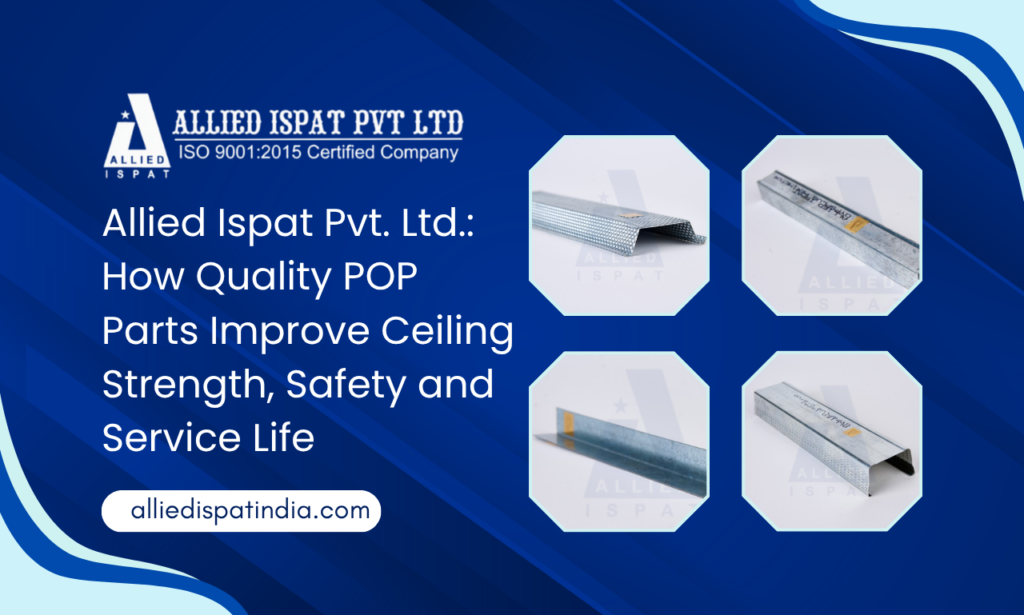
A false ceiling can look perfectly level and finished from below while the real structure responsible for its long-term performance remains completely hidden. Above the gypsum board, decorative surface or finishing layer sits a network of steel sections that carries loads, maintains alignment, connects the ceiling to its supporting structure and helps the entire assembly remain stable over years of use. If this concealed framework lacks adequate strength, dimensional accuracy or corrosion protection, problems may begin long before they become visible.
For architects, contractors and procurement teams, choosing quality POP ceiling parts is therefore not simply a material-purchasing decision. It influences installation efficiency, structural stability, ceiling alignment, maintenance requirements and overall service life. Working with an experienced POP Parts Manufacturer in India and a technically capable POP Ceiling Frame Manufacturer becomes particularly important for commercial, residential and industrial projects where material consistency across large quantities is essential.
Quality in a false ceiling begins before the profiles ever reach the construction site. Steel selection, profile geometry, material thickness, galvanization, roll-forming accuracy, edge finishing and dimensional consistency collectively determine how effectively the framework performs once installed.
This is why Allied Ispat Pvt. Ltd. focuses on precision-engineered galvanized POP frames and partition sections for different construction requirements, ranging from modern interiors to heavier commercial and industrial ceiling applications.
What Are POP Parts and Why Are They Important in False Ceiling Construction?
POP parts are structural framing components used to create the supporting framework behind false ceilings, drywall partitions and related interior systems. Although they usually disappear from view after boards and finishing materials are installed, their role remains critical throughout the service life of the ceiling.
A typical false ceiling framework may include ceiling sections, intermediate sections, perimeter sections, angles and other supporting members. Partition applications can additionally use C-stud and floor sections. Each component performs a defined function, and the overall system works effectively only when the profiles have suitable dimensions, adequate material properties and proper installation.
A quality false ceiling frame helps:
- Maintain the planned ceiling level and geometry.
- Distribute loads through the supporting framework.
- Provide reliable support for boards and compatible ceiling components.
- Reduce unwanted twisting and deformation.
- Maintain consistent spacing between framing members.
- Improve the accuracy of joints and intersections.
- Support easier and more predictable installation.
- Contribute to long-term ceiling stability.
The visible finish, therefore, tells only part of the story. The performance of the concealed POP ceiling framework is equally important.
How POP Part Quality Influences Overall Ceiling Performance
The relationship between material quality and ceiling performance can be understood through a simple sequence:
Material Quality → Profile Accuracy → Installation Quality → Ceiling Stability → Service Life
If the raw material is inconsistent, the resulting profile can have variations in thickness, shape or straightness. When inconsistent sections reach the site, installers may need additional cutting, adjustment or alignment. These small problems can accumulate across a large ceiling area.
In contrast, consistently manufactured GI ceiling sections give installation teams a predictable base to work with. Profiles align more easily, intersections can be positioned more accurately and framework spacing can be maintained according to the project design.
This is one reason contractors evaluating a POP Parts Manufacturer in India should look beyond unit price. Manufacturing consistency often has a direct influence on what happens during installation and after project handover.
1. Stronger POP Profiles Create a More Stable Ceiling Framework
Strength in a POP framing system is not determined by one specification alone. Steel properties, section geometry, profile thickness, knurling or forming features, span, fixing arrangement, support spacing and installation quality all contribute to structural behavior.
A properly selected steel profile should maintain its intended shape under the loads and conditions specified for the ceiling system. If a section lacks sufficient rigidity for the application, it may be more susceptible to bending, twisting or deflection.
These issues can eventually appear as:
- Uneven ceiling levels
- Misaligned board joints
- Localized deformation
- Cracks in finishing materials
- Poor alignment around edges
- Increased need for adjustment or repair
High-quality galvanized POP frames help establish a more stable structural base. Contractors should therefore match the section type and specification to the actual ceiling design rather than assuming one profile is suitable for every project.
For large commercial or infrastructure projects, consistency is equally important. A strong section provides limited value if its dimensions vary significantly from one batch to another. Strength and manufacturing precision need to work together.
2. Correct Material Thickness Helps Control Deflection and Deformation
Material thickness is an important factor in ceiling-profile performance, but it should not be evaluated in isolation.
A thicker steel section may generally provide additional rigidity when other design variables remain comparable. However, profile shape, steel properties, forming method, spacing between supports and fixing details also influence the performance of the finished framework.
Using a section that is too light for a demanding application can increase the possibility of unwanted deflection or deformation. Conversely, specifying unnecessarily heavy profiles for a lightweight decorative ceiling can add material cost without providing a meaningful project benefit.
This is why a dependable POP Parts Manufacturer in India should offer different section options for different construction requirements rather than treating every ceiling as identical.
For procurement teams, the correct question is not simply:
“What is the thickest POP section available?”
A better question is:
“Which section configuration and thickness are appropriate for this ceiling design, loading condition and installation environment?”
That distinction leads to better specification decisions.
3. Galvanized Steel Helps Improve Long-Term Corrosion Resistance
False ceiling frameworks frequently remain enclosed for years, making material durability an important consideration.
Galvanized steel has a zinc-based protective coating that helps improve corrosion resistance compared with untreated steel. This is particularly relevant where the framework may be exposed to humidity, condensation risk or challenging environmental conditions.
Galvanized steel ceiling sections can be useful for projects in:
- Coastal regions
- High-humidity environments
- Commercial buildings
- Hospitals
- Industrial facilities
- Infrastructure projects
- Certain service and utility areas
Galvanization should not be described as making steel completely immune to corrosion. Long-term performance still depends on coating quality, environmental exposure, installation conditions, water leakage and maintenance.
However, correctly specified galvanized POP frames provide a more suitable starting point for ceiling systems where durability is important.
Allied Ispat Pvt. Ltd. manufactures galvanized POP frames and partition sections and lists corrosion resistance, dimensional customization and installer-focused product design among its false-ceiling product features.
4. Precision-Manufactured Profiles Improve Installation Accuracy
Installation teams notice dimensional consistency immediately.
A ceiling profile that is straight, accurately formed and consistent from piece to piece is easier to position than one with irregular dimensions or distorted geometry. Across hundreds or thousands of metres of ceiling framework, these differences can significantly affect site productivity.
Precision roll forming helps maintain controlled profile geometry as steel passes through successive forming stations. When the tooling, roller alignment and incoming material are properly controlled, manufacturers can achieve repeatable cross-sections in continuous production.
Consistent false ceiling sections can help contractors achieve:
- More accurate framework alignment
- More predictable spacing
- Cleaner intersections
- Easier positioning
- Reduced corrective adjustment
- Better consistency across large ceiling areas
- More efficient use of installation labour
This is where the capabilities of the manufacturer become directly relevant to the contractor.
A professional POP Ceiling Frame Manufacturer should understand that profile accuracy is not merely an appearance issue. It affects how efficiently installers can assemble the framework and how consistently the completed ceiling follows the intended design.
5. Quality Sections Help Reduce Sagging and Alignment Problems
Ceiling sagging does not have one universal cause. It can result from unsuitable framing materials, excessive spans, incorrect support spacing, inadequate fixing, improper loading, moisture-related issues or installation errors.
Poor-quality sections can add another risk by introducing inconsistent strength or geometry into the system.
For example, if some profiles in the same ceiling area vary in stiffness or straightness, maintaining a consistent ceiling level can become more difficult. Weak intersections or poorly aligned profiles may also affect the way loads transfer through the framework.
Correctly selected, precision-manufactured GI channels help create a more predictable supporting system. They do not replace proper engineering or installation practices, but they give installers better components with which to execute the specified design.
For project buyers comparing suppliers, this is an important distinction. The lowest material rate may not represent the lowest project cost if inconsistent products create extra installation adjustments or later rework.
6. Better Edge Design Can Improve Installation Safety
Steel sections are handled repeatedly before they disappear behind the finished ceiling.
Profiles are unloaded, carried, measured, cut, positioned and fixed by workers. Edge design therefore matters not only to appearance but also to handling.
Well-finished and folded edges can help reduce exposure to sharp profile edges during routine handling. They can also make profiles more comfortable to position during installation.
Allied Ispat’s GypsPlus Xpert-Plus range incorporates folded-edge construction as part of its installer-focused design. The company’s official product information also identifies 8 ft and 12 ft customizable lengths for this range.
Edge design cannot eliminate every site hazard. Contractors must still follow appropriate protective-equipment and safe-handling procedures. However, thoughtful profile design can support a more installer-friendly working process.
7. Quality POP Parts Support Longer Ceiling Service Life
Ceiling service life depends on the complete system rather than a single component.
Proper design, steel quality, corrosion resistance, fixing, spacing, installation workmanship, environmental exposure and maintenance all influence how a ceiling performs over time.
Quality POP sections contribute by providing a consistent and durable structural framework. When dimensions remain accurate and the correct profiles are selected for the project, the ceiling has a better foundation for maintaining alignment and stability.
For developers and procurement professionals, this leads to an important commercial consideration:
Initial Cost vs Total Lifecycle Value
Buying decisions based purely on the lowest price can overlook potential downstream costs associated with:
- Installation rework
- Material replacement
- Alignment corrections
- Ceiling repairs
- Maintenance interventions
- Project delays
- Premature component deterioration
A suitable product from an experienced POP Parts Manufacturer in India should therefore be evaluated based on specification, manufacturing consistency, application suitability and supply reliability—not price alone.
How Different POP Components Work Together as One Ceiling System
A false ceiling framework is a coordinated assembly. Individual components have different responsibilities, but their dimensions and positioning need to work together.
Ceiling Section
Ceiling sections form an important part of the primary supporting network. Their geometry and rigidity influence framework stability and help maintain alignment across the ceiling area.
Accurate profiles are particularly valuable over larger spaces because small dimensional inconsistencies can become more noticeable as the installation progresses.
Intermediate Section
Intermediate sections help connect and reinforce the supporting framework, assisting with load distribution and spacing control.
Consistent dimensions simplify intersection points and help contractors maintain the planned ceiling grid.
Perimeter Section
Perimeter sections establish the ceiling boundary along walls and edges. Accurate perimeter profiles help maintain a clean reference line for the rest of the ceiling framework.
This becomes especially important in offices, apartments and decorative interiors where edge alignment directly affects the final visual finish.
Angle Section
Angles are commonly used for edge support, perimeter alignment and compatible framing connections.
Straightness and consistent forming allow installers to establish cleaner boundary conditions before the internal framework is completed.
C-Stud
C-studs are primarily associated with drywall partition framing and similar interior systems. They help create vertical structural support for partition assemblies.
Consistent section geometry supports easier alignment of the partition framework.
Floor Section
Floor sections provide supporting tracks or compatible framing interfaces within partition applications. Their dimensional accuracy is important because C-studs and associated components need to fit and align correctly.
Allied Ispat lists Ceiling, Intermediate, Perimeter, Angle, C-Stud and Floor sections within its POP-frame and drywall-partition product portfolio.
GypsPlus Premium: Heavy-Duty Strength for Demanding Ceiling Projects
Commercial and industrial ceiling applications can place very different demands on the framework compared with lightweight decorative interiors.
Allied Ispat’s GypsPlus Premium range is designed as a heavier-duty option for industrial and commercial applications. According to the company’s published product information, the profiles use prime-grade GI steel in approximately 0.5–0.7 mm thickness, incorporate a knurled surface and work-hardened steel, and are specified for loads of up to 50 kg/m², subject to appropriate system design and installation.
Why Does the Knurled Surface Matter?
Knurling introduces a patterned surface into the profile. Depending on the section geometry and application, formed surface features can contribute to profile stiffness and provide additional mechanical characteristics compared with a completely flat surface.
The important point for contractors is that section performance comes from the engineered profile as a whole rather than merely the nominal sheet thickness.
What Does Work-Hardening Contribute?
Cold forming can alter the mechanical characteristics of steel in formed areas. A controlled manufacturing process can therefore contribute to the rigidity and dimensional behavior of a finished profile.
Where Is GypsPlus Premium Suitable?
The range is positioned for applications such as:
- Factories
- Hospitals
- Commercial facilities
- Industrial ceilings
- Projects requiring heavier ceiling sections
- Coastal and higher-humidity environments where the specified coating and system design are suitable
Selection should always follow project loading, spacing, fixing and engineering requirements.
For buyers looking for an established POP Parts Manufacturer in India, having access to both heavier-duty and lightweight profile options allows material selection to be based on application rather than a one-size-fits-all approach.
GypsPlus Xpert-Plus: Precision Sections for Modern Interior Projects
Not every project requires a heavy-duty ceiling frame.
Apartments, office interiors and decorative ceiling designs often benefit from profiles that combine dimensional accuracy with manageable weight and installer-friendly features.
Allied Ispat’s GypsPlus Xpert-Plus range uses prime-grade GI steel with a published thickness of approximately 0.40–0.45 mm. The range incorporates folded edges and is available in customizable 8 ft and 12 ft lengths. Allied Ispat positions it for apartments, offices and three-dimensional decorative ceiling applications.
Lightweight Handling
A suitably designed lighter section can be easier to handle during interior installation where the project does not require a heavier industrial profile.
Folded Edges
Folded-edge construction can improve handling characteristics by reducing direct exposure to raw sharp edges.
Dimensional Consistency
Precision-crafted profiles help contractors maintain alignment across decorative and geometric ceilings where small inconsistencies can become visually noticeable.
Flexible Length Options
Standardized 8 ft and 12 ft options can support project planning and material optimization depending on the ceiling layout.
A capable POP Ceiling Frame Manufacturer should be able to support both high-load commercial requirements and precision-oriented interior applications. These two Allied Ispat product ranges address those distinctly different project needs.
POP Parts for Residential, Commercial and Industrial Projects
Residential Projects
Residential false ceilings often combine functional requirements with decorative geometry.
Applications can include:
- Living rooms
- Bedrooms
- Corridors
- Apartment lobbies
- Decorative ceiling borders
- Layered false ceilings
- Lighting recesses
- 3D ceiling designs
For these projects, profile straightness and accurate dimensions help contractors achieve cleaner lines and consistent finishing.
GypsPlus Xpert-Plus is positioned by Allied Ispat for modern and decorative interior applications where precision and ease of handling are important.
Commercial Projects
Offices, retail spaces, institutional buildings and hospitality projects often cover larger ceiling areas and must accommodate coordinated building services.
Ceiling frameworks may need to integrate around lighting, air-conditioning ducts, access panels and other MEP components.
Consistency becomes particularly important because a small profile variation repeated across a large ceiling can complicate installation.
A reliable POP Parts Manufacturer in India can support commercial procurement with standardized production, suitable section choices and bulk supply capability.
Industrial Projects
Industrial facilities can require more demanding ceiling configurations depending on span, operating environment and service loads.
Factories, hospitals, industrial buildings and infrastructure facilities may therefore need heavier profiles, appropriate corrosion protection and stricter control over dimensional consistency.
Allied Ispat positions GypsPlus Premium for industrial and commercial projects and lists factories, hospitals and coastal/high-humidity zones among its intended applications.
Why Manufacturing Quality Matters When Choosing POP Parts
A good ceiling profile is created on the manufacturing floor long before it is inspected at dispatch.
Quality begins with raw material selection and continues through forming, measurement, finishing, packing and logistics.
Important manufacturing controls include:
Raw material selection: Consistent incoming GI steel provides the foundation for reliable finished sections.
Steel thickness control: Material variation should remain within appropriate manufacturing and project specifications.
Roll-forming accuracy: Correctly aligned rollers progressively form steel into the intended profile geometry.
Tooling condition: Worn or poorly maintained tooling can affect section dimensions and surface finish.
Profile geometry: Flanges, bends, ribs and other formed features need to remain consistent along the profile.
Straightness: Distorted sections create avoidable difficulties during installation.
Edge finishing: Clean and properly formed edges contribute to better handling.
Surface consistency: Coated surfaces should arrive at site without unnecessary manufacturing damage.
Batch consistency: Large projects require profiles supplied today to remain compatible with profiles delivered in later batches.
Packaging: Appropriate packing helps prevent unnecessary damage during transport and unloading.
Production capacity: Large projects also require manufacturers capable of supplying quantity without compromising consistency.
Allied Ispat states that its manufacturing process uses roll-forming technology for ceiling sections and profiles with emphasis on dimensional accuracy, while its POP facility is described as producing 3,000+ units daily for bulk requirements.
For a POP Ceiling Frame Manufacturer, this production discipline matters because contractors need hundreds or thousands of compatible sections—not one perfect sample.
What Should You Expect from a POP Ceiling Frame Manufacturer?
Contractors should expect more than a catalogue of section sizes.
A technically competent manufacturer should understand the relationship between raw material, steel thickness, section geometry, coating, profile accuracy, intended application and production consistency.
Buyers should also look at whether the manufacturer can support different project requirements instead of forcing a single section specification onto every ceiling.
For large B2B orders, supply consistency becomes equally important. A profile may be technically suitable, but project schedules can still be affected if the manufacturer cannot produce repeatable quantities or coordinate bulk deliveries.
This is why experienced purchase teams increasingly evaluate manufacturing capability alongside product specifications.
What Should Contractors Check Before Buying POP Parts?
Before finalizing an order, contractors and procurement teams should evaluate the following:
- Steel quality: Confirm the material specification proposed for the project.
- Section thickness: Match thickness to the intended application rather than selecting on price alone.
- Profile geometry: Check whether the section design suits the ceiling or partition system.
- Galvanization: Review the required corrosion-protection level for the installation environment.
- Straightness: Long profiles should maintain suitable dimensional consistency.
- Edge design: Finished or folded edges can improve handling during installation.
- Section dimensions: Ensure compatibility with other framing components.
- Length options: Select lengths that support installation planning and reduce unnecessary cutting.
- Load requirements: Consider the complete ceiling system and follow engineering or manufacturer specifications.
- Environment: Humidity, coastal exposure and site conditions may affect material selection.
- Batch consistency: Important for multi-stage and high-volume projects.
- Manufacturer capability: Evaluate whether the POP Ceiling Frame Manufacturer has suitable production capacity, process control and project-support capability.
- Supply reliability: Confirm capacity for planned project quantities and delivery schedules.
- Technical support: Product information and specification guidance can simplify procurement decisions.
Why Choose a Reliable POP Parts Manufacturer in India?
For professional construction projects, supplier selection affects far more than material procurement.
A dependable POP Parts Manufacturer in India should be capable of supporting consistent product specifications across large quantities. This matters because ceiling projects are rarely installed from a single bundle of profiles. Commercial and industrial developments may require repeated deliveries over multiple construction phases.
Manufacturing consistency helps procurement teams reduce uncertainty. Project managers can plan material requirements more confidently, while installers work with profiles that are intended to fit the same system throughout the project.
Other important considerations include product range, customization capability, manufacturing scale, quality-management processes, packaging and logistics.
The goal should be to select a manufacturing partner that can support both technical and operational project requirements.
Allied Ispat Pvt. Ltd.: Precision POP Parts Built for Demanding Projects
Allied Ispat Pvt. Ltd., part of the Malik Group of Companies, manufactures false ceiling, drywall partition and other steel-profile solutions for the Indian construction market.
Allied Ispat as a ISO 9001:2015 certified manufacturer, headquartered in Mumbai with production operations in Navi Mumbai. The POP-frame page states a production capacity of more than 3,000 units per day, customizable 8 ft and 12 ft channel lengths and pan-India logistics support.
As a POP Parts Manufacturer in India, Allied Ispat serves construction requirements ranging from modern residential interiors to larger commercial and industrial projects.
The product strategy is particularly relevant because it separates application requirements:
GypsPlus Premium provides heavier-duty sections for commercial and industrial use.
GypsPlus Xpert-Plus provides lightweight, precision-oriented sections for modern interior and decorative applications.
For architects and contractors evaluating a POP Ceiling Frame Manufacturer, this distinction helps match the framing solution more closely to actual project requirements rather than simply choosing a generic ceiling profile.
Allied Ispat’s wider portfolio also includes rolling shutter parts, coils and sheets, and roll-forming machines alongside false ceiling and drywall partition systems.
Allied Ispat’s Manufacturing Strength in Mumbai and Navi Mumbai
Location can influence procurement efficiency, particularly when projects require substantial quantities of steel sections.
For buyers searching for a POP Parts Manufacturer in Mumbai, Allied Ispat combines its Mumbai presence with manufacturing infrastructure in Navi Mumbai. Its official POP product page reports automated manufacturing capacity exceeding 3,000 units per day, supporting both production consistency and bulk-order requirements.
This production capability is relevant to:
- Large commercial projects
- Residential developments
- Industrial facilities
- Interior fit-out companies
- Contractors handling multiple project locations
- Dealers and distributors
- Infrastructure procurement teams
For project buyers evaluating a Mumbai-based POP Ceiling Frame Manufacturer, production scale is only one criterion. Consistent section geometry, material quality, batch repeatability and logistical coordination remain equally important.
Allied Ispat also states that customizable dimensions, thicknesses, coatings and finishes can be offered depending on project requirements.
How Quality POP Parts Can Reduce Long-Term Project Risks
Quality ceiling components do not remove the need for proper design or workmanship. They reduce one important source of uncertainty: inconsistent framing material.
Using appropriate profiles can help contractors reduce risks associated with:
Installation Rework
Dimensionally inconsistent sections may need greater adjustment before installation. Predictable profiles simplify assembly.
Misalignment
Straight and correctly formed sections make it easier to maintain the intended framework geometry.
Premature Replacement
Suitable galvanized steel and appropriate material selection can contribute to longer-term performance.
Installation Delays
Material that fits and aligns predictably can reduce unnecessary site corrections.
Batch Variation
Controlled manufacturing helps maintain more uniform sections across large-volume orders.
Ceiling Deformation
Correctly selected framing contributes to the overall stability of the finished ceiling when installed according to the specified design.
Maintenance Complications
A stable ceiling framework can reduce problems that originate from inadequate framing materials, although maintenance needs also depend on the building environment and other system components.
These are important lifecycle considerations when comparing quotations from a POP Parts Manufacturer in India.
How to Choose the Right POP Section for Your Project
There is no universally correct ceiling profile for every building.
Section selection should consider the complete system, including:
Application: Residential decorative ceilings and industrial ceilings can require different framing solutions.
Ceiling geometry: Flat ceilings, layered designs and three-dimensional features may create different installation requirements.
Span and support spacing: Wider unsupported distances can change structural requirements.
Loads: Boards, compatible fixtures, finishing materials and other approved elements influence system loading.
Humidity: Coastal or higher-humidity environments may require greater attention to corrosion protection.
Building type: Hospitals, factories, offices and apartments have different operational requirements.
Installation method: Profile selection should correspond with the intended fixing and support configuration.
Project specification: Drawings, consultant requirements and manufacturer recommendations should guide final selection.
A reliable POP Parts Manufacturer in India can help buyers understand available section configurations, but the final ceiling system should always follow the project’s engineering, architectural and installation requirements.
Why Quality POP Parts Deliver Better Total Lifecycle Value
The purchase cost of POP sections represents only one part of the ceiling’s total project value.
Consider two procurement scenarios.
In the first, the contractor receives consistent profiles that fit together predictably. Installation progresses according to plan, alignment is easier to maintain and material behavior remains consistent across batches.
In the second, sections arrive with dimensional variations. Workers spend additional time sorting, correcting or adjusting them. Some profiles may need replacement. Installation productivity declines, yet the saving achieved on the initial material purchase may have been relatively small.
This illustrates why professional contractors increasingly consider total lifecycle value instead of evaluating only the cost per section.
Better material selection can contribute to:
- More predictable installation
- Reduced rework
- Better framework alignment
- Consistent finished quality
- Improved durability
- More manageable maintenance
- Reduced risk of premature replacement
The strongest procurement decision is therefore not necessarily the cheapest section or the heaviest section. It is the section best matched to the technical requirements of the project.
Frequently Asked Questions
1. What are POP parts used for in false ceilings?
POP parts create the supporting metal framework behind false ceilings and help maintain proper alignment, stability and load distribution. Allied Ispat Pvt. Ltd. manufactures precision-engineered GI ceiling sections for residential, commercial and industrial projects.
2. Which material is best for POP ceiling frames?
Galvanized steel is commonly preferred for ceiling framing because it combines strength, dimensional stability and improved corrosion resistance. Allied Ispat Pvt. Ltd. manufactures prime-grade GI POP ceiling frames for different construction requirements.
3. What thickness is used for POP ceiling frames?
The required thickness depends on ceiling design, load, spacing and application. Allied Ispat Pvt. Ltd. offers GypsPlus Xpert-Plus in approximately 0.40–0.45 mm and GypsPlus Premium in approximately 0.5–0.7 mm GI steel.
4. Can poor-quality POP frames cause false ceiling sagging?
Poor or incorrectly specified framing can contribute to bending, deformation and uneven ceiling levels, although spacing, fixing and loading also matter. Allied Ispat Pvt. Ltd. focuses on precision-manufactured POP sections for consistent and stable ceiling frameworks.
5. Why is galvanized steel used for false ceiling frames?
Galvanized steel has a protective zinc coating that helps improve corrosion resistance, especially in humid and demanding environments. Allied Ispat Pvt. Ltd. manufactures galvanized ceiling profiles designed for durable false ceiling and drywall applications.
6. How do quality POP parts increase false ceiling service life?
Quality POP parts provide better dimensional consistency, structural support and corrosion resistance, helping the framework maintain its performance over time. Allied Ispat Pvt. Ltd. produces precision GI profiles for reliable long-term ceiling applications.
7. How do I choose the best POP Parts Manufacturer in India?
Check steel quality, section thickness, profile accuracy, galvanization, manufacturing consistency, product range and bulk supply capability. Allied Ispat Pvt. Ltd. is an ISO 9001:2015 certified POP Parts Manufacturer in India serving diverse construction requirements.
8. Which POP ceiling frame is suitable for commercial and industrial projects?
Heavy-duty GI profiles are generally preferred where project specifications demand greater framework strength and rigidity. Allied Ispat Pvt. Ltd. offers GypsPlus Premium with 0.5–0.7 mm GI steel and a stated load capacity of up to 50 kg/m², subject to appropriate system design and installation.
9. What is the difference between GypsPlus Premium and GypsPlus Xpert-Plus?
Allied Ispat Pvt. Ltd. positions GypsPlus Premium as a heavy-duty solution for commercial and industrial applications, while GypsPlus Xpert-Plus is a lightweight, precision-focused range for apartments, offices and decorative ceilings.
10. Where can I find a reliable POP Parts Manufacturer in Mumbai?
Allied Ispat Pvt. Ltd. is headquartered in Mumbai and operates manufacturing facilities in Navi Mumbai, supporting bulk POP frame requirements and pan-India supply. The company manufactures ceiling, intermediate, perimeter, angle, C-Stud and floor sections for professional projects.
Conclusion: Build Ceiling Strength from the Framework Up
A false ceiling should never be evaluated only by what remains visible after installation. The concealed framing system carries the responsibility for maintaining alignment, supporting specified loads and providing a stable base for boards, finishing materials and compatible ceiling elements. Material quality, profile geometry, galvanization, section thickness and manufacturing accuracy all influence how effectively that framework performs.
For contractors, architects and procurement professionals, choosing a dependable POP Parts Manufacturer in India means looking beyond price per section. Manufacturing consistency, application-specific profiles, corrosion protection, dimensional accuracy, bulk-production capability and supply reliability all contribute to overall project value. Selecting a competent POP Ceiling Frame Manufacturer can therefore support more predictable installation as well as longer-term ceiling performance.
Allied Ispat Pvt. Ltd. provides galvanized POP ceiling and drywall partition sections for residential, commercial and industrial applications, supported by its Mumbai presence and Navi Mumbai manufacturing infrastructure. From the heavier-duty GypsPlus Premium range to the precision-focused GypsPlus Xpert-Plus series, the company offers distinct solutions for different project requirements.
Partner with Allied Ispat Pvt. Ltd. for Your POP Framing Requirements
Planning a residential development, commercial interior, industrial facility or large false-ceiling project?
Connect with Allied Ispat Pvt. Ltd. for POP frame specifications, bulk requirements, dealer and distributor enquiries, project-specific section requirements and construction procurement discussions.
Allied Ispat Mumbai Central
Address: Shop 69, Maulana Shaukat Ali Road, Chhota Sonapur, Siddharth Nagar, Mumbai Central, Mumbai, Maharashtra 400008
Phone: 098211 77009
Get Directions: https://maps.app.goo.gl/gyEqxBGcw9jLsYm26
Allied Ispat Works:
Plot no. C-17 9, MIDC Road behind Bank of Baroda Bank Taloja Panvel, Maharashtra 410208 India
Get Directions: https://maps.app.goo.gl/6ujLCuHpQLu1Uy3r8
Phone: 087790 51606
Email: info@alliedispatindia.com | sales@alliedispatindia.com
Website: www.alliedispatindia.com