

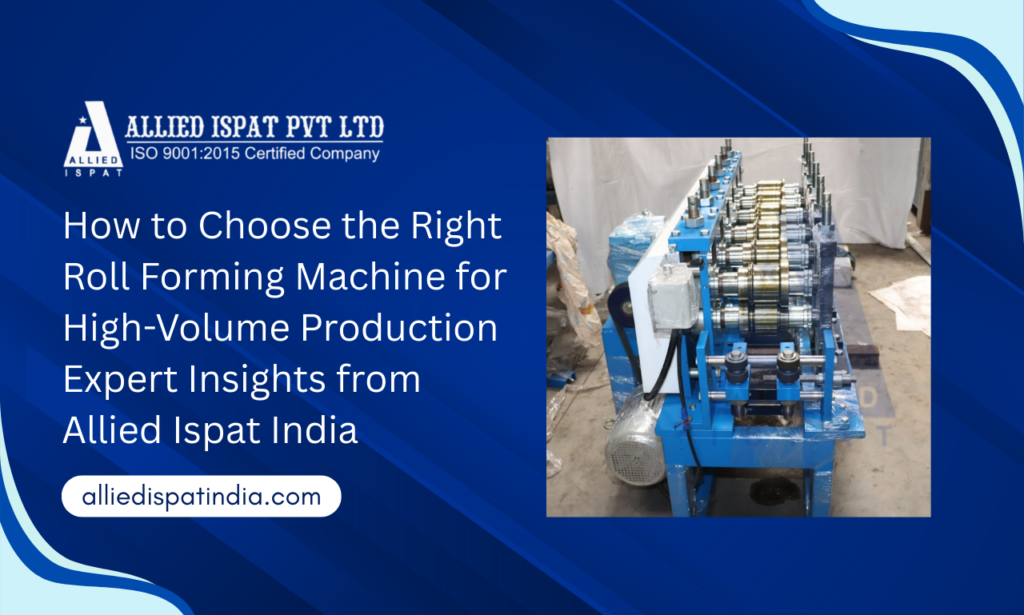
Introduction: Precision Engineering for India’s Growing Industrial Demand
India’s manufacturing sector is expanding rapidly powered by infrastructure projects, urban construction, renewable energy installations, and rising exports. From roofing panels and structural frames to ceiling channels and shutter components, steel-based products form the backbone of industrial growth.
At the heart of this transformation lies a critical piece of technology the industrial roll forming machine. This high-performance system converts metal coils into consistent profiles with minimal waste and maximum precision. However, with dozens of models, configurations, and technologies available in the market, choosing the right roll forming machine can be complex, especially for high-volume production environments.
Allied Ispat India, a reputed Roll Forming Machine Manufacturer in Mumbai, brings decades of metallurgical expertise to help industries across India streamline production with precision-engineered machines. As a Roll Forming Machine Supplier in India, the brand has supported countless contractors, OEMs, and industrial manufacturers in selecting equipment that balances quality, output, and ROI.
In this detailed guide, we’ll explore how to identify the ideal roll forming system for your production goals, the parameters that define efficiency, and why Allied Ispat India is the preferred partner for high-volume roll forming solutions.
Understanding the Industrial Roll Forming Process
A roll forming machine continuously shapes sheet metal or coil into specific cross-sectional profiles by passing it through multiple roller stations. Each station performs gradual bends until the desired geometry is achieved.
This process is essential for manufacturing components such as:
- Rolling shutter slats and channels
- Ceiling sections and T-grids
- Partition frames and door profiles
- Roofing panels and purlins
- Industrial shelves and support systems
Unlike stamping or press-brake methods, roll forming ensures uniform quality across long lengths, higher speed, and reduced material waste.
For industries requiring bulk production and dimensional accuracy, an industrial roll forming machine becomes the most cost-effective investment.
1. Identify Your Production Needs
Before investing in a roll forming system, outline your production parameters. This step defines the type, size, and configuration of the machine you’ll need.
Key questions to consider:
- What material grades (mild steel, GI, aluminum, stainless steel) will you use?
- What is the sheet thickness and coil width range?
- What volume (meters or tons per day) do you intend to produce?
- Are your profiles fixed or do you plan to produce multiple designs?
- What finishing operations (punching, cutting, embossing) are required?
For manufacturers with continuous, large-scale output, Allied Ispat India’s roll forming machines deliver the ideal balance of speed, precision, and durability. With capacities designed for 24/7 operations, they ensure that industrial clients in Mumbai and across India can meet high-volume production schedules efficiently.
2. Understand Machine Configuration and Design Flexibility
Machine configuration determines how well your roll forming system aligns with your production objectives. Broadly, machines are categorized as:
- Single-Profile Machines: Designed for one fixed product type — ideal for consistent, high-volume runs.
- Multi-Profile or Adjustable Machines: Allow quick changeovers between profiles, saving setup time and increasing flexibility.
- Fully Automated Lines: Include integrated punching, shearing, stacking, and material handling systems for continuous operation.
Each setup has its own advantages.
Allied Ispat India offers modular and customizable configurations that can be adapted to produce roofing channels, shutter slats, door frames, or industrial profiles with precision. Their engineering team tailors the roller tooling and forming sequence to minimize stress on the material and extend machine life.
As a trusted Roll Forming Machine Manufacturer in India, Allied Ispat ensures that every system is optimized for strength, repeatability, and efficiency — crucial for clients engaged in heavy industrial manufacturing.
3. Focus on Automation and Smart Controls
In modern production environments, automation is no longer optional — it’s essential. The latest roll forming lines incorporate PLC-based control systems, servo motors, and touchscreen HMIs to simplify operations and boost productivity.
Automated machines offer:
- Consistent forming speeds and minimal manual adjustments.
- Digital profile programming for quick setup changes.
- Real-time error detection to reduce downtime.
- Data integration for production monitoring and maintenance tracking.
Allied Ispat India integrates cutting-edge automation into every industrial roll forming machine, ensuring clients in Mumbai and across India benefit from intuitive control systems that deliver accuracy and efficiency shift after shift.
This level of digital precision is particularly valuable for clients in construction, infrastructure, and export-oriented sectors where every millimeter counts.
4. Prioritize Material Handling and Coil Feeding Systems
Efficiency begins long before the forming process. Material handling systems including coil decoilers, straighteners, and feeders — determine how smoothly production runs.
A robust roll forming setup should include:
- Hydraulic or automatic decoilers with high load capacity.
- Leveling systems to ensure uniform sheet thickness.
- Servo feeders for consistent coil advancement.
- Automatic cutting and stacking mechanisms to improve output flow.
Allied Ispat India, as a Roll Forming Machine Supplier in Mumbai, designs integrated coil feeding and handling systems that reduce operator intervention and downtime. These features are essential for maintaining high-volume throughput in steel and shutter part manufacturing.
5. Quality Standards and Manufacturing Precision
Industrial buyers should always evaluate the quality standards followed by their roll forming machine manufacturer. A sub-standard system can cause production delays, uneven profiles, or high maintenance costs.
At Allied Ispat India, each roll forming machine undergoes multiple quality inspections, ensuring:
- Dimensional accuracy of formed profiles.
- Alignment of rollers and forming stands.
- Consistent torque balance for smooth operation.
- Robust build using premium-grade steel and components.
As a Roll Forming Machine Manufacturer in India, Allied Ispat follows stringent ISO and CE-compliant manufacturing protocols, offering reliability to domestic and export clients alike.
6. Maintenance, Durability, and After-Sales Service
Roll forming machines are long-term investments. To ensure smooth operations, after-sales service and maintenance support are just as important as the initial purchase.
Allied Ispat India provides:
- Preventive maintenance programs
- Spare parts availability across India
- Operator training sessions
- On-site technical support for quick issue resolution
This commitment to service helps industries reduce downtime and maintain consistent productivity — making Allied Ispat a preferred Roll Forming Machine Supplier in India for reliability and long-term partnership.
7. Customization and OEM Capabilities
No two production lines are the same. That’s why customization is critical for achieving efficiency. Allied Ispat India offers OEM-grade customization based on profile shape, material specification, and end-use application.
Custom options include:
- Unique roller dies for complex profiles
- Variable thickness forming capabilities
- Integrated punching, notching, or embossing units
- Adjustable cutting lengths and speed control systems
Whether for rolling shutter parts, steel ceiling channels, or POP profile production, Allied Ispat India designs bespoke solutions that align perfectly with your business needs. This ability to deliver tailored solutions positions them among the top Roll Forming Machine Manufacturers in Mumbai.
8. Evaluate ROI and Production Efficiency
When evaluating a roll forming machine, look beyond its upfront cost. Consider long-term factors such as:
- Energy consumption and power efficiency
- Production speed per meter/minute
- Maintenance frequency
- Tooling replacement intervals
- Scrap reduction rate
Machines from Allied Ispat India are engineered to deliver higher ROI through durable design, minimal energy loss, and extended tooling life. Over time, these savings compound into significant operational advantages for B2B manufacturers.
9. Compliance and Export Readiness
If your business exports formed profiles or metal products, ensure your machinery adheres to international standards and can meet export-grade output requirements.
Allied Ispat India is not only a Roll Forming Machine Manufacturer in India but also an export-ready supplier serving global clients with CE-certified systems. Their machines are built to match the demands of international quality benchmarks, ensuring your production lines remain globally competitive.
10. The Allied Ispat India Advantage
With decades of experience and an industry-proven track record, Allied Ispat India stands as a name synonymous with trust, performance, and engineering excellence.
Why Choose Allied Ispat India:
✔ Decades of Expertise
A strong foundation in steel manufacturing, rolling shutter parts, and POP section production enables Allied Ispat to deliver technologically advanced roll forming systems.
✔ Quality-Assured Manufacturing
All machines are produced using premium-grade materials and inspected for precision under strict quality controls.
✔ Customization and OEM Services
From small-scale workshop lines to automated industrial roll forming systems, Allied Ispat caters to all project scales.
✔ Pan-India Delivery Network
With its base in Mumbai and manufacturing unit in MIDC Taloja, Allied Ispat ensures quick delivery and service support across India.
✔ Export-Ready Solutions
The brand supplies to domestic and overseas buyers, ensuring global-standard packaging, logistics, and technical compliance.
✔ Dedicated After-Sales Support
Clients receive training, spare parts, and on-site service to ensure smooth operations year-round.
As a trusted Roll Forming Machine Supplier in Mumbai, Allied Ispat’s commitment to innovation, durability, and customer success has earned it the trust of leading construction and industrial brands nationwide.
Technical Features of Allied Ispat Roll Forming Machines
To support large-scale industrial operations, Allied Ispat’s machines integrate:
- High-strength forming rollers for uniform shaping
- Servo motor control for precise cutting length
- Heavy-duty frame structure for vibration-free performance
- Lubrication systems to minimize wear
- Quick-change tooling design for faster profile switching
- Energy-efficient motors and drive systems
These engineering refinements ensure long-term reliability, even in demanding manufacturing environments.
Industry Applications
Allied Ispat India’s roll forming machines are widely used in:
- Building and Construction: Roofing, wall cladding, structural beams
- Rolling Shutter Industry: Slats, bottom plates, and guide channels
- Automotive Components: Structural trims and protective frames
- Ceiling and Partition Systems: POP channels, ceiling T-bars, and partition studs
- Electrical and HVAC: Cable trays, ducts, and panel supports
This versatility makes Allied Ispat a Roll Forming Machine Manufacturer in India that serves multiple verticals with equal precision.
FAQs – Choosing the Right Roll Forming Machine
1. What is the minimum order quantity (MOQ) for a roll forming machine?
Allied Ispat India offers customized manufacturing. MOQ depends on machine configuration, profile design, and automation level.
2. Can I get customized tooling for specific profile shapes?
Yes, Allied Ispat provides fully customized tooling based on your profile drawings, ensuring dimensional precision and consistent quality.
3. What is the average lead time for production and delivery?
Typically, lead times range from 8 to 12 weeks, depending on design complexity and customization needs.
4. Do Allied Ispat machines support export packaging and documentation?
Yes, all machines are export-ready with robust packaging and international documentation support for global shipments.
5. Does Allied Ispat provide installation and training support?
Absolutely. Their technical team offers on-site installation, testing, and operator training to ensure seamless machine commissioning.
Conclusion: The Right Machine Drives Long-Term Manufacturing Success
Selecting a roll forming machine is more than a purchase it’s a long-term production strategy. A well-engineered machine can increase throughput, reduce waste, and strengthen your business’s competitive edge in domestic and export markets.
With the right partner, your investment transforms into a source of consistent, high-precision output for years to come.
Allied Ispat India, a leading Roll Forming Machine Manufacturer in Mumbai, continues to empower industries with advanced, reliable, and tailor-made solutions. Whether you are scaling up production, setting up a new facility, or upgrading old lines, Allied Ispat delivers performance that pays for itself — cycle after cycle.
Contact Allied Ispat India Today
Head Office:
Allied Ispat Pvt. Ltd.
69, Chotta Sonapur, Maulana Shaukat Ali Road, Mumbai – 400008
Phone: +91 98211 77009
Manufacturing Works:
Plot No. C-17/9, MIDC Taloja, Behind Bank of Baroda, Dist. Raigad – 410208
Phone: +91 87790 51606
Email: info@alliedispatindia.com | sales@alliedispatindia.com
Website: www.alliedispatindia.com
Direction: https://maps.app.goo.gl/gyEqxBGcw9jLsYm26