Introduction:
India’s manufacturing and infrastructure sectors are witnessing a sharp rise in demand for precision-engineered trading coils. As automotive OEMs, roofing manufacturers, and appliance producers move toward automation and high-volume production, the need for consistent quality, tight dimensional control, advanced coatings, and reliable supply chains has become critical. Trading coils today are no longer generic raw materials they are performance-driven inputs that directly impact efficiency, durability, and finished product quality.
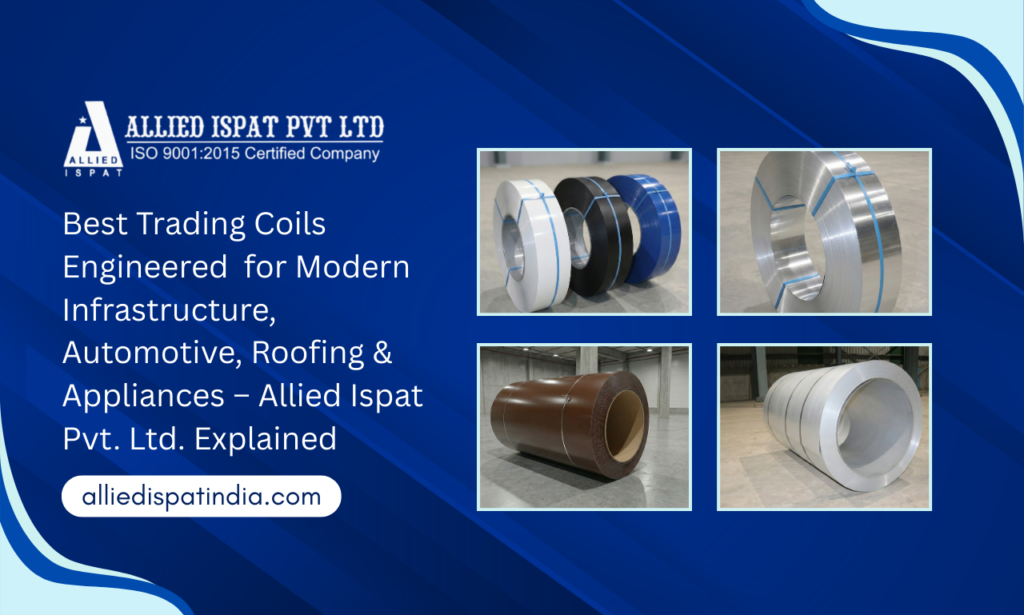
In this evolving industrial landscape, Allied Ispat Pvt. Ltd. has positioned itself as a dependable Trading Coil Manufacturer and Supplier in India, catering to the specialized requirements of automotive manufacturing, roofing & infrastructure projects, and appliance production. With a strong focus on customization, ISO-certified processes, and application-specific steel solutions, Allied Ispat Pvt. Ltd. supports manufacturers across India with GI, GL, PPGI, PPGL, slit steel coils, and customized trading coils engineered for modern production environments.
The Growing Importance of Trading Coils in Modern Manufacturing
Steel trading coils form the foundation of countless downstream manufacturing processes. From roll forming and stamping to profiling and fabrication, coils are transformed into components that power infrastructure, mobility, and consumer products.
Traditional commodity steel coils often fall short in today’s manufacturing environment, where:
- Production lines operate at high speed
- Automation demands consistent input quality
- Material waste directly affects profitability
- End products must meet strict quality and compliance standards
Engineered trading coils address these challenges by offering controlled thickness, accurate width, uniform coating, and predictable mechanical properties. For manufacturers, this translates into smoother operations, reduced rework, and dependable output quality.
Understanding Engineered Trading Coils
Engineered trading coils are not generic steel inputs. They are carefully selected, processed, and supplied based on specific industrial requirements.
Key characteristics of engineered trading coils
- Dimensional accuracy: Tight thickness and width tolerances
- Surface finish control: Smooth, defect-free surfaces for forming and finishing
- Coating performance: Zinc and paint coatings designed for durability
- Customization: Slit coils, narrow widths, or wide formats as required
- Compliance: Alignment with ISO and industry standards
This level of engineering ensures compatibility with modern machinery and predictable performance across large production volumes.
Why Trading Coil Selection Is Critical for Automotive Manufacturing
Automotive manufacturing is one of the most demanding sectors for steel inputs. Components must meet safety, durability, and appearance requirements while being produced at scale with minimal variation.
Automotive industry requirements
- High formability with strength: Steel must bend, stamp, and form without cracking
- Consistent thickness: Ensures precise fitment and structural reliability
- Superior surface quality: Reduces defects during painting and coating
- Corrosion protection: Extends component life under harsh conditions
Commonly used coil types in automotive manufacturing
- GI (Galvanized Iron) coils for corrosion resistance
- CR (Cold Rolled) coils for precision and surface finish
- PPGI coils where appearance and protection are both critical
Role of customization in automotive applications
Automotive production lines rarely accept standard coil dimensions. Custom-slit coils allow manufacturers to:
- Reduce scrap generation
- Minimize machine adjustments
- Improve throughput consistency
- Maintain uniform component quality
By sourcing customized trading coils, automotive manufacturers gain greater control over production efficiency and quality outcomes.
Best Trading Coils for Roofing and Infrastructure Applications
Roofing and infrastructure projects expose steel to extreme environmental conditions. Sunlight, rainfall, humidity, pollution, and temperature fluctuations place continuous stress on materials.
Challenges in roofing applications
- Corrosion risk in humid or coastal regions
- UV exposure leading to paint degradation
- Structural load requirements
- Long service life expectations
Ideal coil solutions for roofing
- GI coils: Provide zinc-based corrosion protection
- GL (Galvalume) coils: Offer enhanced resistance with aluminum-zinc coating
- PPGI / PPGL coils: Combine durability with aesthetic versatility
Color-coated coils are especially valuable in modern infrastructure, where visual appeal is as important as performance. Stable gloss, color retention, and uniform finish make these coils suitable for commercial, industrial, and residential roofing.
Trading Coils in Appliance Manufacturing
Appliance manufacturing demands a balance of precision engineering and visual perfection. Products such as refrigerators, washing machines, ovens, and air conditioners rely on steel panels that are both structurally sound and visually flawless.
Appliance industry expectations
- Uniform thickness for automated forming
- Smooth surface finish to reduce defects
- Long-lasting coatings for daily wear resistance
- Consistent color and gloss
Preferred coil types
- PPGI coils for superior finish and design flexibility
- GI and GL coils for durability and corrosion protection
Engineered trading coils enable appliance manufacturers to maintain consistent quality across large production runs, ensuring customer satisfaction and brand reputation.
Custom Coil Widths, Thickness, and Slitting: A Competitive Advantage
Standard coil sizes often fail to align with modern production requirements. Mismatched dimensions lead to inefficiencies such as trimming losses, frequent machine stoppages, and increased scrap.
Benefits of customized coil solutions
- Exact width matching: Fits machinery without modification
- Controlled thickness tolerance: Improves forming accuracy
- Slit coil formats: Enable multiple profiles from a single master coil
- Reduced waste: Lowers material cost per unit
- Higher productivity: Faster setup and consistent runs
Customization transforms trading coils from a basic input into a productivity enabler, especially for manufacturers operating high-speed or automated lines.
Coating Technology and Surface Performance
Coating quality plays a decisive role in both functional and aesthetic performance. Advanced paint and galvanization processes protect steel against environmental and mechanical stress.
What defines high-performance coated coils
- Premium PPGI / PPGL materials
- Uniform coating thickness
- Strong adhesion between paint layers
- Resistance to corrosion, UV radiation, and abrasion
Superior coating technology ensures that finished products retain their strength and appearance over extended service periods, reducing maintenance and replacement costs.
ISO-Certified Supply Chain and Quality Control
In B2B manufacturing, consistency is non-negotiable. ISO-aligned processes bring discipline, traceability, and reliability to steel coil supply.
Importance of ISO compliance
- Standardized quality benchmarks
- Documentation and traceability
- Reduced variability across batches
- Improved confidence for global buyers
Stringent quality checks from incoming raw material inspection to final dispatch ensure that each coil meets defined specifications. This structured approach minimizes risk for manufacturers and supports long-term partnerships.
Why Manufacturers Choose Allied Ispat for Trading Coils
Manufacturers increasingly look for suppliers who understand industrial challenges rather than simply selling material. Allied Ispat’s approach focuses on aligning steel solutions with production realities.
Key strengths valued by manufacturers
- Expertise in customized coil dimensions
- Industry-grade material selection
- Consistent stock availability
- Reliable logistics and timely dispatch
- Long-term supply reliability
These capabilities position Allied Ispat Pvt. Ltd. as a Trading Coil Manufacturer and Supplier in India trusted by manufacturers across multiple sectors.
Applications Across Industries
Engineered trading coils supplied by Allied Ispat support a wide range of applications, including:
- Automotive components and assemblies
- Roofing sheets and structural panels
- Household appliances and white goods
- Roll forming and profiling operations
- General industrial fabrication
Each application benefits from consistent input quality, reducing downstream variability and improving overall production performance.
Frequently Asked Questions
Which trading coil is best for roofing applications?
PPGI and GL coils are preferred due to their corrosion resistance, weather durability, and long-lasting finish.
Are color-coated coils suitable for appliance manufacturing?
Yes. PPGI coils provide excellent surface quality, color consistency, and durability required for visible appliance components.
Why are customized slit coils better than standard coils?
Customized slit coils match machine specifications precisely, reducing waste, downtime, and production inefficiencies.
How does ISO certification benefit manufacturers sourcing steel coils?
ISO certification ensures standardized processes, consistent quality, traceability, and reduced supply risk.
What makes Allied Ispat a reliable trading coil partner?
A combination of customization capability, quality control, ISO-compliant processes, and dependable logistics.
Conclusion
Modern infrastructure and manufacturing demand steel inputs that deliver precision, durability, and consistency. Trading coils are no longer simple raw materials; they are critical components that influence efficiency, cost control, and end-product quality.
By supplying engineered, customizable, and quality controlled trading coils for automotive, roofing, and appliance manufacturing, Allied Ispat Pvt. Ltd. empowers manufacturers to meet today’s challenges with confidence. From superior coating technology and exact tolerances to ISO-certified processes and reliable supply, Allied Ispat delivers steel solutions designed for performance today and in the future.
Contact Allied Ispat India
Head Office: Allied Ispat Pvt. Ltd.
69, Chotta Sonapur, Maulana Shaukat Ali Road, Mumbai — 400008
Phone: +91 98211 77009
Manufacturing Works:
Plot No. C-17/9, MIDC Taloja, Behind Bank of Baroda, Dist. Raigad — 410208
Phone: +91 87790 51606
Get Directions: https://maps.app.goo.gl/gyEqxBGcw9jLsYm26
Email: info@alliedispatindia.com | sales@alliedispatindia.com
Website: https://alliedispatindia.com