

Introduction
The rapid evolution of India’s manufacturing and infrastructure sectors has created an unprecedented demand for precision-engineered metal components. From large-scale commercial buildings and industrial warehouses to transportation infrastructure and renewable energy projects, modern construction and manufacturing industries require durable, consistent, and cost-effective steel profiles that can be produced at scale.
As industrial automation continues to transform production facilities across the country, manufacturers are increasingly investing in advanced machinery capable of delivering high-volume output without compromising quality. Among the most significant innovations driving this transformation is roll forming technology a highly efficient manufacturing process used to produce uniform metal profiles with exceptional accuracy and consistency.
In today’s competitive industrial environment, businesses seek production methods that minimize material wastage, reduce operational costs, and maximize productivity. Roll forming machines have emerged as one of the most effective solutions for achieving these goals. Their ability to continuously shape sheet metal into complex profiles makes them indispensable across numerous industries. As the demand for precision-engineered metal components continues to grow, partnering with a trusted Roll Forming Machine Manufacturer in Mumbai becomes essential for businesses looking to enhance production efficiency, maintain consistent quality, and stay ahead in an increasingly competitive market.
Recognizing this growing demand, Allied Ispat Pvt. Ltd. has established itself as a trusted Roll Forming Machine Manufacturer in India, delivering advanced roll forming solutions tailored to the evolving needs of modern industries. With decades of manufacturing expertise, cutting-edge infrastructure, and a commitment to engineering excellence, Allied Ispat India continues to support manufacturers, contractors, infrastructure developers, and industrial businesses with reliable and high-performance roll forming equipment.
As industries continue to embrace automation and precision manufacturing, the importance of roll forming technology will only increase. This article explores the industrial applications of roll forming machines across multiple sectors while highlighting the role of Allied Ispat Pvt. Ltd. in advancing metal forming solutions throughout India.
What Is a Roll Forming Machine?
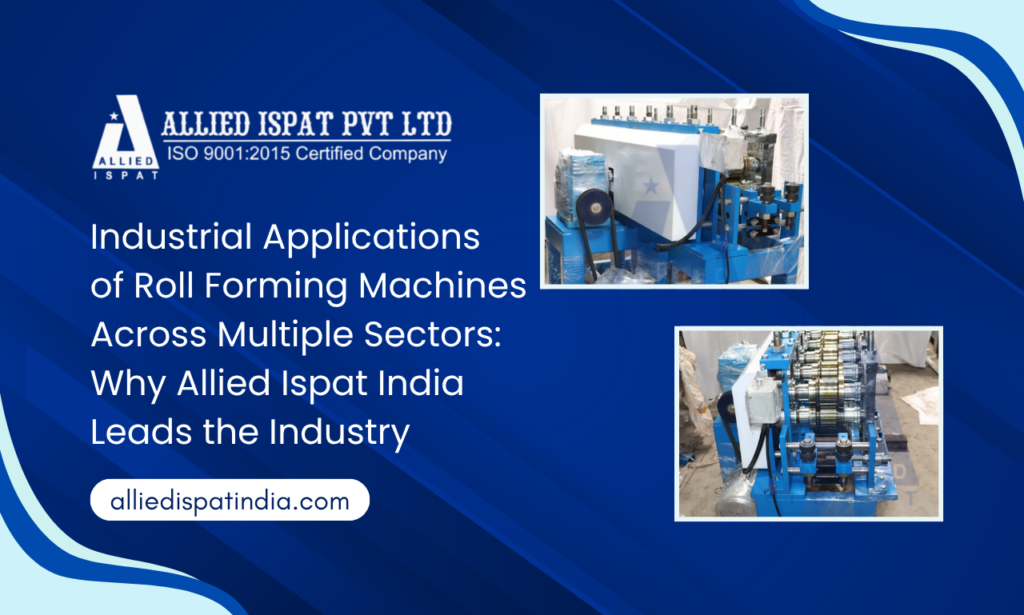
A roll forming machine is a specialized industrial system designed to continuously bend and shape metal strips or coils into specific cross-sectional profiles through a series of precisely engineered roller stations.
Unlike traditional metal fabrication processes that rely on stamping, pressing, or individual bending operations, roll forming is a continuous manufacturing process. Metal passes through multiple sets of rollers, with each station making incremental changes until the desired profile is achieved.
How Does Roll Forming Work?
The process typically involves:
- Coil Feeding
- Material Straightening
- Progressive Roll Forming
- Profile Shaping
- Cutting to Length
- Finished Product Collection
This systematic approach allows manufacturers to produce consistent profiles at high speeds while maintaining dimensional accuracy throughout production.
Key Components of a Roll Forming Machine
- Decoiler
- Entry Guide System
- Roll Stations
- Drive Mechanism
- Cutting Unit
- Control Panel
- Collection Table
Why Industries Prefer Roll Forming Machines
Industries worldwide favor roll forming technology because it offers:
- Continuous production
- High-speed manufacturing
- Exceptional accuracy
- Reduced material wastage
- Superior surface finish
- Lower labor costs
- Long production runs with consistent quality
These advantages make roll forming one of the most efficient metal processing technologies available today.
Why Roll Forming Machines Have Become Essential in Modern Manufacturing
Modern manufacturing demands precision, speed, and cost efficiency. Traditional fabrication methods often struggle to meet these requirements when production volumes increase.
Roll forming technology addresses these challenges by enabling manufacturers to produce large quantities of identical profiles with minimal variation.
Enhanced Productivity
One of the primary reasons industries invest in roll forming equipment is its ability to maintain continuous production. Unlike batch-based manufacturing methods, roll forming machines operate without interruption, significantly increasing output.
Exceptional Precision
Each roller station is designed with exact tolerances, ensuring consistent dimensions across every profile produced. This precision is particularly important in construction, infrastructure, and engineering applications where even minor deviations can impact assembly and performance.
Superior Repeatability
Manufacturers require confidence that every product meets identical specifications. Roll forming machines deliver remarkable repeatability, making them ideal for mass production environments.
Cost Efficiency
By reducing labor requirements and minimizing material wastage, roll forming helps lower overall production costs. Manufacturers can achieve greater profitability while maintaining high-quality standards.
Reduced Material Waste
Traditional cutting and fabrication methods often generate significant scrap material. Roll forming optimizes material utilization, reducing waste and improving sustainability.
Scalability
Whether producing thousands or millions of profiles, roll forming systems can be scaled to accommodate changing production demands.
For industries focused on growth and operational efficiency, investing in advanced roll forming equipment has become a strategic necessity rather than an optional upgrade.
Industrial Applications of Roll Forming Machines Across Multiple Sectors
One of the biggest advantages of roll forming technology is its versatility. Roll forming machines serve numerous industries by producing customized steel profiles designed for specific applications.
Construction Industry
The construction sector represents one of the largest consumers of roll-formed steel products.
False Ceiling Sections
Modern commercial and residential buildings rely on false ceiling systems for aesthetics, insulation, and utility management. Roll forming machines manufacture precise ceiling channels and framework components required for installation.
Dry Wall Partition Systems
Partition systems are widely used in offices, hospitals, educational institutions, and commercial complexes.
Roll formed partition sections provide:
- Structural stability
- Lightweight construction
- Easy installation
- Long-term durability
Steel Framing Systems
Steel framing profiles used in modern construction projects require consistent dimensions and structural integrity.
Roll forming machines ensure uniformity throughout production, enabling efficient project execution.
POP Sections
POP frame components are essential for interior finishing applications.
High-quality roll formed POP sections offer:
- Accurate dimensions
- Smooth finishes
- Enhanced strength
- Easy installation
As infrastructure development accelerates across India, demand for roll formed construction profiles continues to grow significantly.
Infrastructure Development
Infrastructure projects require large quantities of standardized steel components capable of meeting strict engineering requirements.
Metro Rail Projects
Modern metro systems rely on various roll formed structural components for support systems and utility installations.
Airports
Airports require durable steel profiles for:
- Ceiling systems
- Support structures
- Utility management systems
- Architectural frameworks
Railway Stations
Railway modernization projects increasingly utilize roll formed products because of their strength, consistency, and cost efficiency.
Industrial Corridors
Industrial corridors demand extensive infrastructure development involving:
- Warehouses
- Manufacturing facilities
- Utility systems
- Structural frameworks
Government Projects
Public infrastructure projects often specify precision-engineered steel profiles manufactured using advanced roll forming technology.
The ability to produce high volumes of identical components makes roll forming indispensable for large-scale infrastructure development.
Rolling Shutter Manufacturing Industry
The rolling shutter industry represents another major application area for roll forming technology.
Manufacturers require specialized profiles for:
Guides
Guide channels ensure smooth shutter operation and require precise dimensions for optimal performance.
Bottom Profiles
Bottom profiles provide structural support and operational functionality.
Lock Plates
Roll formed lock plates contribute to security and durability.
Shutter Strips
High-quality shutter strips are essential for manufacturing reliable rolling shutters.
Accessories
Various supporting components can also be produced through customized roll forming processes.
As a trusted Roll Forming Machine Manufacturer in Mumbai, Allied Ispat Pvt. Ltd. supplies machinery capable of producing high-quality rolling shutter components with exceptional consistency.
Warehousing and Industrial Buildings
The rapid growth of logistics, e-commerce, manufacturing, and industrial infrastructure has significantly increased the demand for modern warehouses and industrial buildings across India. These facilities require robust structural components that offer strength, dimensional accuracy, and long-term performance.
Roll forming machines play a crucial role in manufacturing the steel profiles used in these structures.
Structural Profiles
Industrial sheds and warehouses depend on structural steel profiles for framing systems, roofing support structures, wall panels, and reinforcement components.
Roll forming technology enables manufacturers to produce:
- C Sections
- U Channels
- Hat Profiles
- Z Purlins
- Structural Support Members
These components provide excellent load-bearing capacity while reducing overall construction weight.
Storage Systems
Large warehousing facilities utilize advanced storage systems that require precision-engineered steel profiles.
Roll formed components are widely used in:
- Pallet racking systems
- Industrial shelving
- Storage racks
- Distribution center infrastructure
The dimensional consistency achieved through roll forming ensures seamless installation and long-term reliability.
Racking Solutions
Modern logistics centers rely on customized racking solutions designed to maximize storage efficiency.
Roll forming machines manufacture profiles that offer:
- High strength-to-weight ratio
- Corrosion resistance
- Uniform dimensions
- Cost-effective production
Industrial Sheds
Industrial sheds require durable structural components capable of withstanding environmental conditions and operational loads.
Roll formed steel sections contribute to:
- Faster construction timelines
- Improved structural stability
- Reduced maintenance requirements
- Long operational life
As India’s manufacturing ecosystem continues to expand, demand for roll formed steel profiles in warehousing and industrial construction is expected to grow substantially.
Automotive Sector
The automotive industry is one of the most technologically advanced sectors utilizing roll forming technology.
Vehicle manufacturers demand precision-engineered components that combine strength, lightweight characteristics, and production efficiency.
Reinforcement Components
Many vehicle structures require reinforcement profiles that improve safety and durability.
Roll forming machines are used to manufacture:
- Door reinforcement beams
- Roof support members
- Side impact protection components
- Structural reinforcements
These components must meet strict quality and safety standards.
Structural Profiles
Modern vehicles incorporate various roll formed structural members that contribute to overall vehicle integrity.
Advantages include:
- Consistent dimensions
- Lightweight construction
- Improved fuel efficiency
- Enhanced structural strength
Body Components
Roll forming technology is frequently used for producing body components requiring complex cross-sectional shapes.
Manufacturers benefit from:
- High-volume production
- Reduced material waste
- Superior repeatability
- Lower production costs
The automotive industry’s focus on precision and efficiency makes roll forming an essential manufacturing process.
Renewable Energy Sector
India’s growing commitment to renewable energy has created substantial demand for roll formed steel structures.
Solar power projects, in particular, rely heavily on roll formed components.
Solar Panel Mounting Structures
Solar installations require durable support systems capable of withstanding varying environmental conditions.
Roll forming machines manufacture:
- Mounting rails
- Support channels
- Structural brackets
- Frame components
These profiles ensure stability and long-term performance.
Support Channels
Solar projects utilize support channels for:
- Panel positioning
- Load distribution
- Structural reinforcement
Roll formed channels offer excellent dimensional consistency and strength.
Framework Components
Renewable energy infrastructure requires large quantities of steel framework components.
Benefits of roll formed structures include:
- Corrosion resistance
- High strength
- Ease of installation
- Cost efficiency
As renewable energy investments continue to increase, roll forming technology will play a vital role in supporting sustainable infrastructure development.
Electrical and Cable Management Industry
Modern commercial, industrial, and infrastructure projects require sophisticated cable management systems.
Roll forming machines are extensively used to manufacture components for these applications.
Cable Trays
Cable trays provide organized pathways for electrical wiring and communication systems.
Roll forming technology enables efficient production of:
- Perforated cable trays
- Ladder-type trays
- Wire mesh support systems
- Industrial cable management structures
Raceway Systems
Raceway systems protect electrical wiring while maintaining accessibility.
Roll formed raceway profiles offer:
- Uniform dimensions
- Smooth edges
- Enhanced durability
- Easy installation
Electrical Support Structures
Industrial electrical systems require support structures capable of handling significant loads.
Roll formed components are used in:
- Electrical distribution systems
- Utility support frameworks
- Power infrastructure projects
- Industrial installations
The demand for electrical infrastructure continues to drive the adoption of roll formed steel products across multiple industries.
HVAC and Ventilation Industry
Heating, Ventilation, and Air Conditioning (HVAC) systems are critical components of modern buildings.
Roll forming machines contribute significantly to the manufacturing of HVAC support structures and ventilation components.
Duct Supports
HVAC ducting systems require reliable support frameworks.
Roll formed duct supports provide:
- Structural stability
- Lightweight construction
- Ease of installation
- Long service life
Framing Systems
Commercial buildings depend on framing systems that support ventilation equipment and duct networks.
Roll formed framing components ensure:
- Accurate dimensions
- Consistent performance
- Efficient assembly
Ventilation Components
Ventilation systems utilize numerous roll formed profiles designed to facilitate airflow management and equipment installation.
The ability to produce large quantities of uniform profiles makes roll forming technology indispensable to the HVAC industry.
Advantages of Using Roll Forming Machines in Industrial Production
Roll forming machines offer several advantages that make them one of the most preferred manufacturing solutions across industries.
High-Speed Production
Unlike traditional fabrication methods, roll forming operates continuously.
This enables manufacturers to achieve:
- Higher output volumes
- Faster production cycles
- Improved operational efficiency
For businesses managing large orders, production speed directly impacts profitability.
Exceptional Dimensional Accuracy
Precision is critical in industrial manufacturing.
Roll forming machines produce profiles with:
- Tight tolerances
- Consistent dimensions
- Reliable quality
This accuracy reduces assembly issues and improves overall product performance.
Reduced Labour Dependency
Automation significantly reduces manual intervention.
Benefits include:
- Lower labor costs
- Improved safety
- Reduced human error
- Greater operational consistency
Consistent Product Quality
Every profile produced through roll forming follows identical specifications.
Manufacturers benefit from:
- Uniform product quality
- Better customer satisfaction
- Fewer defects
- Reduced rejection rates
Better Material Utilization
Material costs represent a significant portion of manufacturing expenses.
Roll forming minimizes waste by:
- Optimizing material usage
- Reducing scrap generation
- Improving yield efficiency
This contributes to both profitability and sustainability.
Lower Production Costs
The combination of automation, speed, and material efficiency results in lower overall production costs.
Businesses can:
- Increase profitability
- Improve competitiveness
- Scale operations efficiently
Long Operational Life
Well-designed roll forming machines offer years of reliable performance.
Their durability ensures:
- Consistent production capability
- Reduced maintenance expenses
- Long-term return on investment
Features of Allied Ispat Roll Forming Machines
As a trusted Roll Forming Machine Manufacturer in India, Allied Ispat Pvt. Ltd. designs and manufactures machines that meet the demanding requirements of modern industrial production.
Heavy-Duty Construction
Every machine is built using high-quality materials and robust engineering principles.
Benefits include:
- Superior durability
- Stable operation
- Resistance to industrial wear and tear
Precision Engineering
Allied Ispat machines are engineered for accuracy.
This ensures:
- Consistent profile dimensions
- Smooth production processes
- High-quality finished products
Smooth and Scratch-Free Production
For coated and decorative metal applications, surface quality is essential.
Precision tooling helps achieve:
- Smooth finishes
- Minimal surface damage
- Professional-grade outputs
Low Maintenance Requirements
Industrial productivity depends on minimizing downtime.
Allied Ispat machines are designed for:
- Easy maintenance
- Reliable performance
- Reduced servicing needs
High Efficiency
Modern manufacturing demands maximum productivity.
These machines offer:
- Continuous production capability
- Faster processing speeds
- Improved output rates
Multiple Profile Capability
Manufacturers often require flexibility.
Allied Ispat machines can be configured to produce various profile types for different industries and applications.
Custom Machine Design
Every industry has unique production requirements.
Allied Ispat provides customized roll forming solutions tailored to:
- Specific profile designs
- Material specifications
- Production capacities
- Operational requirements
Robust Tooling Systems
High-quality tooling ensures:
- Longer service life
- Greater accuracy
- Consistent profile formation
Long-Term Reliability
Built for demanding industrial environments, Allied Ispat roll forming machines deliver dependable performance year after year.
Their reliability makes them a preferred investment for manufacturers seeking long-term operational success.
Why Allied Ispat Pvt. Ltd. Is a Trusted Roll Forming Machine Manufacturer in Mumbai, India
Selecting the right machinery partner is just as important as selecting the right machine. Industrial manufacturers, infrastructure developers, and fabrication businesses require a supplier that understands production challenges, delivers reliable equipment, and provides long-term technical support.
Over the years, Allied Ispat Pvt. Ltd. has built a strong reputation for delivering precision-engineered roll forming solutions that help businesses improve productivity, maintain quality standards, and achieve operational efficiency. As part of the Malik Group of Companies, the organization combines manufacturing expertise, engineering excellence, and customer-centric solutions to meet the evolving needs of India’s industrial sector.
Extensive Manufacturing Expertise
Industrial machinery manufacturing requires a deep understanding of materials, production processes, tooling design, and application requirements.
Allied Ispat India brings years of experience in designing and manufacturing:
- Roll Forming Machines
- Rolling Shutter Parts
- False Ceiling Sections
- Dry Wall Partition Systems
- POP Sections
- Steel Building Components
- Trading Coils
This broad industry exposure enables the company to provide practical and effective solutions for diverse manufacturing applications.
Advanced Manufacturing Infrastructure
A modern production facility is essential for manufacturing precision machinery.
Allied Ispat Pvt. Ltd. operates with advanced infrastructure that supports:
- Precision fabrication
- Quality control processes
- Tooling development
- Machine assembly
- Performance testing
Every machine undergoes rigorous inspection and testing before delivery to ensure consistent quality and dependable performance.
Skilled Engineering Team
Behind every successful roll forming machine is a team of experienced engineers and technical specialists.
The engineering team at Allied Ispat India focuses on:
- Innovative machine design
- Production optimization
- Tooling precision
- Performance enhancement
- Customer-specific customization
This expertise helps clients achieve higher productivity and better operational outcomes.
Quality-Focused Manufacturing
Industrial customers demand equipment that performs consistently under challenging production conditions.
Quality remains a core focus at Allied Ispat Pvt. Ltd., with attention given to:
- Material selection
- Component durability
- Precision machining
- Assembly standards
- Machine reliability
This commitment to quality has helped establish the company as a trusted Roll Forming Machine Manufacturer in India.
Customized Roll Forming Solutions
Every manufacturing facility has unique production requirements.
Some customers require high-speed production lines, while others need specialized profiles or custom tooling systems.
To address these needs, Allied Ispat India offers:
- Custom profile design
- Specialized tooling
- Machine modifications
- Production line optimization
- Industry-specific configurations
This flexibility allows businesses to invest in solutions that match their operational goals.
Nationwide Customer Reach
Manufacturers across India rely on roll forming technology for various applications.
As a leading Roll Forming Machine Manufacturer in Mumbai, Allied Ispat Pvt. Ltd. serves customers across multiple regions and industries, helping businesses improve productivity and maintain consistent product quality.
The company’s growing customer base reflects the trust and confidence that industries place in its machinery and services.
Comprehensive Customer Support
Industrial equipment requires ongoing technical assistance and support.
Allied Ispat India emphasizes long-term customer relationships through:
- Technical consultation
- Installation guidance
- Operational training
- Maintenance support
- Troubleshooting assistance
This customer-focused approach ensures maximum machine performance and long-term satisfaction.
How to Select the Right Roll Forming Machine for Your Industry
Investing in a roll forming machine is a significant business decision. Choosing the right equipment can improve productivity, reduce operating costs, and support future growth.
Here are the key factors manufacturers should consider.
Production Volume Requirements
The first step is understanding production capacity needs.
Questions to evaluate include:
- How many profiles are required daily?
- What is the expected annual production volume?
- Will future demand increase?
Businesses with high-volume production requirements often benefit from automated and high-speed roll forming systems.
Material Thickness and Specifications
Different industries use varying material types and thicknesses.
Consider:
- Galvanized steel
- Mild steel
- Color-coated steel
- Stainless steel
- Aluminum
The machine should be designed to handle the required material specifications efficiently.
Profile Design Requirements
Every product profile requires specific tooling and machine configurations.
Manufacturers should evaluate:
- Profile complexity
- Dimensional tolerances
- Surface finish requirements
- Structural performance expectations
Custom tooling solutions may be necessary for specialized applications.
Automation Level
Automation plays a critical role in manufacturing efficiency.
Options may include:
- Manual Roll Forming Machines
- Semi-Automatic Roll Forming Machines
- Fully Automatic Roll Forming Machines
Businesses should select a level of automation that aligns with their production goals and budget.
Budget Considerations
While cost is important, the focus should be on long-term value rather than initial investment alone.
Factors influencing return on investment include:
- Production efficiency
- Maintenance requirements
- Energy consumption
- Machine durability
- Product quality
A reliable machine often delivers greater value over its operational lifespan.
Future Scalability
Industrial businesses must plan for growth.
Choosing a machine with expansion capabilities allows manufacturers to:
- Increase production volumes
- Add new product profiles
- Improve automation
- Expand market opportunities
Working with an experienced Roll Forming Machine Manufacturer in India helps ensure future-ready investments.
Future of Roll Forming Technology in India
India’s manufacturing sector is entering a new phase of technological advancement driven by automation, infrastructure expansion, and smart production systems.
Roll forming technology is expected to play a central role in this transformation.
Industry 4.0 Integration
Modern manufacturing facilities increasingly incorporate Industry 4.0 principles.
Future roll forming systems will feature:
- Smart sensors
- Data analytics
- Real-time monitoring
- Predictive maintenance
These capabilities improve operational efficiency and reduce downtime.
Increased Automation
Automation continues to reshape industrial production.
Advanced roll forming systems are expected to deliver:
- Faster production cycles
- Greater precision
- Lower labor dependency
- Enhanced consistency
This trend will drive higher adoption across industries.
Digital Monitoring and Process Control
Future manufacturing environments will rely heavily on digital technologies.
Benefits include:
- Production visibility
- Quality tracking
- Performance optimization
- Process transparency
Manufacturers can make better decisions based on real-time production data.
Sustainable Manufacturing Practices
Environmental sustainability is becoming a key consideration across industries.
Roll forming technology supports sustainability through:
- Reduced material wastage
- Improved energy efficiency
- Lower resource consumption
- Optimized production processes
As sustainability regulations evolve, efficient manufacturing solutions will become increasingly important.
Growth of Infrastructure Development
India’s continued investment in infrastructure will fuel demand for roll formed products used in:
- Airports
- Metro projects
- Smart cities
- Industrial corridors
- Commercial developments
This growth will create new opportunities for manufacturers and machinery suppliers.
Frequently Asked Questions (FAQs)
1. What industries use roll forming machines?
Roll forming machines are widely used in construction, infrastructure development, rolling shutter manufacturing, automotive production, renewable energy, HVAC systems, warehousing, and electrical industries.
2. What is a roll forming machine?
A roll forming machine is industrial equipment that continuously shapes metal strips or coils into specific profiles using multiple roller stations.
3. How does a roll forming machine work?
The machine feeds metal through a series of rollers that progressively bend and shape the material into the desired profile before cutting it to the required length.
4. What are the advantages of roll forming?
Advantages include:
- High production speed
- Consistent quality
- Reduced material waste
- Low labor requirements
- Precision manufacturing
- Cost efficiency
5. Which materials can be processed using roll forming machines?
Common materials include:
- Galvanized Steel
- Mild Steel
- Color-Coated Steel
- Stainless Steel
- Aluminum
6. What products can be manufactured using roll forming technology?
Products include:
- Ceiling Sections
- Partition Sections
- POP Profiles
- Rolling Shutter Components
- Solar Mounting Structures
- Cable Trays
- Structural Profiles
7. What is the production capacity of a roll forming machine?
Production capacity depends on machine design, material type, profile complexity, and automation level. Modern systems can support high-volume industrial production.
8. Can roll forming machines be customized?
Yes. Customized roll forming machines can be designed for specific profiles, materials, production capacities, and industry applications.
9. Why is roll forming preferred over traditional fabrication methods?
Roll forming offers greater speed, consistency, accuracy, and material efficiency compared to many conventional fabrication processes.
10. What maintenance is required for roll forming machines?
Regular maintenance includes:
- Lubrication
- Roller inspection
- Alignment checks
- Electrical system monitoring
- Preventive servicing
11. What should be considered before purchasing a roll forming machine?
Key factors include:
- Production volume
- Material thickness
- Profile requirements
- Automation needs
- Budget
- Future scalability
12. Why choose Allied Ispat Pvt. Ltd. for roll forming machines?
Allied Ispat Pvt. Ltd. offers quality-focused manufacturing, customized solutions, advanced engineering, reliable machinery, and comprehensive customer support.
13. Is Allied Ispat India a trusted Roll Forming Machine Manufacturer in India?
Yes. Allied Ispat India is recognized for delivering durable, precision-engineered roll forming machines designed for diverse industrial applications.
14. Does Allied Ispat Pvt. Ltd. provide customized roll forming solutions?
Yes. The company offers customized machine designs and tooling configurations based on customer production requirements.
15. Why is demand for roll forming technology increasing in India?
Growing infrastructure development, industrial expansion, automation adoption, and demand for precision steel components are driving increased demand for roll forming technology.
Conclusion
India’s industrial landscape is evolving rapidly, driven by infrastructure expansion, manufacturing modernization, renewable energy investments, and the growing need for precision-engineered steel products. Across construction projects, rolling shutter manufacturing, warehousing facilities, automotive production lines, solar installations, and industrial infrastructure, roll forming technology has become a critical component of efficient and scalable manufacturing.
The ability to produce high-quality profiles with exceptional consistency, speed, and cost efficiency makes roll forming machines an indispensable asset for modern industries. As businesses continue to prioritize automation, productivity, and sustainability, the importance of advanced roll forming solutions will only continue to grow.
With extensive manufacturing expertise, advanced infrastructure, engineering excellence, and a strong commitment to customer satisfaction, Allied Ispat Pvt. Ltd. has established itself as a trusted Roll Forming Machine Manufacturer in India. Through innovative machinery solutions and customer-focused support, Allied Ispat India continues to help manufacturers achieve greater operational efficiency and long-term business success.
Whether you are expanding production capabilities, launching a new manufacturing facility, or seeking customized roll forming solutions, partnering with an experienced industry leader can make a significant difference.
Contact Allied Ispat Pvt. Ltd.
Allied Ispat Mumbai Central
Address: Shop 69, Maulana Shaukat Ali Road, Chhota Sonapur, Siddharth Nagar, Mumbai Central, Mumbai, Maharashtra 400008
Phone: 098211 77009
Get Directions: https://maps.app.goo.gl/gyEqxBGcw9jLsYm26
Allied Ispat Works:
Plot no. C-17 9, MIDC Road behind Bank of Baroda Bank Taloja Panvel, Maharashtra 410208 India
Get Directions: https://maps.app.goo.gl/6ujLCuHpQLu1Uy3r8
Phone: 087790 51606
Email: info@alliedispatindia.com | sales@alliedispatindia.com
Website: www.alliedispatindia.com
Connect with Allied Ispat India today to explore advanced roll forming machine solutions designed to support the future of industrial manufacturing.