

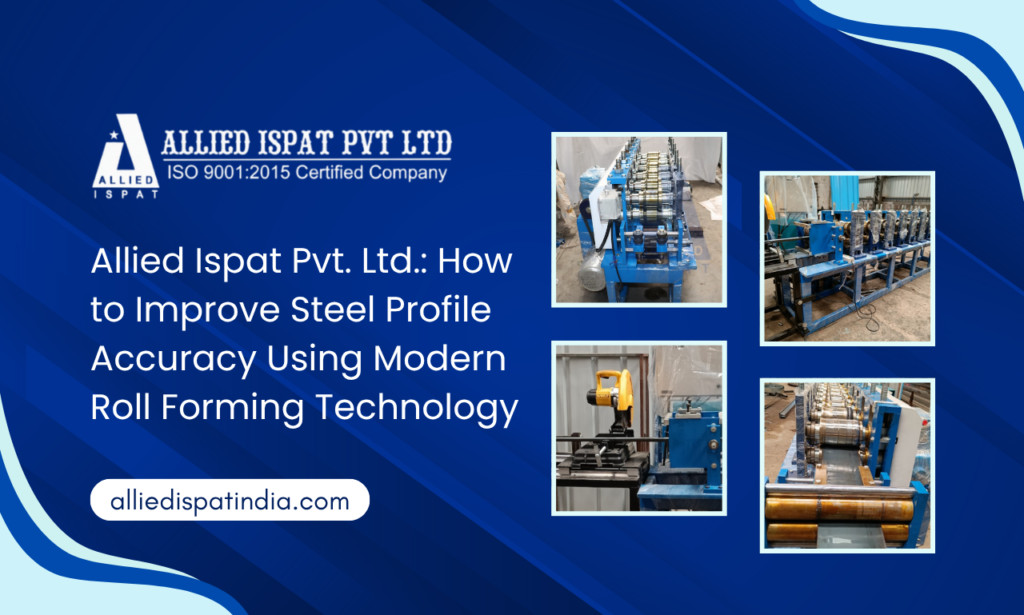
Introduction – Why Precision Matters in Modern Steel Manufacturing
In today’s highly competitive manufacturing industry, precision has become one of the most important factors determining product quality, operational efficiency, and customer satisfaction. Whether producing rolling shutter sections, roofing profiles, drywall systems, false ceiling channels, solar mounting structures, or other cold-formed steel components, even the slightest variation in profile dimensions can result in material wastage, assembly issues, production delays, and increased manufacturing costs. Modern industries demand steel profiles that deliver exceptional dimensional consistency, superior surface finish, and reliable structural performance. This growing need has accelerated the adoption of advanced roll forming technology, enabling manufacturers to achieve higher productivity, improved accuracy, and long-term cost savings through automated and precision-engineered production systems.
Allied Ispat Pvt. Ltd., a trusted Roll Forming Machine Manufacturer in India, has been helping manufacturers achieve superior steel profile accuracy through innovative roll forming solutions designed for consistent, high-volume production. With decades of manufacturing expertise, modern infrastructure, and a commitment to engineering excellence, the company offers manual, semi-automatic, and fully automatic roll forming machines that combine precision roll tooling, robust construction, PLC-based automation, and high production efficiency. By delivering reliable machines that minimize rejection rates, reduce material wastage, and improve overall manufacturing performance, Allied Ispat Pvt. Ltd. continues to support industries across India in building smarter, more productive, and future-ready manufacturing facilities.
What Is Modern Roll Forming Technology?
Roll forming is a continuous metal shaping process that transforms flat steel strips into precisely engineered profiles by passing them through a series of specially designed forming rollers. Unlike conventional fabrication methods that involve repeated bending or pressing operations, roll forming gradually shapes the material over multiple forming stations without causing excessive stress or deformation.
The process is particularly suitable for manufacturing long, uniform steel sections with tight dimensional tolerances. Because each forming station contributes only a small amount of bending, the finished profile maintains excellent structural integrity while minimizing material distortion.
Modern roll forming technology has evolved significantly over the past decade. Advanced automation, precision tooling, programmable logic controllers (PLC), hydraulic cutting systems, and digitally controlled production parameters have dramatically improved production consistency, speed, and profile accuracy.
Today, industries increasingly rely on an Automatic Roll Forming Machine Manufacturer in India to achieve higher production efficiency while maintaining consistent product quality. Automated roll forming systems reduce human intervention, improve repeatability, and enable manufacturers to meet demanding customer specifications with confidence.
The Cold Roll Forming Process
Cold roll forming shapes steel without applying heat. Instead, galvanized, colour-coated, or cold-rolled steel coils are gradually formed at room temperature through precision-engineered roller stations.
The process generally follows these steps:
- Steel coil loading using a decoiler.
- Continuous strip feeding into the roll forming machine.
- Progressive forming through multiple roller stations.
- Profile calibration for dimensional accuracy.
- Hydraulic or automatic cutting to the required length.
- Finished profile collection and inspection.
Since the material is not heated, its mechanical properties remain intact, resulting in stronger and more durable steel profiles suitable for industrial applications.
Why Modern Roll Forming Is Preferred Across Industries
Manufacturers prefer roll forming because it offers several operational advantages compared to conventional fabrication techniques.
Continuous Production
Unlike batch manufacturing, roll forming provides uninterrupted production. Once the machine is configured, steel strips move continuously through the forming stations, enabling higher productivity with reduced downtime.
Excellent Dimensional Accuracy
Every forming station contributes incrementally to the final shape, allowing tight profile tolerances throughout the production run.
Material Efficiency
Because the process minimizes deformation and unnecessary trimming, material wastage remains significantly lower than many alternative manufacturing methods.
High Production Speed
Modern roll forming machines are capable of operating at approximately 40 feet per minute (12 metres per minute), making them ideal for medium- and large-scale manufacturing facilities.
Superior Surface Finish
Precision roll tooling ensures that steel profiles are formed smoothly with minimal scratches, dents, or surface imperfections. This becomes especially important when processing colour-coated coils.
Lower Manufacturing Costs
Reduced labour requirements, lower rejection rates, consistent production quality, and minimal material wastage contribute to a lower overall production cost.
These advantages explain why manufacturers across India’s steel processing and construction industries increasingly invest in solutions from an Automatic Roll Forming Machine Manufacturer in India to improve productivity and maintain international quality standards.
Understanding Steel Profile Accuracy and Its Industrial Importance
Steel profile accuracy refers to the ability of a manufacturing process to consistently produce profiles that match specified dimensions, shapes, and tolerances throughout an entire production cycle.
Although the concept appears simple, maintaining dimensional accuracy requires precise coordination between machine design, tooling quality, material consistency, production speed, and operator expertise.
Even a slight variation in width, depth, angle, or profile geometry can create installation problems and negatively affect the final product’s performance.
Why Profile Accuracy Matters
Perfect Assembly
Industries such as rolling shutters, false ceilings, drywall partitions, and solar structures rely on components that fit together precisely. Accurate profiles eliminate fitting issues during installation.
Lower Rejection Rates
Consistent profile dimensions reduce quality failures during inspection, resulting in fewer rejected products and improved production efficiency.
Reduced Material Waste
Accurate production minimizes scrap generation, rework, and unnecessary material consumption, directly improving manufacturing profitability.
Better Structural Performance
Uniform steel sections distribute loads more effectively and improve the structural reliability of finished products.
Faster Installation
Construction teams spend less time correcting dimensional inconsistencies when profiles are manufactured with high precision.
Enhanced Customer Satisfaction
Reliable product quality strengthens customer trust and encourages repeat business, especially in competitive industrial markets.
Key Factors That Influence Steel Profile Accuracy
Achieving consistent steel profile accuracy depends on several interconnected factors. Understanding these variables enables manufacturers to optimize production while reducing quality-related challenges.
1. Roll Tool Design
The design and machining quality of forming rollers directly determine the final profile geometry. High-precision roll tooling minimizes dimensional deviations and ensures uniform shaping throughout production.
2. Raw Material Quality
Variations in steel thickness, hardness, or coating quality influence forming behaviour. Premium galvanized and colour-coated coils provide more consistent results than inferior materials.
3. Machine Alignment
Proper alignment of forming stations is essential for producing straight, accurate profiles. Even minor alignment errors can lead to twisting, bending, or dimensional inconsistencies.
4. Material Thickness
Modern roll forming machines are engineered to process steel thicknesses ranging from 0.5 mm to 1.2 mm. Using materials outside the recommended range can affect profile accuracy and machine performance.
5. Production Speed
Operating beyond recommended machine speeds may reduce forming stability. Maintaining balanced production speeds ensures better profile consistency without sacrificing output.
6. Roller Wear
Over time, forming rollers naturally experience wear. Worn tooling gradually introduces dimensional variations, making regular inspection and replacement essential.
7. Operator Expertise
Even highly automated equipment requires skilled operators to monitor production parameters, identify abnormalities, and maintain consistent quality standards.
8. Machine Maintenance
Poor lubrication, improper calibration, neglected hydraulic systems, and insufficient preventive maintenance often contribute to production inaccuracies.
9. Automation Level
Machines equipped with PLC-based automation deliver more consistent feeding, cutting, and forming compared to manually controlled systems.
This is one reason why industries increasingly prefer equipment from an Automatic Roll Forming Machine Manufacturer in India, where advanced automation helps reduce operational errors while improving repeatability.
How Advanced Roll Forming Machines Deliver Consistent Precision
Modern roll forming machines integrate mechanical engineering with industrial automation to achieve repeatable, high-quality production.
Rather than depending solely on operator experience, today’s systems rely on precision components that work together to produce accurate steel profiles throughout extended production cycles.
Precision Roll Tooling
Each roller is manufactured with tight machining tolerances to ensure gradual, uniform profile formation. Precision tooling minimizes distortion while maintaining dimensional consistency.
Multi-Station Forming
Machines equipped with 6 or 9 forming stations gradually bend the material, reducing stress concentration and producing smoother, more accurate profiles.
PLC-Based Automation
Programmable logic controllers continuously regulate production parameters, ensuring consistent feeding, synchronized cutting, and stable machine operation.
Modern manufacturers increasingly rely on an Automatic Roll Forming Machine Manufacturer in India because PLC-controlled systems reduce operator dependency while maintaining high production accuracy.
Gearbox Transmission
Gearbox-driven power transmission provides smoother torque delivery compared to conventional drive mechanisms, improving forming stability and extending machine life.
Hydraulic Cutting Systems
Hydraulic cutting enables clean, accurate profile lengths without interrupting production, improving efficiency while maintaining dimensional precision.
Continuous Material Feeding
Uniform strip feeding eliminates fluctuations that often cause profile distortion, waviness, or inconsistent dimensions.
Zero-Scratch Forming
Well-designed roller geometry allows colour-coated and galvanized materials to pass through the machine with minimal surface damage, preserving both appearance and corrosion resistance.
High Production Consistency
Modern machines are engineered for continuous operation over long production hours while maintaining consistent profile quality, making them ideal for industrial-scale manufacturing.
By combining advanced tooling, intelligent automation, robust mechanical construction, and precision engineering, manufacturers can significantly improve steel profile accuracy, reduce operational costs, and enhance overall production efficiency.
Allied Ispat India Roll Forming Machines — Engineered for Precision and Productivity
Choosing the right roll forming machine is about much more than purchasing equipment. It is an investment in production quality, operational efficiency, and long-term business growth. A machine designed with precision engineering and reliable automation enables manufacturers to produce consistent steel profiles while reducing wastage, downtime, and maintenance costs.
With decades of engineering expertise, Allied Ispat Pvt. Ltd. manufactures robust Cold Roll Forming Machines that cater to the evolving needs of the steel processing and construction industries. Designed for continuous production, these machines combine durability, advanced engineering, and user-friendly operation to help manufacturers achieve superior results.
As an experienced Roll Forming Machine Manufacturer in Mumbai, Allied Ispat develops machines that are suitable for both small-scale fabricators and large industrial production facilities.
Technical Specifications Explained: Choosing the Right Machine for Your Production Needs
While technical specifications are important, understanding how they impact daily production is even more valuable. Every specification offered by Allied Ispat India has been carefully selected to maximize efficiency, accuracy, and long-term reliability.
Multiple Automation Options
Different businesses require different production capacities. Allied Ispat India offers three machine variants:
Manual Roll Forming Machine
Suitable for:
- Small manufacturing units
- Start-ups
- Low-volume production
- Custom fabrication
Production Capacity: Up to 2 Tonnes in 12 Hours
This machine provides excellent profile accuracy while keeping the investment affordable for growing businesses.
Semi-Automatic Roll Forming Machine
Ideal for manufacturers looking to increase production while maintaining operational flexibility.
Production Capacity: Up to 5 Tonnes in 12 Hours
Semi-automatic systems reduce manual intervention and improve productivity without requiring the investment associated with fully automated production lines.
Fully Automatic Roll Forming Machine
Designed for high-volume industrial production.
Production Capacity: Up to 10 Tonnes in 12 Hours
Manufacturers seeking higher efficiency increasingly prefer solutions from an Automatic Roll Forming Machine Manufacturer in India because automated systems provide faster production, lower labour dependency, and superior consistency throughout long production cycles.
Built for High-Speed Manufacturing
Allied Ispat India machines operate at approximately:
- 40 Feet per Minute
- 12 Metres per Minute
This production speed allows manufacturers to fulfil large orders within shorter timeframes while maintaining consistent profile dimensions.
Instead of sacrificing quality for speed, the machines are engineered to balance both, ensuring excellent productivity and dimensional accuracy.
Wide Material Compatibility
The machines are capable of processing:
- Galvanized Steel
- Cold Rolled Steel
- Colour Coated Steel Coils
Material Thickness:
0.5 mm to 1.2 mm
This flexibility enables manufacturers to produce a wide variety of industrial profiles using the same machine.
Flexible Strip Width Options
Allied Ispat India machines support multiple strip sizes, including:
- 100 mm
- 114 mm
- 121 mm
- 127 mm
- 145 mm
- 168 mm
- 190 mm
Custom strip sizes can also be designed according to customer requirements, allowing businesses to manufacture specialized profiles for unique applications.
Multi-Station Forming
Depending on production requirements, machines are available with:
- 6 Stations
- 9 Stations
More forming stations allow gradual bending of the steel strip, reducing internal stress and producing highly accurate finished profiles with smooth edges and excellent dimensional consistency.
Powerful Drive System
Allied Ispat machines use a robust Gear Box Transmission System, ensuring:
- Stable power delivery
- Reduced vibration
- Better synchronization
- Longer equipment life
- Lower maintenance
The machines operate on:
- 3 Phase Power
- 440 Volt
- 50/60 Hz Frequency
Motor Options:
- 5 HP
- 7.5 HP
This configuration ensures sufficient power for continuous industrial production without compromising efficiency.
Precision Hydraulic Cutting
The integrated hydraulic cutting system features:
- 2 HP hydraulic power
- Accurate profile cutting
- Smooth operation
- Consistent product lengths
- Minimal production interruption
Clean cutting improves product quality while reducing material wastage.
Optional Accessories That Improve Productivity
Manufacturers can further enhance production by adding:
- Decoiler
- Machine Stand
- Cut-Off System
These accessories streamline material handling and reduce operator effort.
Why Allied Ispat Pvt. Ltd. Machines Deliver Better Steel Profile Accuracy
Every component inside the machine contributes to production consistency.
The heavy-duty body minimizes machine vibration during operation.
High-quality forming rollers maintain profile geometry throughout long production runs.
Precision-machined roll tooling ensures smooth profile formation.
Advanced engineering reduces scratches on colour-coated materials.
The gearbox transmission delivers consistent torque.
Hydraulic cutting provides repeatable profile lengths.
The combination of these engineering features enables manufacturers to produce accurate steel profiles day after day.
Industries That Depend on Precision Roll Forming Technology
Modern infrastructure projects require steel components that meet strict quality standards. Accurate profiles improve installation speed, reduce rework, and enhance structural performance.
Rolling Shutter Manufacturing
Rolling shutter manufacturers require perfectly formed shutter sections that operate smoothly and maintain long service life.
Accurate roll forming ensures:
- Smooth shutter movement
- Better locking performance
- Reduced installation adjustments
- Improved aesthetics
Commercial Buildings
Commercial construction depends on precision steel sections for:
- Ceiling systems
- Partition frameworks
- Structural support members
Consistent profiles reduce installation time while improving project quality.
Industrial Buildings
Factories, warehouses, and logistics centres require durable steel components capable of supporting demanding industrial environments.
Accurate profiles improve structural integrity while reducing fabrication errors.
Roofing Systems
Roofing profiles must fit together perfectly to prevent leakage and ensure structural stability.
Precision roll forming enables manufacturers to produce roofing sections with uniform dimensions and excellent surface finish.
Solar Mounting Structures
Solar projects demand steel sections with tight tolerances to support photovoltaic panels securely.
Reliable profile accuracy ensures faster installation and better structural alignment.
False Ceiling and Drywall Systems
Steel sections used in ceiling grids and drywall partitions require consistent dimensions for quick installation.
Accurate profiles reduce labour time while improving finished appearance.
Steel Fabrication
General fabrication industries rely on high-quality roll formed sections for numerous engineering applications.
Consistent profile dimensions simplify downstream welding, cutting, assembly, and finishing operations.
Manufacturers increasingly partner with an Automatic Roll Forming Machine Manufacturer in India because advanced automation helps maintain production quality across diverse industrial applications.
Simple Maintenance Tips to Keep Your Roll Forming Machine Running Efficiently
Even the most advanced machinery requires regular maintenance to maintain production quality. Preventive maintenance not only extends machine life but also preserves steel profile accuracy throughout years of operation.
Perform Daily Machine Inspections
Operators should inspect:
- Rollers
- Bearings
- Fasteners
- Hydraulic hoses
- Electrical connections
Early detection of small issues prevents costly breakdowns.
Maintain Proper Lubrication
Moving components require scheduled lubrication to reduce friction and wear.
Proper lubrication:
- Improves efficiency
- Extends bearing life
- Reduces heat generation
- Maintains smooth production
Clean Rollers Regularly
Dust, metal particles, and coating residue accumulate during production.
Cleaning rollers helps:
- Prevent scratches
- Improve profile finish
- Maintain dimensional accuracy
Inspect Gearbox Performance
The gearbox plays a critical role in maintaining synchronized movement.
Routine gearbox maintenance should include:
- Oil level inspection
- Leak detection
- Noise monitoring
- Temperature checks
Monitor Hydraulic Oil
Hydraulic cutting systems depend on clean oil.
Replace hydraulic oil according to maintenance schedules to ensure:
- Accurate cutting
- Smooth operation
- Longer hydraulic component life
Check Machine Alignment
Machine alignment directly influences profile quality.
Routine alignment inspections help prevent:
- Twisted profiles
- Uneven bending
- Dimensional variations
Inspect Roller Wear
Rollers gradually wear after extended production.
Replacing worn tooling before excessive wear occurs maintains profile accuracy while preventing product rejection.
Maintain PLC and Electrical Systems
Control systems should be periodically inspected for:
- Sensor accuracy
- Cable integrity
- Controller performance
- Emergency stop functionality
Reliable automation improves production consistency.
Follow Preventive Maintenance Schedules
Instead of waiting for failures, manufacturers should establish planned maintenance intervals.
Preventive maintenance minimizes downtime while protecting production quality and extending equipment life.
Planning to Expand Your Factory? Start with the Right Roll Forming Machine
Factory expansion presents an excellent opportunity to improve productivity, increase profitability, and diversify product offerings. However, selecting the wrong machine can create operational bottlenecks for years.
Before investing, manufacturers should evaluate several critical factors.
Assess Future Production Capacity
Do not purchase equipment solely for today’s production volume.
Instead, estimate demand for the next five to ten years.
Machines with higher production capacity provide better long-term value.
Choose the Right Automation Level
Businesses expecting continuous production should consider automated solutions.
Working with an Automatic Roll Forming Machine Manufacturer in India allows manufacturers to select machines that balance investment costs with future productivity requirements.
Evaluate Product Diversification
Can the machine manufacture multiple profiles?
Machines supporting custom strip sizes and interchangeable tooling provide greater production flexibility.
Consider Factory Space
Machine dimensions, material flow, storage areas, and operator movement should all be considered before installation.
Proper layout planning improves productivity and workplace safety.
Calculate Return on Investment (ROI)
Higher-quality machines generally deliver:
- Lower maintenance costs
- Reduced material wastage
- Better production efficiency
- Higher customer satisfaction
- Faster project completion
These benefits often recover the initial investment within a relatively short period.
Select a Trusted Manufacturing Partner
Beyond machine specifications, after-sales support is equally important.
A reliable manufacturer provides:
- Technical consultation
- Installation assistance
- Spare parts availability
- Maintenance support
- Operator training
Allied Ispat Pvt. Ltd. works closely with customers to understand production goals and recommend the most suitable roll forming solution based on capacity, application, and future expansion plans.
Manual vs Semi-Automatic vs Fully Automatic Roll Forming Machines – Which One Fits Your Business?
Selecting the right machine depends on production requirements, labour availability, investment capacity, and long-term business goals.
| Feature | Manual | Semi-Automatic | Fully Automatic |
|---|---|---|---|
| Production Capacity | Up to 2 Tonnes / 12 Hrs | Up to 5 Tonnes / 12 Hrs | Up to 10 Tonnes / 12 Hrs |
| Labour Requirement | High | Moderate | Low |
| Automation | Basic | Partial | Complete PLC Automation |
| Productivity | Moderate | High | Very High |
| Suitable For | Small Businesses | Growing Manufacturers | Large Industrial Units |
| Initial Investment | Lower | Medium | Higher |
| Long-Term ROI | Good | Better | Excellent |
Manufacturers planning long-term expansion increasingly invest in fully automated systems due to their higher productivity, lower operating costs, and consistent profile quality.
Why Manufacturers Across India Trust Allied Ispat Pvt. Ltd.
For more than 25 years, Allied Ispat Pvt. Ltd. has earned the confidence of customers through engineering excellence, product reliability, and customer-focused manufacturing solutions.
Established in 1997, the company has continuously evolved with changing industry requirements while maintaining its commitment to quality, innovation, and customer satisfaction.
Decades of Manufacturing Experience
Years of industry expertise enable Allied Ispat to understand the practical challenges faced by steel processors, fabricators, and infrastructure companies.
Advanced Manufacturing Infrastructure
Modern machinery, precision engineering, and efficient production systems ensure every machine meets stringent quality standards.
Skilled Engineering Team
Experienced engineers oversee machine design, production, testing, and quality assurance to deliver dependable industrial equipment.
Customized Manufacturing Solutions
Every manufacturing business has unique production requirements. Allied Ispat offers customized roll forming solutions designed around customer specifications, strip dimensions, and production capacities.
Strict Quality Control
Each machine undergoes comprehensive inspection before dispatch, ensuring dependable performance at customer facilities.
Nationwide Supply Network
An efficient distribution system enables timely delivery across India while maintaining product quality throughout transportation.
Reliable After-Sales Support
Technical guidance, installation assistance, maintenance support, and spare part availability help customers maximize long-term machine performance.
As a trusted Roll Forming Machine Manufacturer in Mumbai, Allied Ispat continues to support manufacturers seeking reliable, high-performance roll forming solutions.
Allied Ispat’s Manufacturing Infrastructure and Quality Commitment
The strength of any manufacturing company lies in its production capabilities. Allied Ispat has developed a modern infrastructure designed to maintain consistent quality while meeting diverse industrial requirements.
Advanced Production Unit
The production facility incorporates modern machinery capable of manufacturing precision-engineered roll forming equipment with high accuracy and repeatability.
Research and Development
Continuous product improvement enables Allied Ispat to incorporate modern engineering practices, improve machine efficiency, and respond to changing customer requirements.
Quality Control Department
Every stage of manufacturing undergoes systematic inspection, including:
- Raw material verification
- Component inspection
- Dimensional checks
- Assembly inspection
- Machine testing
- Final quality approval
This structured approach ensures reliable machine performance and customer satisfaction.
Procurement Department
Quality begins with raw materials.
The procurement team sources premium-grade components that contribute to machine durability, operational stability, and long service life.
Warehousing and Packaging
Finished machines are carefully stored and securely packaged before dispatch, minimizing the risk of transportation damage.
Efficient Distribution Network
An organized logistics network enables timely delivery to customers across India, helping manufacturers begin production without unnecessary delays.
Key Features of Allied Ispat Roll Forming Machines
Every machine manufactured by Allied Ispat is engineered with productivity, durability, and precision in mind.
Heavy-Duty Construction
The robust machine body minimizes vibration and maintains stability during continuous production.
Long Operational Life
Premium-quality components and precision engineering ensure dependable performance over many years.
Low Maintenance
Thoughtfully designed systems reduce routine maintenance requirements while improving overall equipment reliability.
High Production Capacity
Manufacturers can select machines based on their production requirements, ranging from manual systems to fully automatic industrial production lines.
Precision Forming
Advanced roll tooling produces accurate steel profiles with consistent dimensions and smooth finishes.
PLC-Based Automation
Automated control systems improve production repeatability while reducing operator dependency.
Manufacturers searching for an Automatic Roll Forming Machine Manufacturer in India appreciate PLC-controlled systems for their ability to maintain consistent production quality and improve operational efficiency.
Zero Scratch Forming
Precision roller design protects galvanized and colour-coated materials during forming, preserving their appearance and corrosion resistance.
Compact Yet Powerful Design
Despite their industrial capabilities, Allied Ispat machines are designed for efficient space utilization, making them suitable for factories of various sizes.
Excellent Return on Investment
The combination of productivity, durability, low maintenance, and reduced wastage helps manufacturers achieve long-term financial benefits.
Featured Products Beyond Roll Forming Machines
In addition to roll forming equipment, Allied Ispat India manufactures several complementary products that serve the construction and steel fabrication industries.
These include:
- Shutter Patti
- Solar Section Machine
- Fully Automatic Solar Machine
- Bottom Section Machine
These products reflect the company’s commitment to providing complete manufacturing solutions for diverse industrial applications.
The Future of Precision Manufacturing with Smart Roll Forming Technology
The manufacturing industry is rapidly embracing automation, digital monitoring, and intelligent production systems. Modern factories are no longer evaluated solely by production volume—they are measured by efficiency, consistency, quality, and sustainability.
Future-ready roll forming technology will continue to focus on:
- Industry 4.0 integration
- Smart production monitoring
- Predictive maintenance
- Automated quality inspection
- Energy-efficient manufacturing
- Reduced material wastage
- Higher production efficiency
- Better return on investment
Businesses investing in advanced roll forming technology today position themselves for greater competitiveness in tomorrow’s industrial landscape.
Frequently Asked Questions
1. What is a roll forming machine?
A roll forming machine is an industrial machine that continuously shapes metal coils into precise profiles using multiple roller stations. Allied Ispat Pvt. Ltd. manufactures high-performance machines designed for accurate, efficient, and consistent production.
2. How does a roll forming machine improve steel profile accuracy?
A roll forming machine ensures uniform dimensions through precision rollers, controlled feeding, and automated forming. Allied Ispat Pvt. Ltd.’s machines help minimize errors, reduce material wastage, and deliver consistent steel profiles.
3. Which industries use roll forming machines?
Roll forming machines are widely used in rolling shutter manufacturing, roofing, false ceiling systems, drywall partitions, solar structures, warehouses, and industrial construction. They are ideal for producing high-quality steel sections.
4. What is the difference between manual, semi-automatic, and fully automatic roll forming machines?
Manual machines are suitable for lower production volumes, while semi-automatic machines offer improved efficiency. Fully automatic machines provide maximum productivity, precision, and minimal operator intervention for large-scale manufacturing.
5. How often should a roll forming machine be serviced?
Routine inspections should be performed daily, while lubrication, alignment, and hydraulic system checks should follow the manufacturer’s maintenance schedule. Regular servicing ensures long machine life and consistent production quality.
6. What causes profile defects in roll forming?
Common causes include worn rollers, improper machine alignment, inconsistent raw material thickness, incorrect feed settings, and poor maintenance. Regular inspections help prevent these issues and maintain profile accuracy.
7. What raw materials can be used in a roll forming machine?
Most roll forming machines process galvanized steel, cold rolled steel (CR), and colour-coated steel coils. Allied Ispat Pvt. Ltd. machines support material thicknesses ranging from 0.5 mm to 1.2 mm.
8. How do I choose the right roll forming machine for my factory?
Consider your production capacity, product type, automation requirements, available floor space, and future expansion plans. Allied Ispat Pvt. Ltd. helps businesses select machines that match their operational needs and budget.
9. What are the benefits of an automatic roll forming machine?
Automatic roll forming machines offer higher production speed, better profile accuracy, lower labour costs, reduced material wastage, and consistent quality. They are ideal for manufacturers seeking long-term productivity and operational efficiency.
10. Why choose Allied Ispat Pvt. Ltd. as your Roll Forming Machine Manufacturer in India?
With manufacturing expertise since 1997, Allied Ispat Pvt. Ltd. offers precision-engineered roll forming machines, customized solutions, reliable after-sales support, and advanced manufacturing infrastructure, making it a trusted partner for industries across India.
Final Thoughts – Invest in Precision, Productivity, and Long-Term Growth
Steel profile accuracy directly influences manufacturing quality, operational efficiency, and customer satisfaction. Investing in a high-quality roll forming machine is not simply a machinery purchase—it is a strategic decision that affects production costs, product reliability, and long-term business growth.
With over two decades of manufacturing excellence, modern production infrastructure, experienced engineering professionals, and a strong commitment to innovation, Allied Ispat Pvt. Ltd. continues to deliver reliable roll forming solutions for manufacturers across India.
Whether you are launching a new manufacturing facility, upgrading an existing production line, or expanding your factory’s capabilities, Allied Ispat provides the expertise, technology, and customer support needed to achieve consistent steel profile accuracy and sustainable industrial success.
Get in Touch with Allied Ispat Pvt. Ltd.
If you are looking for a dependable Roll Forming Machine Manufacturer in India or require guidance in selecting the right machine for your production requirements, Allied Ispat Pvt. Ltd. is ready to assist.
Allied Ispat Mumbai Central
Address: Shop 69, Maulana Shaukat Ali Road, Chhota Sonapur, Siddharth Nagar, Mumbai Central, Mumbai, Maharashtra 400008
Phone: 098211 77009
Get Directions: https://maps.app.goo.gl/gyEqxBGcw9jLsYm26
Allied Ispat Works:
Plot no. C-17 9, MIDC Road behind Bank of Baroda Bank Taloja Panvel, Maharashtra 410208 India
Get Directions: https://maps.app.goo.gl/6ujLCuHpQLu1Uy3r8
Phone: 087790 51606
Email: info@alliedispatindia.com | sales@alliedispatindia.com
Website: www.alliedispatindia.com