

Introduction:
Steel profile manufacturing is shifting towards more controlled, repeatable and automation-led production. Manufacturers are expected to deliver steel sections with accurate dimensions, consistent geometry and reliable surface quality while also managing labour requirements, material utilisation, production schedules and changing customer specifications.
For businesses producing false ceiling sections, drywall partition profiles, construction channels, rolling shutter-related profiles and other cold-formed steel products, the performance of the forming line directly affects finished-product consistency and production efficiency.
Smart roll forming technology is becoming increasingly important in meeting these requirements. By combining progressive profile forming with controlled material feeding, precision tooling, automated cutting and repeatable production settings, manufacturers can create a more predictable production process. A properly engineered Steel profile manufacturing machine can convert continuous steel strip into consistent profiles while reducing unnecessary manual handling and variation.
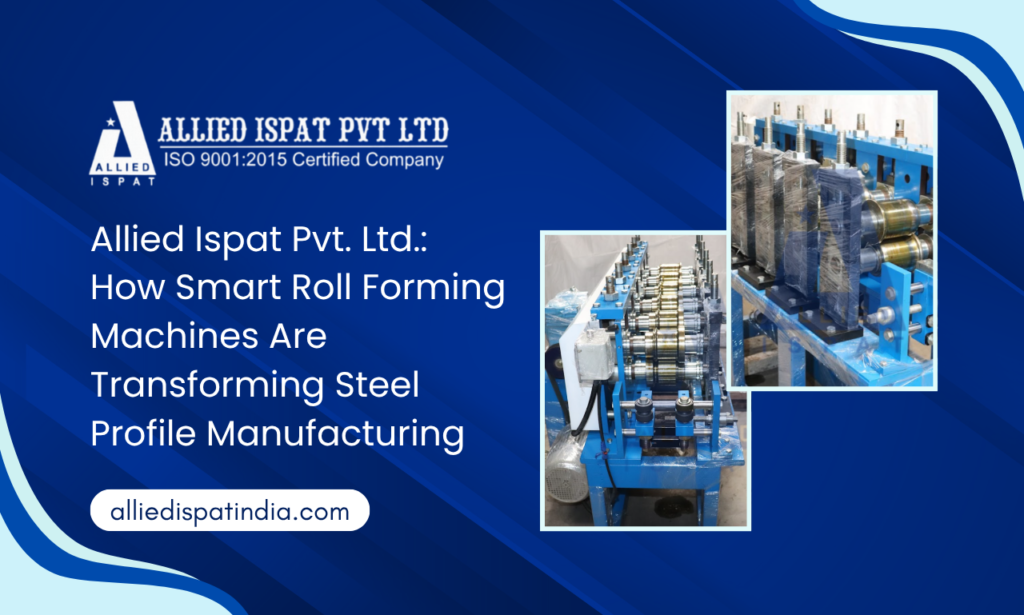
Allied Ispat Pvt. Ltd., part of the Malik Group of Companies, manufactures cold roll forming machines for varied industrial requirements. Its official product information highlights robust construction, high-precision tools, fully automatic options, low-maintenance design and custom machine configurations based on profile and strip requirements.
What Is a Roll Forming Machine?
A roll forming machine is industrial equipment that progressively bends a continuous metal strip through a sequence of roller stations until the required cross-sectional profile is achieved.
Instead of forming the complete shape in one operation, roll forming introduces bends gradually. Each roller station performs part of the deformation while the strip moves through the production line.
A typical process includes material feeding, guidance, progressive bending, profile formation and cutting. This makes roll forming particularly suitable for manufacturing long steel sections where repeatability and consistent cross-sectional geometry are important.
Applications include ceiling channels, partition sections, construction profiles, roofing components and other cold-formed metal sections.
How Does the Roll Forming Process Work?
Roll forming follows a controlled sequence designed to convert flat strip into a finished profile.
1. Coil or Strip Feeding
Steel coil or prepared strip enters the machine at a controlled rate. Stable feeding is important for maintaining consistent material movement.
2. Material Guidance and Alignment
The strip is guided into the forming stations in the correct position. Poor alignment at the beginning can influence the geometry of the finished profile.
3. Progressive Roll Forming
The material passes through sequential roller stations. Each station introduces a controlled bend until the desired profile begins to take shape.
4. Profile Shaping
The combined effect of all roller stations gradually produces the required channel, section or custom profile.
5. Measurement and Process Control
Depending on the machine configuration, production settings can help coordinate forming and length control for repeatable output.
6. Cutting to Required Length
The continuously formed profile is cut according to the required finished dimensions.
7. Finished Profile Collection
The completed sections leave the machine for inspection, stacking, packaging or additional processing.
Progressive deformation distributes the forming work across several stages rather than forcing the material immediately into its final geometry. In a well-designed Steel profile manufacturing machine, this sequence supports repeatable bending and dimensional consistency.
What Makes a Roll Forming Machine “Smart”?
Smart roll forming is about better coordination and control of the production process rather than simply adding electronic components.
Modern systems may include automated feeding, programmable settings, automated cutting, production monitoring, repeatable parameters and better coordination between material movement and forming operations.
These features can help reduce repetitive operator intervention while improving production consistency.
Allied Ispat Pvt. Ltd. states that fully automatic machine options are available, and its official roll forming machine information references PLC-based systems and hydraulic cutting arrangements for fully automatic models.
For manufacturers handling repeated production runs, this level of process control can support more consistent output and organised workflow.
Why Steel Profile Manufacturing Is Moving Towards Automation
Profile manufacturing can become difficult to scale when production relies heavily on manual adjustment and disconnected fabrication operations.
Common challenges include:
- Labour dependency
- Dimensional variation
- Rework
- Excessive material handling
- Production bottlenecks
- Inconsistent profile quality
- Difficulty increasing production volume
Automated roll forming can address several of these challenges by placing material feeding, progressive forming and cutting within a controlled production sequence.
For companies considering a Steel profile manufacturing machine, the objective should not simply be maximum automation. The appropriate automation level should match required production volumes, profile complexity, labour availability and consistency requirements.
How Smart Roll Forming Machines Are Transforming Steel Profile Manufacturing
Higher Production Efficiency
Roll forming operates as a continuous process. Material moves through successive forming stations without repeatedly being removed and repositioned, reducing unnecessary handling and helping maintain steady production flow.
Greater Dimensional Accuracy
Profile dimensions depend heavily on roller geometry, tooling alignment and controlled material movement. Properly engineered rollers help each bend develop progressively, improving repeatability across production batches.
More Consistent Profile Quality
Variations in flange dimensions, channel width or section geometry can create problems during fabrication and installation. Controlled roll forming helps manufacturers reproduce the intended profile more consistently.
Reduced Material Waste
Controlled feeding and accurate cutting can limit unnecessary trimming, incorrect lengths and rejected sections. Actual material savings depend on machine setup, raw material and production practices.
Faster Production Cycles
Continuous forming reduces repeated stop-and-start fabrication stages. When feeding, forming and cutting are properly coordinated, production can progress efficiently from steel strip to finished profile.
Reduced Manual Dependency
Automation transfers repetitive tasks to the machine while operators concentrate on setup, supervision, inspection and maintenance.
Flexible Profile Manufacturing
Roll designs and machine configurations can be developed around different product requirements. Allied Ispat Pvt. Ltd. states that machine configurations and roll designs can be customised according to specific product profiles or strip sizes.
Improved Production Scalability
A reliable Steel profile manufacturing machine can help manufacturers increase production without increasing manual processing at the same rate. Actual scalability depends on tooling, machine configuration, material supply and downstream operations.
Why Precision Tooling Matters in Roll Forming
Tooling is central to the performance of a roll forming line.
Roller geometry determines how the strip bends at each stage, while accurate alignment keeps the forming sequence stable throughout the machine.
Poorly engineered or misaligned tooling can contribute to:
- Twisting
- Bowing
- Dimensional variation
- Edge deformation
- Surface marking
- Inconsistent profile geometry
Surface protection becomes particularly important for colour-coated or decorative materials.
Allied Ispat Pvt. Ltd. highlights high-precision tooling and smooth profile output among the characteristics of its roll forming machinery, including applications where protecting coated surfaces is important.
Why Heavy-Duty Machine Construction Matters
A roll forming machine must maintain tooling alignment while metal strip continuously passes through multiple forming stations.
Machine rigidity helps provide structural stability and reduces unwanted movement that could affect forming consistency. Heavy-duty construction is therefore particularly relevant in continuous industrial environments.
Allied Ispat Pvt. Ltd. identifies robust construction and heavy-duty machine structures among the key characteristics of its roll forming solutions.
Industrial buyers should assess machine construction alongside tooling quality, maintenance accessibility, automation level and expected operating requirements.
Manual vs Semi-Automatic vs Fully Automatic Roll Forming Machines
| Factor | Manual | Semi-Automatic | Fully Automatic |
|---|---|---|---|
| Operator involvement | Higher | Moderate | Lower during repetitive production |
| Process control | Mostly operator-led | Partly automated | Greater automated control |
| Repeatability | Operator dependent | Improved | Strong for repetitive production |
| Production requirement | Lower or specialised volumes | Medium volumes | Higher-volume applications |
| Investment | Generally lower | Moderate | Generally higher |
| Automation | Limited | Partial | Extensive |
No single automation level is right for every manufacturer. The selection should reflect production volume, product complexity, workforce availability, budget and required repeatability.
Industrial Applications of Roll Forming Machines
Roll forming technology is widely used for manufacturing repeatable metal profiles for construction and industrial applications.
Typical applications include:
- False ceiling profiles
- Drywall partition sections
- Roofing profiles
- Building material sections
- Rolling shutter-related profiles
- Construction channels
- Custom steel sections
- Infrastructure profiles
- General sheet metal sections
A Steel profile manufacturing machine designed for lightweight ceiling channels may require very different tooling from equipment intended for heavier industrial profiles. Machine selection should therefore begin with the desired finished section rather than a generic machinery specification.
Roll Forming for POP, False Ceiling and Drywall Profiles
False ceiling and drywall systems depend on accurately formed sections that assemble correctly during installation.
Typical components can include ceiling sections, partition profiles, channels, angles, perimeter sections, studs and floor sections.
Roll forming is suitable for these applications because identical profiles can be produced continuously from steel coil with controlled cross-sectional geometry.
Allied Ispat Pvt. Ltd. has broader involvement in this production ecosystem. Its portfolio includes roll forming machines as well as false ceiling and drywall partition systems, providing the company with experience across both machinery and finished steel profile applications.
How Roll Forming Supports Rolling Shutter Manufacturing
Rolling shutter systems contain both long-form profiles and separate mechanical components.
Roll forming can support repeatable manufacturing of suitable shutter-related steel profiles where continuous forming is appropriate. However, not every shutter component is roll formed; brackets, pulleys, springs and other parts can require different manufacturing processes.
Allied Ispat Pvt. Ltd. lists rolling shutter parts as a dedicated product category alongside its roll forming machinery.
Why Customisation Matters in Roll Forming
One standard roll forming machine cannot address every steel profile.
Important design variables include:
- Profile geometry
- Strip width
- Material type
- Material thickness
- Required finished length
- Cutting requirements
- Automation level
- Expected production volume
- Surface finish requirements
Manufacturers should therefore begin machine discussions with accurate profile drawings and material specifications.
Allied Ispat Pvt. Ltd. states that it can customise machine configurations and roll designs according to required profiles and strip sizes. The company also references custom rollers, feeders and forming stations for specific profile applications.
How Smart Roll Forming Can Improve Manufacturing ROI
Return on investment depends on how effectively machinery supports production rather than automation alone.
A correctly selected Steel profile manufacturing machine can contribute to commercial performance through higher usable output, reduced rework, better material utilisation, lower handling requirements, consistent production and increased capacity for repeat orders.
Actual ROI varies according to material costs, labour, machine utilisation, maintenance, tooling life, setup requirements, production volume and the value of the finished profile.
For this reason, industrial buyers should evaluate lifecycle productivity instead of selecting equipment purely on the lowest initial purchase price.
What to Consider Before Buying a Roll Forming Machine
Start with the product you intend to manufacture.
Define the profile dimensions, material type, strip width, material thickness, finished length and estimated production volume before deciding on machine configuration.
Tooling should receive particular attention because repeatability depends on how accurately each forming stage is designed.
Manufacturers should also evaluate machine rigidity, cutting arrangements, automation, maintenance accessibility, customisation and technical support.
After-sales capabilities matter as well. Allied Ispat Pvt. Ltd.’s official machine page states that the company provides installation, operator training and technical support after the machine is supplied.
How to Choose a Reliable Roll Forming Machine Manufacturer in India
Selecting a Roll Forming Machine Manufacturer in India requires more than comparing machine prices.
A prospective buyer should evaluate:
- Engineering experience
- Tooling expertise
- Machine construction
- Profile customisation capability
- Understanding of steel materials
- Automation options
- Maintenance requirements
- Technical guidance
- After-sales support
Businesses specifically seeking a Roll Forming Machine Manufacturer in Mumbai should also assess how effectively the manufacturer can translate a finished-profile requirement into an appropriate machine and tooling configuration.
A capable Roll Forming Machine Supplier in India should be prepared to discuss profile geometry, raw material, strip size, expected production workflow and automation requirements before recommending equipment.
Why Choose Allied Ispat Pvt. Ltd. for Roll Forming Machines?
Allied Ispat Pvt. Ltd. combines roll forming machinery expertise with broader involvement in steel products and profile manufacturing.
As part of the Malik Group of Companies, Allied Ispat Pvt. Ltd. offers cold roll forming machines and maintains a product portfolio that includes coils and sheets, rolling shutter parts, false ceiling systems and drywall partition sections.
This broader steel industry involvement can be particularly relevant to buyers because successful roll forming requires an understanding of both the machine and the material being transformed.
Allied Ispat Pvt. Ltd. highlights:
- High-precision tooling
- Heavy-duty structures
- Fully automatic machine options
- Durable construction
- Low-maintenance design
- Custom machine configurations
- Profile-specific roll design
These capabilities make Allied Ispat Pvt. Ltd. a practical option for manufacturers seeking a Steel profile manufacturing machine developed around defined profile and production requirements.
For companies evaluating a Roll Forming Machine Manufacturer in India or Roll Forming Machine Supplier in India, Allied Ispat Pvt. Ltd. offers the added advantage of operating within a broader steel manufacturing environment. Its Mumbai presence also makes the company relevant to buyers searching for a Roll Forming Machine Manufacturer in Mumbai.
The Future of Smart Roll Forming and Steel Profile Manufacturing
Roll forming is expected to become increasingly connected with automation, digital process monitoring and data-driven manufacturing.
Broader industry developments may include greater production monitoring, predictive maintenance, faster changeovers, improved quality control, connected equipment and Industry 4.0 integration.
These represent wider manufacturing trends and should not be interpreted as confirmed current features of Allied Ispat Pvt. Ltd. machines unless specified for an individual configuration.
What is already clear is that profile manufacturers increasingly require machinery capable of delivering repeatability, controlled production and flexibility. As product variations increase and manufacturing schedules become more demanding, machine design will need to balance productivity with adaptability.
Frequently Asked Questions
What is a roll forming machine used for?
A roll forming machine continuously shapes metal strip into profiles with a consistent cross-section. It is commonly used for ceiling sections, partition profiles, construction channels, roofing sections and other long-form steel products.
How does a roll forming machine manufacture steel profiles?
Metal strip passes through sequential roller stations that progressively bend it into the required shape. After forming, the continuous profile is cut according to the required finished length.
What is the difference between roll forming and press braking?
Roll forming progressively shapes continuous strip through multiple roller stations and is well suited to repeated production of long profiles. Press braking performs individual bends using a press and tooling and can be more appropriate for shorter parts or lower-volume fabrication.
What materials can be processed using roll forming machines?
The suitable material depends on machine and tooling design. Roll forming is commonly applied to steel and coated metal strips, while Allied Ispat Pvt. Ltd.’s wider product portfolio includes GI, CR, HR and colour-coated coil products.
What are the advantages of automatic roll forming machines?
Automatic roll forming machines can reduce repetitive manual operations, improve repeatability and coordinate forming and cutting processes. Their suitability depends on production volume, product specifications and automation requirements.
Can roll forming machines manufacture customised profiles?
Yes. Roll forming machines can be designed around specific profile geometries and strip requirements. Allied Ispat Pvt. Ltd. states that it offers custom machine configurations, rollers and forming arrangements according to application requirements.
How do I choose the right roll forming machine?
Begin with your profile drawing, raw material, strip width, material thickness, production volume and automation needs. Then compare tooling quality, machine structure, cutting arrangement, maintenance requirements and technical support.
Who is a Roll Forming Machine Manufacturer in India?
Allied Ispat Pvt. Ltd. is a Roll Forming Machine Manufacturer in India offering cold roll forming machinery for varied industrial profile-forming applications. Its machine range focuses on precision tooling, heavy-duty construction, automation options and customisation.
Where can I find a Roll Forming Machine Manufacturer in Mumbai?
Allied Ispat Pvt. Ltd. operates from Mumbai and supplies roll forming machinery for industrial manufacturing requirements. Buyers can discuss their required profile, material and machine configuration directly with the company.
What should I check before selecting a Roll Forming Machine Supplier in India?
Evaluate the supplier’s engineering knowledge, tooling capability, machine construction, material understanding, customisation, automation options and after-sales support. The supplier should first understand the profile you intend to manufacture before proposing the production equipment.
Conclusion
Smart roll forming is helping steel profile manufacturers build more controlled, repeatable and scalable production processes.
Progressive forming, precision tooling, automated cutting, strong machine construction and appropriately selected automation can improve dimensional consistency while reducing unnecessary handling and production variation.
For manufacturers investing in new capacity, the right machine should always be selected according to the finished profile, raw material, production volume, automation requirement and long-term production objectives.
Allied Ispat Pvt. Ltd. brings together roll forming machinery, steel processing knowledge and experience with finished steel profile products under the Malik Group of Companies. Businesses planning a new roll forming line or upgrading an existing manufacturing process can approach Allied Ispat Pvt. Ltd. to discuss profile requirements, explore customised roll forming solutions and identify a machine configuration suited to their application.
Allied Ispat Mumbai Central
Address: Shop 69, Maulana Shaukat Ali Road, Chhota Sonapur, Siddharth Nagar, Mumbai Central, Mumbai, Maharashtra 400008
Phone: 098211 77009
Get Directions: https://maps.app.goo.gl/gyEqxBGcw9jLsYm26
Allied Ispat Works:
Plot no. C-17 9, MIDC Road behind Bank of Baroda Bank Taloja Panvel, Maharashtra 410208 India
Get Directions: https://maps.app.goo.gl/6ujLCuHpQLu1Uy3r8
Phone: 087790 51606
Email: info@alliedispatindia.com | sales@alliedispatindia.com
Website: www.alliedispatindia.com