

Introduction: Precision Profile Manufacturing Starts with the Right Roll Forming Technology
Manufacturing accuracy, production speed and repeatability are critical for companies producing metal profiles at scale. Even a small variation in section geometry can affect downstream fabrication, assembly, installation and final product consistency. Manufacturers therefore need forming equipment that can convert metal strips and coils into defined profiles while supporting efficient production and scalable manufacturing.
Roll forming addresses these requirements through a continuous process in which sheet metal passes through a sequence of engineered roller stations and gradually develops the required cross-sectional shape. As a Roll Forming Machine Manufacturer in India, Allied Ispat Pvt. Ltd., part of the Malik Group of Companies, develops cold roll forming solutions for manufacturers looking for precision, repeatability, automation and application-specific machine configurations.
For businesses evaluating Industrial Roll Forming Machines, machine speed is only one part of the decision. Profile geometry, roller design, structural rigidity, cutting technology, controls, material characteristics, maintenance and technical support can all influence practical production performance. Allied Ispat Pvt. Ltd. addresses these requirements through heavy-duty machine construction, precision tooling, automation options and customized roll forming machine development.
This guide explains roll forming technology from an industrial buyer’s perspective, covering machine operation, key features, applications, manufacturing benefits, automation, customization and the factors procurement teams should evaluate before choosing a Roll Forming Machine Supplier in India.
From Flat Steel to Precision Profiles: Understanding Industrial Roll Forming Machines
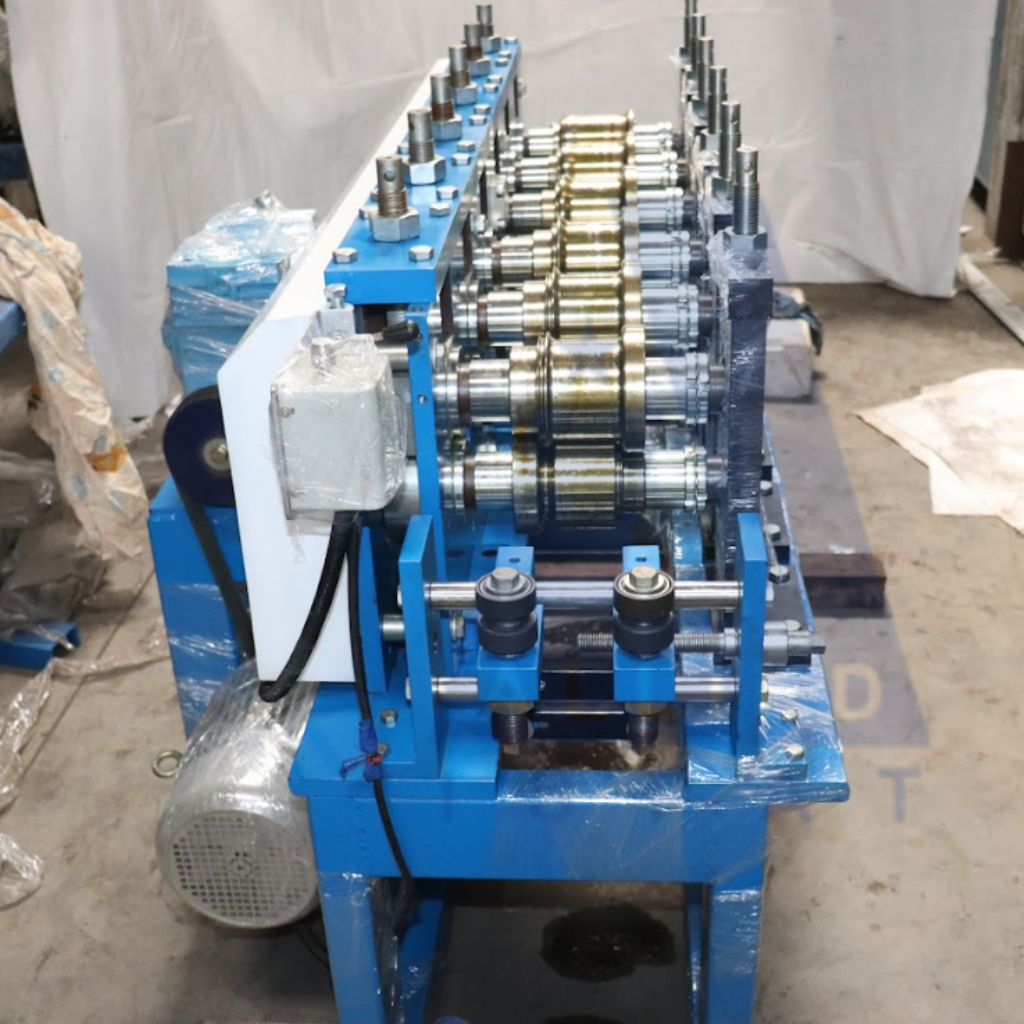
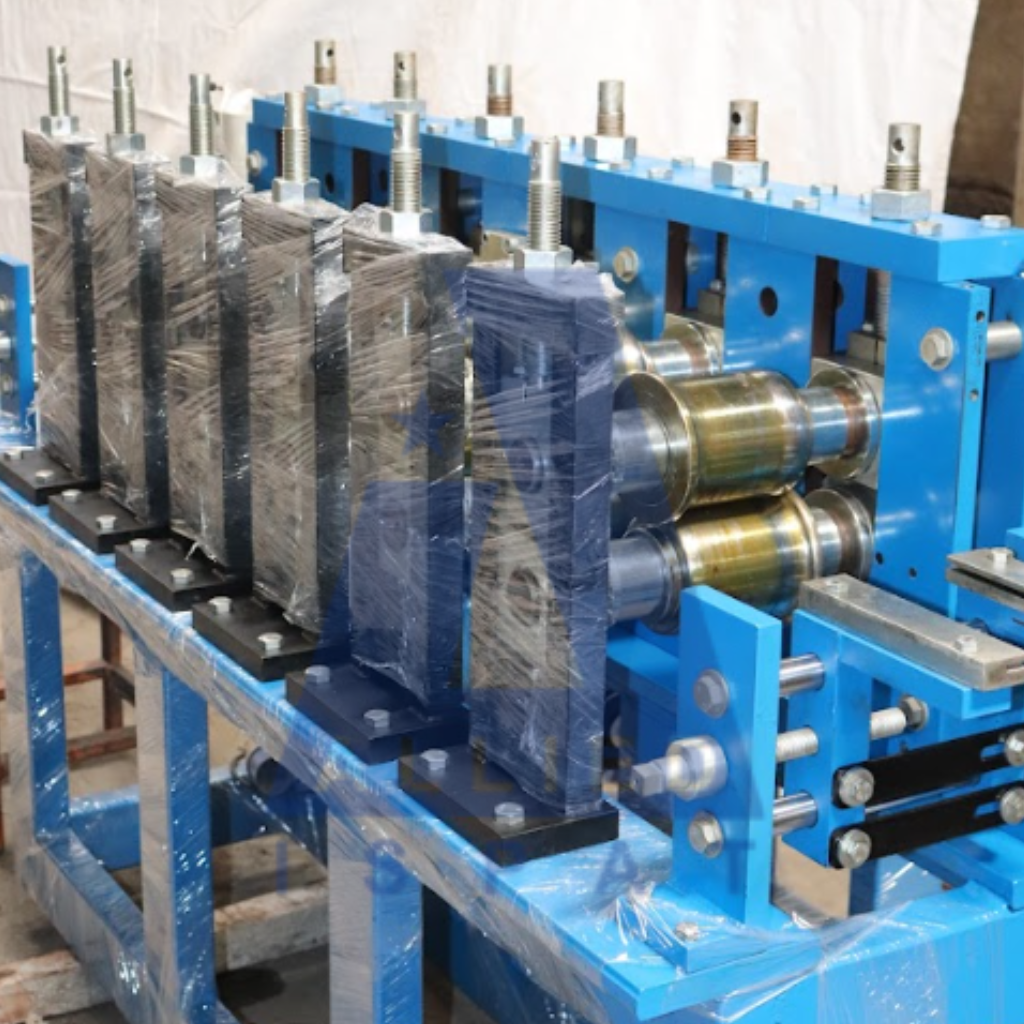
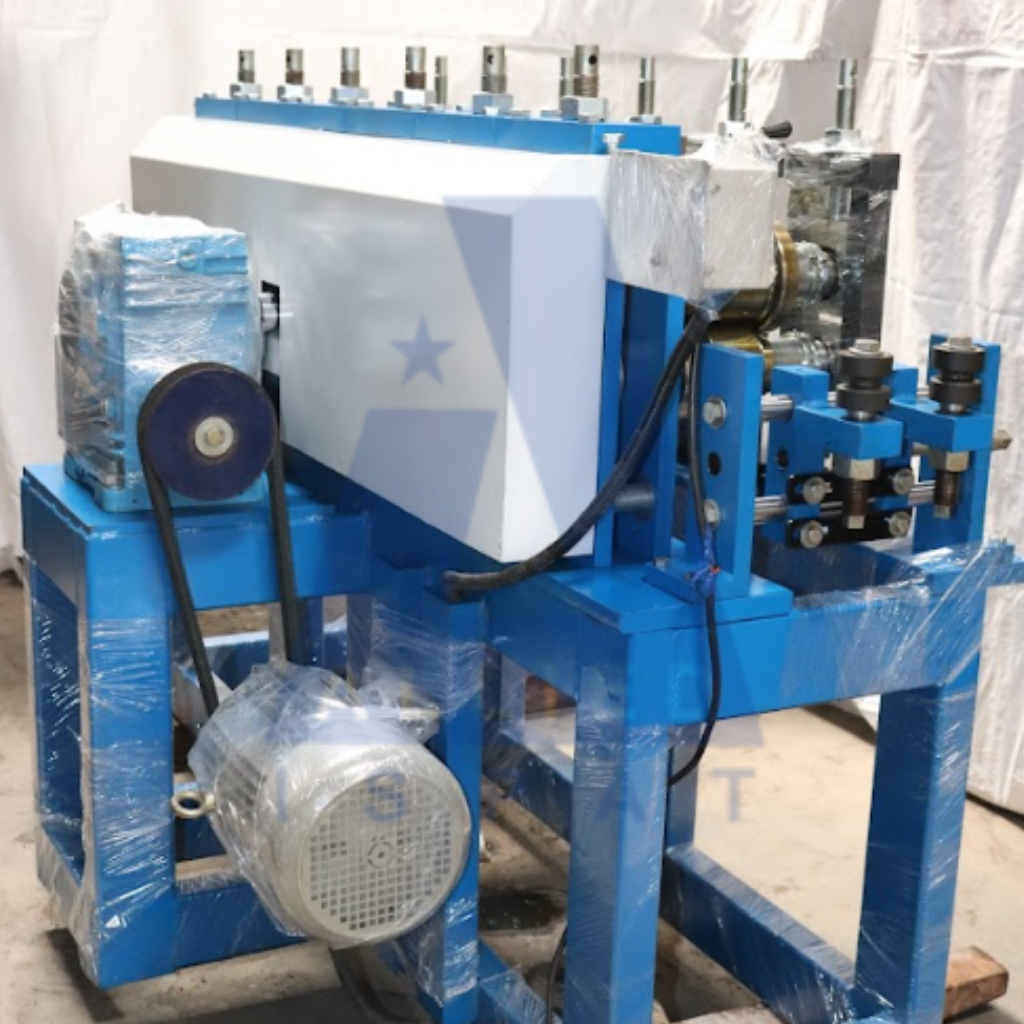
An industrial roll forming machine continuously converts flat sheet metal or coil into a profile with a predetermined cross-sectional shape. Instead of creating the entire form through one bending operation, the material passes through several forming stations. Each station progressively changes the strip until the required profile geometry is achieved.
The process normally begins by feeding metal strip into the machine. The material enters a series of paired forming rolls designed around the required profile. As it travels through consecutive stations, progressive deformation creates bends, channels, flanges, ribs or other section features before the finished profile is cut to the required length.
This progressive process distinguishes a steel roll forming machine from equipment such as a press brake. Press brakes typically create individual bends through separate operations, while roll forming is designed around continuous material movement and sequential shaping. A profile roll forming machine is therefore particularly relevant for manufacturers producing recurring sections, long profiles and larger production quantities.
Machine architecture depends on the intended product. Specifications may vary depending on the required profile, material thickness, production speed and machine configuration.
Inside the Process: How a Roll Forming Machine Creates Consistent Steel Profiles
The principle behind roll forming is controlled, gradual deformation. Rather than forcing the complete profile into shape in one operation, the machine distributes forming across multiple stations. Successful production therefore depends on coordinated feeding, alignment, roller geometry, forming sequence and cutting.
Accurate Feeding Sets the Foundation
Sheet metal enters the machine as coil or prepared strip. Consistent feeding establishes the starting condition for the entire forming process because irregular material movement can affect alignment at later stations.
A correctly engineered feeding arrangement helps guide the material smoothly into the forming section and reduces unnecessary operator correction.
Controlled Alignment Keeps the Strip on Track
Before substantial forming begins, the strip needs to enter the rollers at the correct position. Guiding arrangements establish a controlled path between the incoming material and forming tooling.
Even precisely manufactured rollers cannot consistently create the intended section if the material enters incorrectly. Reliable guiding therefore contributes to dimensional repeatability.
Progressive Forming Builds the Profile Step by Step
The roller stations form the core of a sheet metal roll forming machine. Each station performs a controlled portion of the total deformation required to create the finished section.
Instead of concentrating the bending force at one point, progressive forming distributes it across consecutive stages. Well-designed roll passes can help control profile development and reduce unwanted distortion during continuous production.
Final Calibration Refines Profile Accuracy
Later forming stations refine dimensions established earlier in the process. Depending on the product, this may include controlling flange angles, channel dimensions, sectional alignment or other profile characteristics.
Accurate calibration becomes particularly important when the finished profiles must fit with other components during fabrication or installation.
Integrated Cutting Converts Continuous Profiles into Production-Ready Lengths
After forming, the profile needs to be cut to the specified length. Allied Ispat Pvt. Ltd. offers fully automatic configurations incorporating hydraulic cutting technology, allowing this operation to become part of the production workflow.
Proper coordination between forming and cutting supports repeatable lengths while reducing the need for separate downstream cutting operations.
Finished Profiles Move to Inspection and Further Processing
After cutting, profiles can proceed to inspection, collection, packaging or subsequent manufacturing operations. Handling arrangements depend on section geometry, profile length and factory requirements.
This continuous workflow demonstrates a fundamental advantage of roll forming: material progresses from flat strip to finished profile through a controlled sequence rather than being repeatedly repositioned for individual bending operations.
Why Industrial Manufacturers Are Choosing Continuous Roll Forming Technology
Manufacturers need production systems capable of combining repeatability with scalable output. Roll forming supports this requirement by moving material continuously through consecutive forming operations instead of relying entirely on separate manual fabrication stages.
Once tooling and operating settings have been established for a profile, the same section can be manufactured repeatedly using a controlled forming sequence. This makes roll forming equipment particularly valuable for standardized steel profile manufacturing.
Automation further extends this capability. Feeding, forming, controls and cutting can operate as parts of an integrated production line. PLC-based systems can support repeatable settings and reduce routine manual intervention during established production runs.
These characteristics make Industrial Roll Forming Machines relevant to construction products, steel framing, rolling shutters, engineered profiles and other applications requiring recurring metal sections.
Engineered for Production: Key Features of Allied Ispat Pvt. Ltd. Roll Forming Machines
A productive roll forming line depends on how effectively its mechanical structure, tooling, controls and cutting systems work together. Allied Ispat Pvt. Ltd. develops machines around these interconnected requirements, with an emphasis on precision, durability and application-specific configurations.
Built Strong for Continuous Industrial Production
A roll forming machine must maintain the relationship between multiple forming stations while material continuously travels through them. A heavy-duty machine structure provides a stable platform for shafts, rollers and other operating components.
Structural rigidity can help control unwanted movement and vibration while supporting consistent tooling alignment. Allied Ispat Pvt. Ltd. uses heavy-duty construction to provide the mechanical foundation required for repetitive industrial profile manufacturing.
Precision Roll Tooling for Consistent Profile Geometry
The rollers determine how metal changes shape at every stage. Their geometry, alignment and relationship with subsequent stations influence dimensional consistency and finished profile quality.
Precision tooling helps create a controlled forming path and repeatable profile geometry. Allied Ispat Pvt. Ltd., as a Roll Forming Machine Manufacturer in India, emphasizes precision-engineered tooling as an important part of dependable profile manufacturing.
Automation That Supports Productive Manufacturing
A fully automatic roll forming machine can coordinate repetitive production functions and reduce unnecessary operator intervention once the process has been correctly established.
Operators remain important for setup, supervision, inspection, maintenance and material management. Automation instead allows them to spend less time on repetitive tasks and more time controlling overall production.
PLC Controls for Smarter Process Management
PLC-based control systems help coordinate production settings and machine operations. Depending on the configuration, they can support functions such as length settings, production control and coordination between different stages of the line.
The value of PLC technology lies in repeatability and process management rather than automation simply for its own sake.
Hydraulic Cutting for Accurate Finished Lengths
A well-formed profile also needs accurate cutting. Hydraulic cutting technology can integrate profile separation into the production workflow and help manufacturers achieve repeatable finished lengths.
This integration can reduce additional material movement between forming and separate cutting operations.
Smooth Forming for Better Surface Protection
Surface quality becomes especially important when processing coated, pre-painted or decorative materials. Tooling geometry and controlled material contact can help minimize unnecessary marking during forming.
Allied Ispat Pvt. Ltd. emphasizes smooth, scratch-free output as part of its precision roll forming approach.
Durable Engineering Designed Around Reliable Production
Unexpected interruptions affect labour planning, production scheduling and downstream processes. Durable machine construction and practical maintenance requirements can help manufacturers establish a more predictable production environment.
Preventive maintenance remains necessary, but machines engineered for industrial operation can simplify routine production management.
Customized Machines Built Around Your Profile Requirements
Not every manufacturer needs the same profile, tooling or automation configuration. Channel geometry, flange dimensions, strip width, cut length and application requirements can differ substantially.
Allied Ispat Pvt. Ltd. can customize machine configurations, rollers, strip feeders and forming stations according to required profile shapes, sizes and industrial applications. This approach is particularly relevant for OEMs and specialized profile manufacturers.
Specifications may vary depending on the required profile, material thickness, production speed and machine configuration.
Automatic vs Conventional Roll Forming Machines: Which One Fits Your Production?
The most automated machine is not automatically the most appropriate machine. Selection should depend on production volume, product variety, operator involvement and process-control requirements.
Lower-automation configurations may suit manufacturers with moderate production quantities or operational requirements that do not justify extensive automation. Automatic roll forming machines become increasingly relevant where repetitive production, consistent cut lengths and coordinated process control are priorities.
PLC controls and integrated cutting can improve workflow, but buyers should evaluate whether those features create practical value within their factory.
A professional Roll Forming Machine Supplier in India should therefore understand the customer’s production requirement before recommending an automation configuration.
Industrial Applications of Roll Forming Machines Across Key Sectors
The adaptability of roll forming comes largely from tooling design. Machines can be configured around different profile geometries, making the process relevant across construction, fabrication and industrial manufacturing.
Building Stronger Profiles for Construction and Infrastructure
Construction applications use repeatable steel sections such as framing profiles, channels, support sections and roofing-related profiles. Roll forming supports the production of long sections with controlled geometry for recurring installation requirements.
Precision Components for Rolling Shutter Manufacturing
Rolling shutter systems rely on compatible metal components working together during operation. Roll forming technology can manufacture recurring shutter-related profiles and sections with controlled geometry.
Allied Ispat Pvt. Ltd.’s experience in rolling shutter components also provides practical manufacturing knowledge of steel-profile applications.
Consistent Sections for False Ceilings and Drywall Systems
False ceiling and drywall systems require lightweight metal profiles such as studs, tracks and channels. Consistent dimensions are important because multiple sections must align correctly during installation.
A steel profile forming machine configured for these products can support continuous and repeatable section manufacturing.
Profile Solutions for Warehouses and Industrial Buildings
Industrial buildings use formed profiles across access systems, partitions, roofing and supporting applications. Continuous production is particularly relevant where standardized sections are required repeatedly across projects.
Engineered Profiles for Automotive and Transportation Applications
Roll forming can also support suitable long and repetitive sections for transportation-related manufacturing. The feasibility of individual components depends on profile geometry, material characteristics, tolerance requirements and production quantities.
Custom Channels for Electrical and Engineering Applications
Roll forming can manufacture channels and other repetitive metal profiles used in suitable electrical and engineering applications. Tooling can be developed around the required cross section for recurring production.
Efficient Long-Profile Production for Metal Fabricators
Fabricators repeatedly producing the same elongated sections may benefit from moving away from multiple individual bending operations toward a dedicated roll forming line. The process can provide a structured route to standardized production at larger quantities.
Precision, Productivity and Consistency: Key Benefits of Industrial Roll Forming Machines
The strongest advantage of roll forming is not a single feature. Its manufacturing value comes from combining continuous material movement, progressive forming, repeatability and automation within one coordinated process.
Higher Output Through Continuous Processing
Roll forming brings consecutive shaping operations into one material path. Once production is stable, recurring sections can be manufactured without separately positioning the workpiece for each bend.
Repeatable Geometry from Profile to Profile
Every forming station performs a controlled portion of the total profile transformation. Proper tooling and alignment allow this sequence to be repeated consistently across production runs.
Less Material Movement Across the Shop Floor
Instead of moving workpieces repeatedly between separate bending operations, roll forming integrates multiple forming stages into one production line. This can simplify workflow for repetitive profiles.
Designed for Recurring High-Volume Requirements
Once tooling and machine settings have been developed, the same cross-sectional profile can be manufactured repeatedly. This is a major reason companies evaluate Industrial Roll Forming Machines in India for standardized steel profile production.
Better Control of Finished Surfaces
Precision tooling and controlled contact can help protect coated and decorative surfaces during forming. Tool condition, cleanliness and correct machine setup remain equally important.
Reduced Dependence on Repetitive Manual Forming
Automation can reduce repeated positioning, measuring and forming activities. Skilled operators can focus more attention on setup, inspection and process monitoring.
Greater Process Consistency Across Production Runs
Integrating multiple forming stages into a controlled sequence helps reduce the variability associated with repeated independent fabrication operations.
A Practical Route to Scalable Profile Manufacturing
As recurring order quantities increase, batch-forming methods may become harder to scale efficiently. A dedicated roll forming production line can provide a structured path toward larger manufacturing volumes.
Better Material Control Can Help Reduce Avoidable Waste
Consistent forming and cutting can support more systematic material use. Actual scrap levels still depend on coil planning, setup, cut lengths, profile geometry and operating practices.
Productivity That Should Be Measured Over the Machine’s Working Life
Machine value extends beyond initial production speed. Tooling quality, reliability, repeatability, maintenance, operator usability and technical support all influence long-term productivity.
How Automation Improves Roll Forming Efficiency and Control
Automation creates the most value when it solves a genuine manufacturing requirement. PLC controls, automated feeding and integrated cutting can help coordinate repetitive functions and provide more consistent process management.
A fully automatic metal roll forming machine can be particularly relevant for manufacturers producing recurring profiles in larger quantities. Operators still remain responsible for setup verification, material loading, quality inspection, monitoring and maintenance.
Companies evaluating Industrial Roll Forming Machines should therefore ask a practical question: what measurable production problem does each automation feature solve?
Allied Ispat Pvt. Ltd. can develop machine configurations around the required automation level rather than applying the same system to every manufacturing application.
Allied Ispat Pvt. Ltd. – Custom Roll Forming Solutions for Specialized Profiles
Industrial manufacturers often require sections with unique bends, flanges, ribs, widths or dimensional characteristics. Such profiles may require dedicated tooling and a machine configuration developed specifically around the finished product.
Engineering discussions should therefore begin with the profile drawing. Material type, thickness, strip dimensions, production requirement, cut length and automation expectations can then be evaluated together.
Allied Ispat Pvt. Ltd. develops customized machine configurations and can adapt rollers, strip feeders and forming stations to required profile shapes, sizes and applications.
For an OEM selecting a Roll Forming Machine Supplier in India, this engineering dialogue is particularly important. The supplier must understand the finished product before determining the correct forming sequence and machine configuration.
Specifications may vary depending on the required profile, material thickness, production speed and machine configuration.
Roll Forming Solutions for Scalable and Consistent Profile Manufacturing
High-volume manufacturing is not simply about operating a machine faster. Usable production depends on maintaining quality and repeatability as quantities increase.
Roll forming supports scalability by producing the profile through the same continuous sequence. Once the line is correctly configured, recurring batches can follow a standardized forming process.
Automation can coordinate routine operations, while precision tooling helps maintain repeatable geometry. For manufacturers with stable demand for recurring profiles, these characteristics can create a more scalable production system.
What Industrial Buyers Should Check in a Roll Forming Machine
Industrial machinery procurement should start with the component that needs to be manufactured rather than a generic machine catalogue. Buyers should assess profile geometry, material grade and thickness, strip width, production volume, required production speed, forming complexity, cutting requirements and appropriate automation.
Machine rigidity and tooling accuracy should receive equal attention because they influence forming stability and profile consistency. Maintenance requirements, spare parts availability and operator training also affect long-term usability.
Installation assistance and technical support should be clarified before the purchase. These factors become particularly important for customized machinery where the machine, tooling and finished product are closely connected.
How the Right Roll Forming Machine Manufacturer Supports Better Production
Machinery becomes part of a factory’s production capability for years, so purchase price alone provides an incomplete basis for comparison. Engineering knowledge, tooling development, structural design, customization capability and technical support can have a much greater influence on long-term manufacturing value.
A capable Roll Forming Machine Manufacturer in India should first understand what the customer needs to manufacture. Profile geometry, material characteristics, expected output and automation requirements can then guide equipment development.
Companies searching for a Roll Forming Machine Manufacturer in Mumbai should similarly evaluate engineering capability rather than geography alone. Regional accessibility can be useful, but machine construction, tooling quality, customization and technical support should remain the primary considerations.
Allied Ispat Pvt. Ltd.: Engineering Roll Forming Solutions Around Real Production Needs
Allied Ispat Pvt. Ltd., part of the Malik Group of Companies, combines steel-processing experience with the development of cold roll forming machinery. Its approach focuses on machine stability, precision tooling, industrial construction, automation and customization for different profile requirements.
As a Roll Forming Machine Manufacturer in India, Allied Ispat Pvt. Ltd. develops equipment for businesses requiring consistent steel profile manufacturing. Instead of assuming every customer needs the same configuration, machinery can be developed according to required profile shapes, strip dimensions and applications.
Heavy-duty construction provides a stable machine platform, while precision tooling progressively creates the required profile. Fully automatic options with PLC-based controls and hydraulic cutting can support manufacturers requiring a more integrated production workflow.
Allied Ispat Pvt. Ltd. also supports machine implementation through installation assistance, operator training and technical support. These services matter because reliable production depends on correct equipment setup, operation and maintenance as well as machine engineering.
Why Manufacturers Choose Allied Ispat Pvt. Ltd. for Roll Forming Solutions
Practical Engineering Experience
Roll forming combines mechanical engineering, tooling, material behaviour, controls and production planning. Allied Ispat Pvt. Ltd.’s broader steel manufacturing experience provides practical context when developing machinery for industrial profile production.
Machines Developed Around Customer Profiles
Allied Ispat Pvt. Ltd. can customize machine configurations, rollers, strip feeders and forming stations according to the required profile and application.
Precision-Focused Manufacturing
Accurate tooling helps establish a controlled forming sequence from one roller station to the next, supporting repeatable finished sections.
Heavy-Duty Construction for Industrial Use
Machine structure supports the shafts, rollers and tooling responsible for profile formation. Structural stability therefore contributes directly to consistent operating conditions.
Automation Matched to Production Requirements
Fully automatic configurations can incorporate PLC controls and hydraulic cutting. The appropriate automation level can be evaluated according to the manufacturer’s actual production requirements.
Quality-Focused Machine Development
Inspection and machine testing are important stages in preparing roll forming equipment for its intended application and helping verify the relationship between mechanical systems and tooling.
Installation Assistance for a Smoother Production Start
Correct installation establishes the foundation for machine alignment and operation. Allied Ispat Pvt. Ltd. provides installation support for its roll forming machine customers.
Operator Training for Confident Machine Operation
Automated machinery still depends on knowledgeable operators. Training helps production personnel understand machine controls, routine procedures and appropriate operating practices.
Technical Support Beyond Machine Delivery
Machinery requirements do not end when equipment reaches the factory. Allied Ispat Pvt. Ltd. provides technical support to help customers address machine-related requirements after installation.
Together, these capabilities position Allied Ispat Pvt. Ltd. as a Roll Forming Machine Supplier in India focused on both equipment and its practical implementation.
Engineering Custom Roll Forming Machines for Specific Profile Requirements
A customized roll forming machine project starts with understanding the finished profile. The drawing communicates the section shape and dimensions that the forming sequence needs to produce.
Material type, thickness, strip dimensions, production expectations and automation requirements can then be reviewed to establish an appropriate machine and tooling concept.
Rollers and forming stations are developed around the intended section, while feeding, machine structure, controls and cutting need to operate as parts of the same production system.
After machine fabrication and testing, installation and operator familiarization help move the equipment into production. Because every customized requirement is different, final configurations should always be discussed directly with Allied Ispat Pvt. Ltd.
Why Consistent Output Matters More Than Maximum Machine Speed
A machine’s maximum speed may appear to be the simplest productivity benchmark, but factory performance depends on usable output.
High operating speed provides limited value if profiles require frequent correction, production stops repeatedly or quality varies between batches. Buyers should therefore consider profile accuracy, repeatability, downtime, scrap, operator involvement, maintenance and final product quality alongside speed.
This becomes especially important when assessing Industrial Roll Forming Machines as a long-term manufacturing investment. The goal should be consistent usable output rather than maximum theoretical speed alone.
Industrial Roll Forming Machines: A Smart Investment for Growing Manufacturers
Dedicated roll forming machinery makes the strongest commercial sense when a manufacturer needs recurring metal profiles in sufficient quantities to benefit from continuous production.
Growing fabricators may consider the technology when repeated manual bending and material handling begin to restrict capacity. Rolling shutter manufacturers, drywall profile producers, construction component businesses, steel processors and OEM manufacturers may also benefit when profile geometry remains consistent across substantial production quantities.
The decision should consider production volume, profile repeatability, labour requirements, existing fabrication processes, expected machine utilization and future demand.
An experienced Roll Forming Machine Supplier in India can help convert these manufacturing requirements into an appropriate machine configuration.
Allied Ispat Pvt. Ltd.: Customized Roll Forming Machines for Industrial Production
Successful custom machinery procurement begins with understanding the product rather than simply selecting machine features. Profile geometry, material characteristics, production goals and automation requirements all need to be considered together.
As a Roll Forming Machine Supplier in India, Allied Ispat Pvt. Ltd. can customize rollers, feeders, forming stations and machine configurations according to specific industrial requirements.
This approach is particularly valuable because even similar-looking profiles may require different tooling or forming sequences. Businesses seeking a Roll Forming Machine Manufacturer in Mumbai can discuss their required sections directly with Allied Ispat Pvt. Ltd. before finalizing the machine configuration.
Allied Ispat Pvt. Ltd.: Complete Solutions for Steel Processing and Manufacturing
Allied Ispat Pvt. Ltd. offers a wider steel product portfolio beyond roll forming machinery, supporting construction, fabrication and industrial manufacturing requirements.
Rolling Shutter Parts
As a Rolling Shutter Parts Manufacturer in India, Allied Ispat Pvt. Ltd. supplies guide channels, bottom sections and other rolling shutter components designed for industrial and commercial shutter systems.
POP, False Ceiling and Drywall Sections
Allied Ispat Pvt. Ltd., a POP Parts Manufacturer in India, manufactures false ceiling sections, drywall partition sections, studs, tracks and channels for interior framing and construction applications.
Trading Coils and Steel Sheets
Allied Ispat Pvt. Ltd. supplies Trading Coils in Manufacturer India, including GI, CR, HR and coated steel coils and sheets for roll forming, fabrication and steel profile manufacturing.
Together, these products strengthen Allied Ispat Pvt. Ltd.’s presence across the steel-processing and construction materials industry.
Industrial Roll Forming Machines in India: Building a Scalable Future for Steel Profile Manufacturing
Scalable manufacturing requires output to increase without allowing process variability and material handling complexity to rise at the same pace. Continuous roll forming provides a structured production method for recurring cross-sectional profiles.
Once a line has been developed around a particular section, repeated production can follow the same forming sequence. Automation can coordinate routine functions while integrated cutting reduces separate downstream operations.
The objective is not maximum automation for every factory. The right solution is a machine configuration that matches production volume, profile requirements, workforce structure and future growth plans.
Frequently Asked Questions
1. What is a roll forming machine?
A roll forming machine converts metal strip or coil into a continuous profile through a sequence of shaped rollers. Each station progressively changes the section until the required geometry is achieved, after which the profile can be cut to length.
2. How does a roll forming machine work?
Metal strip is fed and guided through consecutive roller stations. Each station performs part of the required deformation, gradually creating the final profile before cutting. This progressive process makes roll forming suitable for repetitive production of long metal sections.
3. Which industries use roll forming machines?
Roll forming machinery is used for suitable applications across construction products, steel framing, rolling shutters, roofing-related products, metal fabrication, industrial building systems and other sectors requiring repeatable profiles.
4. What are the advantages of an automatic roll forming machine?
Automatic systems can coordinate repetitive production functions, process controls and cutting. For appropriate production requirements, PLC controls and integrated hydraulic cutting can improve workflow, repeatability and routine process management.
5. Can Allied Ispat Pvt. Ltd. customize a roll forming machine for my profile?
Yes. Allied Ispat Pvt. Ltd. can customize machine configurations, rollers, feeders and forming stations according to required profile shapes, sizes and industrial applications. Final specifications depend on the customer’s profile and production requirements.
6. What materials can be processed on a roll forming machine?
Suitable galvanized steel, cold-rolled steel, coated steel, pre-painted steel and other sheet metals can be used for roll forming applications. Actual compatibility depends on material characteristics, thickness, tooling and machine configuration.
7. How should I choose a Roll Forming Machine Manufacturer in India?
Evaluate engineering expertise, tooling capability, customization, machine rigidity, automation options, installation assistance and technical support. Allied Ispat Pvt. Ltd. combines roll forming machine engineering with practical experience in steel processing and profile manufacturing.
8. What determines the cost of a roll forming machine?
Machine cost can vary according to profile complexity, tooling requirements, automation, feeding arrangement, cutting technology and overall configuration. Providing a profile drawing and production requirement allows Allied Ispat Pvt. Ltd. to evaluate the requirement more accurately.
9. Is Allied Ispat Pvt. Ltd. a Roll Forming Machine Supplier in India for customized machines?
Yes. Allied Ispat Pvt. Ltd. develops customized roll forming solutions and can adapt rollers, feeders, forming stations and overall machine configurations to the required profile and industrial application.
10. Does Allied Ispat Pvt. Ltd. provide installation and operator training?
Allied Ispat Pvt. Ltd. provides installation assistance, operator training and technical support for its roll forming machines. This helps production teams understand the machine and establish appropriate operating practices after installation.
Advance Steel Profile Manufacturing with Allied Ispat Pvt. Ltd.
Successful roll forming depends on more than producing profiles quickly. Machine rigidity, precision tooling, controlled forming, automation and accurate cutting need to work together to deliver consistent and usable production.
For manufacturers evaluating Industrial Roll Forming Machines, the investment should begin with the required finished product. Profile geometry, material characteristics, output requirements, automation, maintenance and technical support should all be considered before selecting a machine.
Allied Ispat Pvt. Ltd. combines heavy-duty machine engineering, precision tooling, customized configurations and automated options for industrial profile manufacturing. Businesses searching for a dependable Roll Forming Machine Manufacturer in India, an engineering-focused Roll Forming Machine Manufacturer in Mumbai, or a customized Roll Forming Machine Supplier in India can discuss their specific manufacturing requirements with Allied Ispat Pvt. Ltd.
Manufacturers planning to automate profile production, increase capacity or develop specialized steel sections can connect with Allied Ispat Pvt. Ltd. to discuss profile drawings, material requirements and suitable roll forming machine configurations.
Allied Ispat Mumbai Central
Address: Shop 69, Maulana Shaukat Ali Road, Chhota Sonapur, Siddharth Nagar, Mumbai Central, Mumbai, Maharashtra 400008
Phone: 098211 77009
Get Directions: https://maps.app.goo.gl/gyEqxBGcw9jLsYm26
Allied Ispat Works:
Plot no. C-17 9, MIDC Road behind Bank of Baroda Bank Taloja Panvel, Maharashtra 410208 India
Get Directions: https://maps.app.goo.gl/6ujLCuHpQLu1Uy3r8
Phone: 087790 51606
Email: info@alliedispatindia.com | sales@alliedispatindia.com
Website: www.alliedispatindia.com