

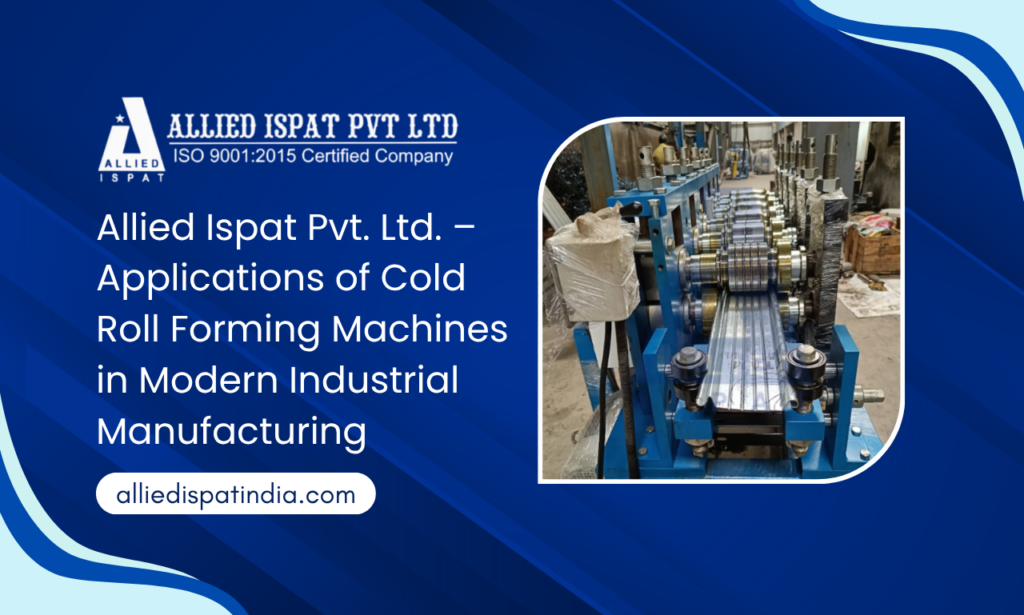
Introduction: Modern Manufacturing Starts with Precision-Formed Steel
Modern industrial manufacturing demands more than simply producing metal components at scale. Manufacturers today need repeatable dimensions, accurate profile geometry, efficient material utilization, reliable production cycles and the flexibility to manufacture sections for different applications. Whether the finished product is a rolling shutter profile, false ceiling section, construction channel or customized industrial component, consistency begins with the manufacturing process.
This is where the Cold Roll Forming Machine plays an important role. Cold roll forming is a continuous sheet metal forming process in which metal strip or coil passes through a carefully engineered sequence of forming rolls. Instead of forcing the material into its final shape in a single operation, each station progressively develops the required profile. The result is an efficient approach to steel profile manufacturing, particularly when repetitive sections are required in commercial quantities.
For industrial buyers looking for a dependable Roll Forming Machine Manufacturer in India, machine selection is about much more than production speed. Tooling accuracy, machine rigidity, material compatibility, surface protection, cutting systems, automation and customization capabilities all influence production performance.
This is where Allied Ispat Pvt. Ltd., a division of the Malik Group of Companies, brings practical manufacturing knowledge to the conversation. The company manufactures roll forming machinery while also working across rolling shutter parts, false ceiling and drywall profiles, and steel coils. This wider steel-processing background helps Allied Ispat understand roll forming not only from the machinery perspective but also from the requirements of the finished profile.
As a Roll Forming Machine Manufacturer in Mumbai, Allied Ispat Pvt. Ltd. focuses on machines designed around precision tooling, robust construction, automation options and customized profile requirements.
Let us explore how this technology supports today’s industrial manufacturing landscape.
What Is a Cold Roll Forming Machine and How Does the Process Work?
A Cold Roll Forming Machine continuously forms sheet or strip metal into a defined cross-sectional profile using a series of roller dies. The term “cold” refers to forming the material without intentionally heating it to the temperatures associated with hot-forming processes.
Unlike processes in which a profile is created through a single major deformation, roll forming distributes the required shape change across multiple stations. This progressive approach makes the technology particularly suitable for repetitive production of long sections with consistent cross-sectional geometry.
Understanding the Continuous Roll Forming Process
A roll forming production line typically begins with flat strip or coil stock. The material enters the machine and passes through successive pairs of contoured rolls.
The first stations normally introduce relatively small bends. Subsequent stations continue developing the profile until the metal reaches the intended geometry. Depending on the product and production line, cutting and other operations may be integrated before or after forming.
This progressive sequence is central to precision roll forming. Tooling engineers must consider the material, thickness, profile complexity, bend locations and final dimensional requirements when developing the forming sequence.
From Coil Feeding to the Finished Profile
Although actual machine layouts vary considerably, a typical production sequence may include:
- Material feeding: Coil or strip material enters the production line.
- Guiding: The incoming strip is positioned so that it enters the forming stations correctly.
- Progressive forming: Multiple roll stations gradually develop the required profile.
- Profile control: Alignment and tooling help maintain the intended section geometry.
- Cutting: The continuous profile is cut according to the required finished length.
- Collection: Finished sections move to the next stage of handling, inspection, packaging or fabrication.
Additional operations such as punching, embossing or specialized cutting may be integrated into some production lines where the product and machine design require them.
Why Multiple Forming Stations Matter
Attempting to create a complicated section through one severe forming operation can introduce unnecessary stress, dimensional problems or surface issues. Progressive forming distributes the deformation.
Each roller station performs part of the work. The number, geometry and arrangement of stations therefore need to match the profile being manufactured.
This is why developing custom roll forming equipment involves more than increasing or reducing the number of rollers. The entire forming sequence must be considered as a coordinated system.
Cold Roll Forming vs Other Sheet-Metal Forming Methods
Roll forming, press braking, stamping and extrusion serve different manufacturing requirements.
Press braking is highly useful for producing bends in individual sheets or plates and can offer considerable flexibility for shorter production runs. Stamping is well suited to parts manufactured using dedicated dies, particularly when the component requires localized forming, blanking or piercing. Extrusion, meanwhile, creates profiles by forcing suitable material through a die and operates on a fundamentally different forming principle.
Continuous roll forming becomes particularly attractive when a manufacturer repeatedly requires long profiles with a substantially consistent cross-section.
The correct process therefore depends on part geometry, material, required quantity, tolerances, tooling economics, length and downstream manufacturing requirements. Roll forming should be selected because it suits the product and production strategy—not simply because it is automated.
Why Cold Roll Forming Has Become Important in Modern Industrial Manufacturing
Manufacturers are under pressure to produce more consistently while maintaining control over material, labor, quality and production schedules. A properly configured Cold Roll Forming Machine can address several of these requirements when the product is suited to continuous forming.
Repeatability Across Long Production Runs
A major advantage of roll forming is the ability to reproduce the same cross-sectional profile continuously.
This matters because small dimensional variations can create larger problems downstream. Profiles may need to fit with boards, brackets, panels, fasteners, mating sections or other components. In such applications, repeatable geometry supports easier assembly and more predictable fabrication.
Continuous Production for Higher Manufacturing Efficiency
Roll forming operates as a continuous process. Once the material, tooling and machine parameters are correctly established, strip can move through sequential forming stations rather than requiring separate handling for every bend.
For high-volume or repetitive metal profile manufacturing, this can create a more organized production flow.
Actual productivity, however, depends on machine design, profile complexity, material properties, line speed, cutting requirements, handling and operator practices. Buyers should therefore evaluate production requirements based on the specific profile rather than relying on generic speed claims.
Material Utilization and Process Planning
Efficient manufacturing is not only about machine speed. Material utilization also affects production economics.
When profile geometry, incoming strip width and tooling are engineered appropriately, manufacturers can plan the material around the required finished section. Coil-fed production can also support continuous material handling and reduce some of the intermediate handling associated with individual blanks.
Good material planning begins before the machine runs. Strip width, edge conditions, material thickness and the developed profile all need to be considered during process design.
Automation and Production Control
Modern roll forming machine automation can combine mechanical forming with electronic controls, feeding arrangements and cutting systems.
PLC-based controls can help coordinate production functions, while servo-based systems may be used in appropriate machine architectures for controlled positioning or related operations. Hydraulic cutting is another commonly used arrangement for cutting profiles to specified lengths.
Allied Ispat Pvt. Ltd. states that its fully automatic models incorporate PLC-based systems and hydraulic cutters, while its machines can also be customized around profile shape, size, roller requirements, strip feeding and forming stations.
Supporting Standard and Custom Profiles
Not every manufacturer needs the same profile.
One business may repeatedly manufacture standardized channels, while another needs an application-specific section for an OEM product. Roll forming technology can accommodate both approaches when the machine and tooling are designed accordingly.
This customization capability is particularly relevant when selecting a Roll Forming Machine Manufacturer in India, because the discussion should begin with the intended profile rather than with a standard machine catalogue alone.
Where Cold Roll Forming Machines Power Modern Industry
The versatility of the Cold Roll Forming Machine comes from its ability to continuously produce profiles with defined cross-sectional geometry.
From construction materials to industrial components, roll forming equipment supports a wide range of manufacturing environments.
1. Rolling Shutters: Where Profile Accuracy Directly Supports Performance
Rolling shutter manufacturing is closely connected with roll forming technology because shutter systems depend on accurately produced metal sections and supporting components.
Depending on the product design, roll forming machinery can support the production of suitable shutter profiles and related sections where manufacturers need:
- Consistent geometry
- Profile straightness
- Dimensional accuracy
- Batch-to-batch repeatability
- Controlled surface condition
- Efficient production
Allied Ispat Pvt. Ltd. brings direct experience from this sector through its rolling shutter parts manufacturing activities.
The company’s product portfolio includes guide channels, bottom sections, brackets, springs, coils, fittings and related rolling shutter components. This manufacturing exposure helps Allied Ispat understand how component accuracy influences subsequent fabrication and assembly.
For rolling shutter manufacturers seeking a Roll Forming Machine Manufacturer in Mumbai, this connection between machinery knowledge and actual shutter-component manufacturing can be particularly relevant.
2. False Ceilings and Drywall: Precision Behind Every Clean Installation
False ceiling and drywall framing systems rely on lightweight metal sections that must align during installation.
Typical profiles include:
- Ceiling sections
- Intermediate sections
- Perimeter channels
- Angles
- C-studs
- Floor channels
These profiles may look straightforward, but dimensional consistency can influence board fixing, alignment and installation efficiency.
Roll forming provides an effective manufacturing method for producing these repetitive GI profiles.
Allied Ispat Pvt. Ltd. already operates in this product category through its false ceiling and drywall profile range. This gives the company practical familiarity with the production requirements of lightweight galvanized sections.
For manufacturers planning GI profile manufacturing, Allied Ispat’s combination of product experience and machinery capability can support conversations around material thickness, profile dimensions, roll design and finished-section requirements.
3. Construction Profiles: Shaping the Sections Behind Modern Buildings
Construction and infrastructure use a wide variety of metal channels, sections and framing profiles.
Depending on engineering requirements, steel roll forming machines can manufacture:
- Channels
- Framing sections
- Supporting profiles
- Cladding-related sections
- Lightweight steel profiles
- Application-specific building sections
Roll forming becomes especially useful when large quantities of a defined profile are required.
However, not every roll-formed section should automatically be considered structural. Structural suitability depends on material grade, thickness, section design, connections, loading and engineering validation.
A technically capable Roll Forming Machine Supplier in India should therefore understand the intended application before recommending a machine configuration.
Allied Ispat Pvt. Ltd. works with customers to develop machinery around required profile shapes and strip sizes rather than approaching every application with the same machine design.
4. Roofing and Cladding: Continuous Profiles with Controlled Surface Quality
Roofing and cladding manufacturing represents one of the clearest examples of continuous sheet-metal profile production.
Roll forming machinery can progressively shape suitable metal sheets into repetitive roofing or cladding profiles while supporting long production lengths.
Important production factors include:
- Profile geometry
- Sheet alignment
- Straightness
- Coating protection
- Surface finish
- Finished length
- Production repeatability
When pre-painted or decorative material is used, surface protection becomes particularly important.
Poor tooling condition or inappropriate contact can mark the coating. Allied Ispat Pvt. Ltd. emphasizes smooth profile output and precision tooling suitable for color-coated applications within its roll forming machine offering.
This capability can be important for manufacturers processing PPGI and other finished steel surfaces.
5. Automotive and Transportation: Forming Profiles for Complex Production Environments
Roll forming technology is also widely applicable to suitable profiles within automotive and transportation manufacturing.
Potential applications include:
- Reinforcement sections
- Rails
- Channels
- Framing profiles
- Suitable formed brackets and supporting sections
These applications may require closer control over tolerances, material properties and downstream integration.
A machine configuration therefore needs to consider component geometry, metal grade, thickness, production quantity and any additional punching or cutting operations.
These are general applications of roll forming technology and do not imply that Allied Ispat Pvt. Ltd. manufactures automotive components.
However, manufacturers requiring customized industrial roll forming machines can discuss application-specific profile requirements with Allied Ispat.
6. Solar Mounting Systems: Roll-Formed Profiles Supporting Renewable Infrastructure
Solar infrastructure requires substantial quantities of standardized metal mounting components.
Depending on system design, these may include:
- Mounting rails
- Channels
- Support sections
- Framing profiles
- Connection-related sections
Roll forming can be an effective production method where these profiles are needed repeatedly across large projects.
Consistent geometry can simplify modular assembly and help maintain compatibility between components.
For businesses producing solar mounting profiles, selecting a Roll Forming Machine Manufacturer in India capable of developing custom tooling becomes particularly important because mounting profiles can differ significantly between system designs.
Allied Ispat Pvt. Ltd.’s customizable approach allows machinery requirements to be discussed around the intended profile rather than a predetermined generic section.
7. Cable Management: Precision Profiles for Organized Infrastructure
Electrical installations often depend on standardized metal profiles for routing, supporting and organizing services.
Suitable roll forming applications may include:
- Cable-management sections
- Raceway profiles
- Support channels
- Electrical mounting sections
Repeatable dimensions are particularly useful when profiles need to work within modular systems.
Some products may also require perforation, punching or related operations. These requirements should be identified during production-line planning so that the appropriate manufacturing sequence can be developed.
This is where cooperation between the customer and the roll forming machine manufacturing company becomes important.
8. Storage and Racking: Repeatable Profiles for Modular Systems
Warehouses and industrial storage facilities use numerous repetitive metal sections.
Depending on the engineered system, roll forming may be suitable for manufacturing:
- Rack profiles
- Uprights
- Beam-related sections
- Shelving profiles
- Supporting channels
Consistent cross-sectional geometry helps components fit within modular assemblies.
Load capacity, however, is an engineering matter and depends on material, profile geometry, connections and system design. Roll forming ensures profile production; it does not independently determine structural performance.
A manufacturer considering a new racking profile can work with Allied Ispat Pvt. Ltd. to evaluate appropriate custom roll forming machine requirements based on the specified section.
9. HVAC and Building Services: Small Profiles with a Big Role
Commercial and industrial buildings contain extensive HVAC and mechanical-service networks.
These installations frequently require channels, framing profiles and support sections. Where the same metal section is needed repeatedly, roll forming can provide an efficient manufacturing route.
The required metal roll forming machine configuration will depend on:
- Section geometry
- Material thickness
- Coil width
- Production volume
- Finished length
- Required secondary operations
For manufacturers serving building-service contractors, repeatable profile production can improve inventory planning and simplify downstream fabrication.
10. Custom Engineering Profiles: When Standard Sections Are Not Enough
Not every industrial application can be served by a standard channel or section.
OEMs, engineering companies and fabricators may need proprietary profiles developed around a specific product.
This is where custom roll forming technology becomes particularly valuable.
The process begins with understanding:
- Profile drawing
- Material grade
- Strip thickness
- Strip width
- Critical tolerances
- Surface requirements
- Finished length
- Expected production volume
Allied Ispat Pvt. Ltd. supports customized roll forming solutions, including adaptations to rollers, strip feeding and forming stations according to the required product profile.
For businesses evaluating a Roll Forming Machine Manufacturer in Mumbai, this engineering flexibility can be an important consideration when standard machinery cannot meet the production requirement.
How Cold Roll Forming Machines Improve Manufacturing Efficiency
The value of a Cold Roll Forming Machine is best understood by looking at the complete production flow rather than focusing only on forming speed.
Consistent Profile Geometry
Consistent geometry helps simplify downstream operations.
If channels, rails or other sections vary excessively from one piece to another, manufacturers may encounter difficulties during cutting, joining, fastening, assembly or installation.
Well-designed tooling, suitable material and controlled machine setup help reduce unnecessary variation and support repeatable profile production.
Reduced Dependence on Repetitive Manual Forming
Producing a profile through several separate manual forming operations can involve repeated handling and repositioning.
A roll forming production line combines progressive forming into a continuous sequence. Depending on the automation level, material feeding and cutting can also become part of the coordinated production process.
This does not eliminate the need for skilled operators. Instead, the operator’s role increasingly involves setup, monitoring, inspection, adjustment and process control.
Faster Continuous Production
For suitable high-volume profiles, continuous processing can create an efficient manufacturing flow.
Material enters the forming line and progressively develops into the finished section without requiring separate handling between every bend.
The economic advantage depends on sufficient production demand because custom tooling and machine configuration represent an investment. For very short runs or frequently changing geometries, another manufacturing process may sometimes be more appropriate.
Integration of Cutting and Control Systems
Modern roll forming production lines can integrate forming with cutting and control functions.
A coordinated system can help manufacturers manage finished lengths and repetitive production requirements. Allied Ispat’s official machine page identifies PLC-based systems and hydraulic cutters among the features of its fully automatic models.
The exact control architecture should always be matched to the profile and production requirement.
Lower Downtime Through Suitable Machine Design
Downtime cannot realistically be eliminated, but machine design can influence maintenance requirements and production availability.
A rigid frame, properly designed tooling, accessible components, appropriate lubrication and maintenance procedures, and suitable electrical and hydraulic systems can contribute to more manageable operation.
Preventive maintenance remains essential. Even a heavy-duty industrial roll forming machine requires inspection and appropriate servicing to maintain production quality.
Materials Commonly Processed Through Cold Roll Forming Machines
Material selection affects almost every aspect of roll forming.
Common materials used in suitable applications include:
- Galvanized steel
- Cold-rolled steel
- Pre-painted galvanized steel
- Aluminium-zinc or similar coated steel products
- Other sheet metals where the tooling and machine are designed for their characteristics
The same profile geometry cannot automatically be produced from every material using identical machine settings. Thickness, yield characteristics, coating, width and surface sensitivity all affect forming behavior.
For example, a color-coated strip may require additional attention to tooling condition and surface protection. A change in material strength can influence forming loads and springback. Similarly, changing thickness can affect how the strip behaves through successive stations.
This is one reason manufacturers should provide accurate material specifications when requesting machinery.
Allied Ispat’s broader steel portfolio gives the company experience with multiple coil categories. Its product pages list GI, CR, HR and color-coated coils, while its trading coil range includes customized slit and wide-width formats for industrial machinery and production lines.
For a Roll Forming Machine Supplier in India, understanding the relationship between incoming coil and finished profile is therefore a fundamental part of machine specification.
The Role of Precision Tooling in Roll Forming Quality
A Cold Roll Forming Machine cannot produce an accurate profile through frame strength alone. The tooling that physically guides and shapes the strip is equally critical.
Roll Design and Profile Development
Roll tooling determines how the profile changes from one station to the next.
Tooling designers must decide where bends are introduced, how rapidly each feature develops and how the material will behave as it moves through the machine.
For complex profiles, this requires careful planning. Poorly developed forming sequences can contribute to twisting, bowing, distortion, surface marking or dimensional inconsistency.
Alignment Across Forming Stations
Every forming station works as part of the same sequence.
If stations are incorrectly aligned, the material may be forced away from its intended path. This can influence profile dimensions and surface condition and may accelerate tooling wear.
Machine setup and alignment are therefore important both during commissioning and throughout the equipment’s operating life.
Protecting Coated and Finished Materials
PPGI and other finished materials present an additional manufacturing consideration: the visible surface may already be part of the final product.
Roller surfaces, tooling cleanliness, pressure and material handling therefore require careful attention.
Allied Ispat specifically identifies smooth, scratch-free output and precision tooling for color-coated and decorative applications among its machine design priorities.
Cutting Accuracy and Finished Length
Producing the correct cross-section is only one part of profile manufacturing. The section must also be cut to the required length.
Cutting arrangements should therefore operate in coordination with the production line. The appropriate system depends on profile geometry, material and machine architecture.
Where hydraulic cutting is incorporated, its design and synchronization should reflect the intended product and production cycle.
Tooling for Custom Profiles
Custom profile manufacturing is not simply a matter of changing a few machine settings.
A different cross-section may require different roller geometry, station sequencing, guides, strip dimensions and cutting tooling.
This makes tooling-development capability an important criterion when comparing a Roll Forming Machine Manufacturer in Mumbai with alternative machinery sources.
Automation in Modern Roll Forming Machines
Industrial manufacturing automation is changing the way roll forming lines are operated. The objective is not automation for its own sake, but better coordination of repetitive production functions.
PLC-Based Machine Control
A PLC-controlled roll forming machine can coordinate selected machine operations and provide operators with a more structured way to manage production parameters.
The actual functions controlled depend on the machine architecture.
Allied Ispat states that PLC-based systems are available on its fully automatic models.
Servo-Controlled Operations
Servo technology can be used where precise controlled movement or positioning is required within an automated production system.
Whether servo control is necessary depends on the profile, production arrangement and required functions. Buyers should therefore evaluate it according to the intended process rather than assuming that every machine requires the same automation package.
Hydraulic Cutting Systems
Hydraulic cutting systems are commonly integrated into roll forming lines to separate the continuous profile into required lengths.
The cutting arrangement must be designed around section geometry, material thickness and production requirements. Allied Ispat identifies hydraulic cutters as a feature of its fully automatic roll forming models.
Automatic Production Options
Automation can extend beyond the forming rolls themselves.
Depending on machine design, a production line may coordinate feeding, forming, length measurement, cutting and other operations. This can reduce repeated manual intervention during steady production.
However, more automation also introduces additional control, maintenance and investment considerations.
Operator Control and Production Repeatability
Automation does not replace process knowledge.
Operators still need to understand material loading, setup, tooling condition, alignment, inspection, safety procedures and routine maintenance.
The best automation level is therefore the one that supports the manufacturer’s actual production volume, workforce, profile complexity and operating strategy.
How to Select the Right Cold Roll Forming Machine for Your Application
Buying roll forming equipment should begin with the product specification rather than with a generic machine comparison.
Define the Required Final Profile
Start with a detailed profile drawing.
Define:
- Cross-sectional geometry
- Critical dimensions
- Tolerances
- Finished length
- Bend locations
- Hole or punching requirements, if applicable
- Surface expectations
- Connection or assembly requirements
The machine builder needs this information to determine an appropriate forming approach.
Identify Material Specifications
The manufacturer should also receive accurate information about:
- Material type
- Thickness
- Strip width
- Material strength or grade
- Coating
- Surface sensitivity
- Expected material variation
Changing the material after tooling has been designed may change forming behavior.
Determine Required Production Capacity
Production demand affects machine configuration.
A manufacturer producing a single profile continuously has different requirements from a business producing smaller quantities or several variants.
Buyers should therefore discuss expected output, working shifts, batch sizes and profile changes with the machine supplier instead of focusing only on maximum advertised speed.
Evaluate Tooling and Customization Capabilities
Tooling is one of the most important areas to investigate when selecting a Roll Forming Machine Manufacturer in India.
Ask how the supplier approaches profile development, roll design, forming sequence, material compatibility and trial production. If the product is customized, establish which components of the line will be engineered specifically for it.
Consider Automation Requirements
Manual, semi-automatic and fully automatic configurations can all have valid industrial applications.
The correct choice depends on production volume, labor availability, profile complexity, required controls, cutting arrangements and investment objectives.
Automation should solve a manufacturing requirement rather than simply add complexity.
Review Machine Construction and Maintenance
Frame rigidity, component accessibility, tooling arrangement and maintainability affect long-term operation.
A machine that operates continuously should be designed around realistic industrial conditions. Buyers should also discuss routine maintenance, wear components and operator requirements before procurement.
Allied Ispat lists heavy-duty construction, high-precision tooling, low-maintenance design, automatic options and customizable designs among the characteristics of its roll forming machinery.
Evaluate Manufacturer Technical Support
A machinery purchase continues beyond dispatch.
Depending on the supplier and agreement, important considerations can include:
- Installation
- Commissioning
- Operator training
- Technical documentation
- Troubleshooting
- Spare or wear-part support
- After-sales assistance
Allied Ispat’s current product information states that it provides on-site installation, operator training and technical support after installation.
For a company comparing a Roll Forming Machine Manufacturer in Mumbai or a Roll Forming Machine Supplier in India, these service considerations can be as relevant as the machine’s initial specification.
Why Manufacturers Consider Allied Ispat Pvt. Ltd. for Roll Forming Machines
Allied Ispat’s position in roll forming machinery is closely connected to its broader involvement in steel profile and component manufacturing.
According to the company’s official product information, its roll forming equipment is offered with heavy-duty construction, high-precision tooling, manual and fully automatic configurations, low-maintenance design and customizable machine arrangements. The company also states that roller design, strip feeding and forming stations can be customized around the required product profile.
For automatic production requirements, its current product page identifies PLC-based control and hydraulic cutting among the available features. The same page also highlights tooling intended to maintain smooth surfaces when processing color-coated or decorative material.
These capabilities are particularly relevant to manufacturers that need machinery developed around a defined section rather than a one-size-fits-all production line.
A business searching for a Roll Forming Machine Manufacturer in India may need customized tooling for a specific profile. A manufacturer evaluating a Roll Forming Machine Manufacturer in Mumbai may place additional importance on technical communication, installation and support. Similarly, a buyer comparing a Roll Forming Machine Supplier in India should assess whether the supplier understands the relationship between raw material, tooling, machine configuration and the final section.
The appropriate machine should ultimately be selected after reviewing the actual profile drawing, material specification, production objective and automation requirement.
Beyond Roll Forming Machines – Allied Ispat’s Integrated Steel Product Expertise
Machinery design benefits from understanding what happens to steel before, during and after forming. Allied Ispat’s portfolio extends beyond roll forming equipment into finished steel components and coil products.
Rolling Shutter Parts – Built for Reliable Performance
As a Rolling Shutter Parts Manufacturer in India, Allied Ispat Pvt. Ltd. manufactures guide channels, bottom sections, springs, brackets, coils, fittings and accessories. Its experience in steel profile manufacturing and in-house production supports consistent components for shutter manufacturers, fabricators and OEMs.
False Ceiling & Drywall Sections – Precision in Every Profile
As a POP Frame Manufacturer in India, Allied Ispat offers ceiling sections, intermediate sections, perimeter channels, angles, C-studs and floor channels. Its expertise in GI profile manufacturing helps deliver consistent lightweight sections for false ceiling and drywall applications.
Trading Coils – Quality Steel for Efficient Production
As a Trading Coil Manufacturer in India, Allied Ispat supplies GI and color-coated coils in narrow, wide and custom-slit options. These materials support roll forming, sheet metal processing and coil-fed manufacturing across diverse industrial applications.
The Future of Cold Roll Forming in Industrial Manufacturing
The future direction of roll forming is likely to be shaped less by one single machine feature and more by the integration of mechanical engineering, tooling and production control.
Manufacturers increasingly need production systems that can support repeatability while remaining responsive to different profile requirements. This places greater emphasis on digital controls, configurable machinery, customized tooling and coordinated forming and cutting operations.
Automation will continue to be relevant, particularly where manufacturers handle repetitive, higher-volume profiles. At the same time, the economic case for automation will remain application-dependent. A highly automated production line is useful only when its capabilities match the manufacturer’s actual workload and product mix.
Custom profile development is another important area. Construction systems, renewable-energy infrastructure, OEM products and specialized engineering applications can all create requirements for application-specific metal sections.
Efficient material processing will remain equally important. Manufacturers will continue to examine strip utilization, coil dimensions, material strength, coating protection and downstream operations when designing new profiles.
For the next generation of Roll Forming Machine Manufacturer in India capabilities, success will increasingly depend on connecting four disciplines: material knowledge, mechanical machine design, precision tooling and industrial automation.
A Roll Forming Machine Manufacturer in Mumbai serving diverse B2B industries will similarly need to understand that two profiles made from similar steel can require different forming strategies.
For buyers, this means selecting a Roll Forming Machine Supplier in India should increasingly involve a technical conversation about the finished product rather than simply comparing machine specifications on paper.
Frequently Asked Questions
1. What is a Cold Roll Forming Machine?
A Cold Roll Forming Machine progressively shapes metal strips or coils through multiple roller stations to create consistent profiles. Allied Ispat Pvt. Ltd. offers roll forming solutions designed for diverse industrial profile-manufacturing requirements.
2. What are the main applications of roll forming machines?
Roll forming machines are widely used for rolling shutter profiles, ceiling sections, roofing, construction channels, solar mounting profiles, racking systems and custom metal sections. Allied Ispat Pvt. Ltd. provides machinery for application-specific production requirements.
3. How does a cold roll forming machine work?
The machine passes metal strip through sequential forming stations, with each set of rollers gradually developing the required cross-section. Allied Ispat Pvt. Ltd. focuses on precision tooling and suitable machine configurations for consistent profile production.
4. Which materials can be used in a roll forming machine?
Depending on machine and tooling specifications, roll forming can process materials such as galvanized steel, cold-rolled steel and pre-painted galvanized steel. Allied Ispat Pvt. Ltd. designs machinery according to the required material and profile specifications.
5. What are the advantages of using a roll forming machine?
Roll forming supports continuous production, repeatable profile geometry, efficient material processing and automation for suitable high-volume applications. Allied Ispat Pvt. Ltd. offers roll forming solutions focused on precision, durability and production efficiency.
6. Can roll forming machines manufacture customized profiles?
Yes. Roll forming equipment can be engineered with profile-specific rollers, forming stations and feeding arrangements. Allied Ispat Pvt. Ltd. provides customizable machine configurations based on the required profile shape, material and production needs.
7. What is the difference between roll forming and press braking?
Roll forming progressively shapes continuous strip through multiple stations and is well suited to repetitive long profiles, while press braking forms individual sheets through separate bending operations. Allied Ispat Pvt. Ltd. provides roll forming machinery for continuous profile-production applications.
8. How do I choose the right Roll Forming Machine Manufacturer in India?
Evaluate tooling expertise, machine construction, customization, automation, material compatibility and technical support before making a decision. Allied Ispat Pvt. Ltd. combines roll forming machinery expertise with practical experience in steel processing and profile manufacturing.
9. Are automatic roll forming machines suitable for high-volume production?
Automatic machines can be useful for repetitive, higher-volume manufacturing where coordinated forming, control and cutting are required. Allied Ispat Pvt. Ltd. offers automatic configurations with PLC-based controls and hydraulic cutting arrangements for applicable requirements.
10. Why choose Allied Ispat Pvt. Ltd. for roll forming machines?
Allied Ispat Pvt. Ltd. offers heavy-duty construction, precision tooling, customizable designs and manual and automatic roll forming solutions. Its wider experience across steel coils, rolling shutter components and profile manufacturing adds practical industrial knowledge to machine development.
Conclusion: Build Better Profiles with Allied Ispat Pvt. Ltd.
The Cold Roll Forming Machine has evolved into an important production technology for manufacturers that require repetitive, dimensionally controlled metal profiles.
Its applications span rolling shutters, false ceiling and drywall framing, construction profiles, roofing and cladding, transportation, solar mounting structures, cable-management systems, warehouse profiles, HVAC sections and customized engineering products. The common requirement across these industries is consistent profile production.
Achieving that consistency requires more than a set of rollers. Machine rigidity, precision tooling, material compatibility, alignment, cutting accuracy, automation and proper profile development all influence the final result.
This is where Allied Ispat Pvt. Ltd. brings together multiple areas of manufacturing expertise.
As a Roll Forming Machine Manufacturer in India, Allied Ispat develops machinery around industrial production requirements with precision tooling, robust construction and customizable configurations.
Manufacturers seeking a Roll Forming Machine Manufacturer in Mumbai can also benefit from Allied Ispat’s practical involvement in rolling shutter components, false ceiling profiles and steel processing.
For companies evaluating a reliable Roll Forming Machine Supplier in India, Allied Ispat provides manual and automatic machine options along with profile-specific customization, PLC-based automation and hydraulic cutting arrangements for applicable configurations.
From raw coil to precision-formed section, every successful production line begins with understanding what the finished product needs to achieve.
Planning a new profile or upgrading your existing roll forming production?
Connect with Allied Ispat Pvt. Ltd. to discuss your material, profile dimensions, production requirements and machine configuration.
Allied Ispat Mumbai Central
Address: Shop 69, Maulana Shaukat Ali Road, Chhota Sonapur, Siddharth Nagar, Mumbai Central, Mumbai, Maharashtra 400008
Phone: 098211 77009
Get Directions: https://maps.app.goo.gl/gyEqxBGcw9jLsYm26
Allied Ispat Works:
Plot no. C-17 9, MIDC Road behind Bank of Baroda Bank Taloja Panvel, Maharashtra 410208 India
Get Directions: https://maps.app.goo.gl/6ujLCuHpQLu1Uy3r8
Phone: 087790 51606
Email: info@alliedispatindia.com | sales@alliedispatindia.com
Website: www.alliedispatindia.com