

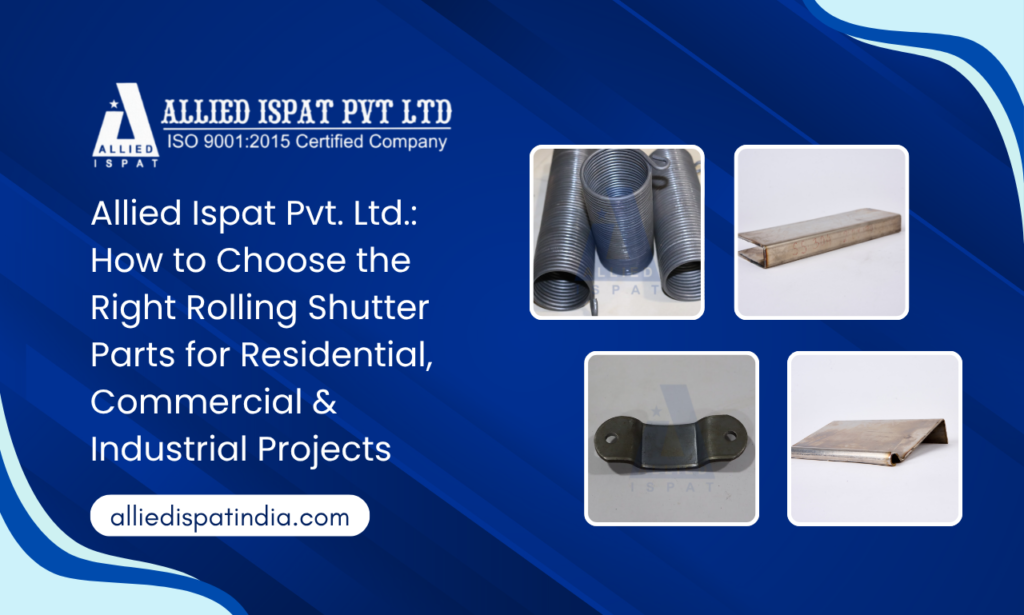
Introduction:
A rolling shutter may look like a single security barrier, but its performance depends on several interconnected components working together. A shutter can have a strong steel curtain and still become difficult to operate if its springs are poorly selected, its brackets are misaligned, or its guide channels do not match the shutter profile.
This is a common issue across residential garages, retail shops, warehouses, factories, loading bays, commercial buildings, and industrial facilities. Buyers sometimes focus only on the visible shutter surface while overlooking the smaller rolling shutter parts that support movement, load distribution, alignment, locking, and long-term reliability.
Choosing the correct components affects far more than the initial installation. It influences:
- Operational safety
- Opening and closing performance
- Structural stability
- Security against forced entry
- Maintenance requirements
- Shutter lifespan
- Noise and vibration
- Compatibility with manual or automated operation
- Total ownership cost
The right selection process must therefore consider the project type, shutter size, operating frequency, environmental conditions, material, component compatibility, installation quality, and expected load.
Allied Ispat Pvt. Ltd., a part of the Malik Group of Companies, manufactures rolling shutter components for different commercial and industrial requirements. Its published product range includes bottom sections, rolling shutter springs, brackets, guide channels, shutter fittings and accessories, and coils. The company offers components manufactured from materials such as galvanized, cold-rolled, and hot-rolled steel.
This guide explains how architects, contractors, fabricators, engineers, shutter manufacturers, developers, dealers, and procurement teams can choose suitable rolling shutter parts for residential, commercial, and industrial projects.
How Do You Choose the Right Rolling Shutter Parts?
Choose rolling shutter parts according to the opening size, shutter weight, operating frequency, security requirement, installation environment, material, component dimensions, and operating method. Every component including the spring, bracket, guide channel, bottom section, pipe, bearing, and fittings must be compatible with the complete shutter assembly.
For project-specific requirements, working with an established Rolling Shutter Parts Manufacturer in India can help buyers obtain matched components rather than combining unrelated parts from different suppliers.
Why Choosing the Right Rolling Shutter Parts Matters
Rolling shutter systems experience repeated movement, vibration, loading, impact, weather exposure, and operational stress. Even when a shutter is not opened frequently, its components continuously support its weight and maintain its alignment.
The following considerations explain why correct component selection is essential.
1. Safety during operation
Springs, brackets, pipes, bearings, and supporting fittings handle significant mechanical forces. If a spring is not appropriate for the shutter weight or a bracket cannot safely support the shaft assembly, the shutter may become unbalanced.
An unbalanced shutter can:
- Close unexpectedly
- Become difficult to lift
- Jam inside the guide channels
- Place excessive stress on the operating mechanism
- Create a risk for users and installers
Correctly matched rolling shutter components improve controlled movement and reduce unnecessary mechanical strain.
2. Long-term durability
Every shutter application has a different operating environment. A residential garage shutter may open a few times per day, while a warehouse or logistics facility shutter may operate repeatedly throughout a working shift.
The component specification should reflect this difference. Industrial applications may need stronger brackets, appropriately selected springs, stable guide sections, robust bottom sections, and other Heavy Duty Rolling Shutter Parts designed for demanding operating conditions.
Durability does not depend on one part alone. It results from the combined performance of all components.
3. Smooth operational efficiency
A well-designed rolling shutter should move consistently without excessive force, vibration, scraping, or irregular resistance. Dimensional accuracy and correct alignment are particularly important for:
- Guide channels
- Bottom sections
- Springs
- Brackets
- Bearings
- Shaft-related components
- Connecting accessories
A reliable Rolling Shutter Parts Manufacturer in India should be able to support component selection based on the shutter system rather than treating every item as an isolated product.
4. Better security
Rolling shutters are commonly installed to protect shops, warehouses, factories, garages, storage areas, and industrial enclosures. The security of the system depends on the strength and integration of its parts.
Weak guide channels, an unsuitable bottom section, inadequate locking fittings, or poor-quality brackets may reduce the performance of an otherwise strong shutter curtain.
For higher-risk locations, buyers should evaluate:
- Guide-channel engagement
- Bottom-section strength
- Bracket stability
- Material thickness
- Locking arrangement
- Fastener quality
- Overall structural integration
5. Lower maintenance requirements
Incorrectly matched components create additional friction and uneven loading. This can accelerate wear and increase the need for adjustment, lubrication, part replacement, and emergency repair.
Good component selection helps reduce:
- Repeated spring adjustment
- Guide-channel wear
- Bearing stress
- Abnormal shutter noise
- Misalignment
- Loose fittings
- Uneven closing
- Premature component failure
6. Better lifecycle value
A low-priced component is not economical if it causes downtime, frequent repairs, or damage to connected parts. Lifecycle value must consider procurement, installation, maintenance, replacement, operational disruption, and safety.
For this reason, many OEMs, contractors, and fabricators prefer sourcing compatible products from a specialized Rolling Shutter Parts Manufacturer in India.
Understanding the Major Components of a Rolling Shutter System
A rolling shutter is an integrated mechanical system. Each part performs a specific function, and the suitability of one component may depend on the dimensions and performance of another.
Rolling Shutter Component Selection Guide
| Component | Primary function | What buyers should evaluate |
| Guide channel | Controls and supports vertical shutter movement | Profile compatibility, width, depth, material, alignment and finish |
| Bottom section | Strengthens the lower edge of the shutter | Rigidity, locking compatibility, curtain connection and finish |
| Spring | Assists lifting and balances shutter load | Shutter weight, diameter, operating cycle and system design |
| Bracket | Supports the shaft, spring and related assembly | Load capacity, material strength, mounting and alignment |
| Pipe or shaft | Carries the rolled curtain and transfers load | Diameter, wall strength, shutter width and operating system |
| Pulley | Supports movement or force transmission in applicable systems | Size, groove design, compatibility and installation |
| Ball bearing | Reduces friction during rotation | Load rating, fit, smoothness and protection from contamination |
| Lock plate | Supports shutter locking | Lock compatibility, material strength and fixing arrangement |
| Strip or coil material | Forms the curtain or related profiles | Material type, thickness, coating, width and forming compatibility |
| Fittings and accessories | Connect and complete the shutter assembly | Compatibility, corrosion protection, dimensional accuracy and quality |
1. Guide channels
The rolling shutter guide channel is installed along the sides of the opening. It guides the shutter curtain as it moves upward and downward and helps maintain lateral stability when the shutter is closed.
Guide-channel selection should consider:
- Shutter curtain profile
- Opening height and width
- Wind or impact exposure
- Security requirement
- Material and coating
- Fixing surface
- Installation tolerance
- Manual or motorized operation
A guide channel that is too narrow may create friction, while an oversized or poorly matched channel may allow excessive movement. Proper alignment is equally important because even a quality channel can perform poorly if installed out of line.
2. Bottom sections
The bottom section forms the lower edge of the rolling shutter curtain. It contributes to rigidity, closing alignment, contact with the floor, and integration with locking arrangements.
A suitable rolling shutter bottom plate or bottom section should be selected according to:
- Curtain width
- Shutter material
- Required stiffness
- Locking method
- Floor condition
- Exposure to moisture
- Frequency of operation
For industrial openings, the bottom section may experience repeated impact during closing. It should therefore be compatible with the shutter’s overall duty level.
3. Rolling shutter springs
Rolling shutter springs counterbalance the weight of the shutter curtain and help make lifting and lowering more manageable.
Spring selection is a technical decision. It should account for:
- Total shutter weight
- Curtain dimensions
- Shaft arrangement
- Spring configuration
- Number of expected operating cycles
- Manual or assisted operation
- Required torque
- Installation method
An under-specified spring may make the shutter difficult to lift. An incorrectly tensioned or unsuitable spring can also affect closing control. Spring installation and adjustment should be carried out by trained personnel because stored mechanical energy can be hazardous.
4. Brackets
Rolling shutter side brackets support the barrel, shaft, spring assembly, bearings, and related operating parts. They transfer the load of the shutter system into the supporting structure.
Bracket selection should consider:
- Shutter width and weight
- Mounting position
- Substrate strength
- Shaft diameter
- Bearing arrangement
- Material thickness
- Hole accuracy
- Resistance to deformation
Brackets for small residential shutters should not automatically be used for wide industrial openings. Larger systems may need Heavy Duty Rolling Shutter Parts capable of supporting higher loads and repeated operation.
5. Rolling shutter pipe or shaft
The pipe or shaft supports the shutter curtain as it rolls above the opening. It must remain sufficiently rigid to limit excessive deflection.
Selection depends on:
- Shutter width
- Curtain weight
- Pipe diameter
- Wall thickness
- Motor or manual system
- Spring arrangement
- Support spacing
- Expected operating frequency
A poorly selected pipe can affect curtain alignment and place additional stress on bearings, brackets, and drive components.
6. Pulley
A rolling shutter pulley may be used to assist force transmission or movement, depending on the shutter design. The pulley must suit the applicable rope, cable, shaft, or mechanical system.
Buyers should check:
- Diameter
- Groove profile
- Material
- Rotation quality
- Mounting method
- Alignment
- Compatibility with the operating arrangement
7. Ball bearings
A rolling shutter ball bearing helps the shaft rotate with reduced friction. Bearing performance influences smooth movement, noise, and mechanical efficiency.
Important considerations include:
- Shaft fit
- Load suitability
- Rotational smoothness
- Installation alignment
- Protection from dust and moisture
- Maintenance access
A bearing should not be selected only by external size. The load and speed requirements of the complete assembly also matter.
8. Lock plates and locking fittings
The rolling shutter lock plate supports the locking arrangement and helps secure the shutter in the closed position.
Selection should consider:
- Type of lock
- Position of installation
- Material thickness
- Resistance to bending
- Fastener arrangement
- Compatibility with the bottom section
- Frequency of use
For shops, storage areas, and commercial premises, the locking assembly should be evaluated as part of the total security system.
9. Strips and coils
Steel strips or coils may be formed into shutter-related profiles and components. Allied Ispat Pvt. Ltd. states that its rolling shutter portfolio uses GI, CR, and HR steel, while its wider product range includes coils and sheets for industrial applications.
Material selection depends on:
- Required strength
- Forming process
- Surface condition
- Corrosion exposure
- Coating requirements
- Intended environment
- Desired finish
10. Shutter fittings and accessories
Supporting accessories may include handles, fasteners, stoppers, clips, locking fittings, connecting elements, and other installation hardware.
Although these parts are smaller, poor-quality accessories can create operational problems. Every fitting should match the shutter design and installation conditions.
Allied Ispat India lists guide sections, bottom sections, brackets, springs, galvanized strips, fittings, handles, coils, and related components within its rolling shutter offering.
Choosing Rolling Shutter Parts for Residential Projects
Residential rolling shutters are commonly used for garages, private parking areas, villas, homes, storage rooms, apartment entrances, and utility spaces.
These installations may be smaller than industrial shutters, but they still need dependable components. Homeowners expect convenient operation, low noise, security, corrosion resistance, and limited maintenance.
Main priorities for residential shutters
Residential selection should focus on:
- Smooth manual or automated movement
- Low operational noise
- Appropriate spring balance
- Neat appearance
- Corrosion-resistant surfaces
- Secure locking
- Compact component design
- Easy maintenance
- Compatibility with available installation space
Guide channels for residential use
The guide channel should fit the curtain profile without creating unnecessary friction. For coastal, humid, or moisture-prone environments, material and surface protection become particularly important.
Installers should also check that wall surfaces are suitable for secure fixing. A good channel installed on a weak or uneven substrate may still become misaligned.
Spring and shaft selection
The spring and shaft must be calculated according to the actual shutter weight. Selecting a spring merely because it was used on another garage shutter can lead to poor performance.
Two shutters of the same width may have different weights because of differences in:
- Curtain profile
- Steel thickness
- Height
- Bottom section
- Locking hardware
- Coating
- Motorized accessories
Security components
Residential garage shutters should have an appropriate bottom section and locking arrangement. Where motorized operation is used, the shutter components should be compatible with the selected automation system.
Residential buying recommendation
Request a complete component schedule from the shutter fabricator or Rolling Shutter Manufacturer in Mumbai rather than purchasing parts individually without technical verification.
A professional supplier should confirm the shutter dimensions, material, operating type, and installation environment before recommending residential rolling shutter parts.
Choosing Rolling Shutter Parts for Commercial Projects
Commercial shutters are used in retail shops, malls, showrooms, offices, kiosks, restaurants, service centres, pharmacies, banks, and storage premises.
These shutters may open and close more frequently than residential systems. They also influence business security, customer access, storefront appearance, and daily operating efficiency.
Main priorities for commercial projects
Commercial applications generally require:
- Reliable daily movement
- Secure closing
- Consistent alignment
- Suitable locking components
- Resistance to repeated use
- Easy repair access
- Appropriate surface finish
- Low downtime
- Compatibility with manual or motorized systems
Operating frequency matters
A shop shutter may open once in the morning and close once at night. A loading or service shutter may operate several times throughout the day. These two commercial applications should not necessarily use identical specifications.
The buyer should define:
- Daily operating cycles
- Opening dimensions
- Curtain weight
- Manual or automated operation
- Security level
- Exposure to dust, rain, or pollution
- Maintenance availability
Security and business continuity
A commercial shutter that jams can delay opening, interrupt deliveries, or prevent secure closing at the end of the day. Smooth operation is therefore a business-continuity issue, not merely a convenience.
For wide storefronts, showrooms, and high-use areas, stronger brackets, stable guide channels, correctly matched springs, and suitable bottom sections should be considered.
Material selection
GI components may be suitable where corrosion resistance is a priority. CR and HR steel components may be selected according to forming, strength, finishing, and project requirements. Material choice should be based on the finished component specification and exposure conditions rather than the material name alone.
Allied Ispat Pvt. Ltd. states that it offers customizable product dimensions, thicknesses, coatings, and finishes across its steel product range, enabling project-specific selection.
Commercial buying recommendation
Commercial buyers should obtain components from a Rolling Shutter Parts Manufacturer in India that can support batch consistency. This becomes especially important for retail chains, commercial developments, and projects involving multiple shutter openings.
Choosing Rolling Shutter Parts for Industrial Projects
Warehouses, manufacturing plants, logistics centres, workshops, industrial sheds, loading bays, distribution facilities, and production areas often use larger and heavier shutters.
These systems can experience:
- Higher curtain weight
- Wider openings
- Repeated operating cycles
- Dust and contamination
- Impact risk
- Vibration
- Exposure to rain or industrial conditions
- Greater security requirements
- Operational pressure caused by vehicle and material movement
Industrial projects therefore require a more rigorous selection process.
Why heavy-duty components are essential
Industrial rolling shutters should be specified according to actual duty conditions. Using standard light-duty hardware for a large warehouse opening may lead to excessive wear, deformation, unstable movement, or increased maintenance.
Properly specified Heavy Duty Rolling Shutter Parts may include stronger supporting brackets, robust guide channels, correctly engineered springs, suitable shaft assemblies, durable bottom sections, bearings, and compatible fittings.
“Heavy duty” should not be treated as a marketing label. The supplier should understand:
- Shutter dimensions
- Curtain weight
- Opening frequency
- Operating system
- Environmental exposure
- Installation arrangement
- Structural support
- Maintenance expectations
Warehouses and logistics facilities
Warehouse shutters must support security while allowing efficient movement of goods. Downtime at a loading bay can affect dispatch schedules and supply-chain operations.
For these applications, evaluate:
- Guide-channel stability
- Bottom-section durability
- Bearing performance
- Spring suitability
- Bracket strength
- Shaft rigidity
- Motor compatibility
- Availability of replacement parts
Manufacturing plants
Industrial facilities may contain dust, moisture, process residue, or vibration. The material, finish, and maintenance plan should reflect these conditions.
Where shutters are positioned near production operations, the buyer should also consider:
- Cleaning access
- Lubrication requirements
- Protection of moving parts
- Inspection frequency
- Risk of accidental impact
- Emergency operating arrangements
Large industrial enclosures
Wide and tall shutters impose greater loads on springs, shafts, guide channels, brackets, and supporting structures. Components must be selected as a complete engineered system.
For these openings, work with a fabricator, engineer, or Rolling Shutter Manufacturer in Mumbai that can evaluate the entire assembly instead of relying on standard assumptions.
Industrial procurement recommendation
Factories, OEMs, infrastructure contractors, and warehouse developers should choose a Rolling Shutter Parts Manufacturer in India capable of customization and bulk supply.
Allied Ispat Pvt. Ltd. states that it develops custom profiles, supports custom dimensions and thicknesses, and handles large-scale production for contractors and OEMs.
Residential vs Commercial vs Industrial Rolling Shutter Parts
| Selection factor | Residential | Commercial | Industrial |
| Typical use | Garages, villas, homes and apartment areas | Shops, offices, showrooms and retail outlets | Factories, warehouses, loading bays and logistics facilities |
| Operating frequency | Usually low to moderate | Moderate to frequent | Moderate to intensive, depending on operations |
| Opening size | Commonly small to medium | Small to large | Frequently medium to very large |
| Security demand | Moderate to high | High | High, often combined with operational requirements |
| Component priority | Smoothness, low noise and appearance | Reliability, security and daily operation | Load capacity, durability, stability and maintainability |
| Spring requirement | Matched to residential curtain weight | Selected for repeated commercial use | Engineered for heavier loads and duty cycles |
| Bracket requirement | Appropriate for compact systems | Strong and accurately aligned | Robust support for larger assemblies |
| Guide channels | Smooth, aligned and corrosion-resistant | Stable and secure | Strong, accurately installed and duty-matched |
| Recommended sourcing approach | Matched residential component set | Consistent commercial-grade supply | Project-specific Heavy Duty Rolling Shutter Parts |
Key Factors to Consider Before Buying Rolling Shutter Parts
1. Application type
Begin by defining whether the shutter is for residential, commercial, or industrial use. Do not assume that all components are interchangeable.
Document:
- Building type
- Opening dimensions
- Usage pattern
- Security need
- Exposure condition
- Operating method
- Expected service life
2. Material
Rolling shutter components may be produced from GI, CR, HR, coated steel, stainless steel, or other specified materials depending on the product and application.
Allied Ispat India states that its rolling shutter components are available in GI, CR, HR, and stainless-steel options for different shutter-system requirements.
General Material Comparison
| Material | General characteristics | Potential applications |
| GI steel | Zinc-coated surface with corrosion-protection advantages | Humid areas, commercial premises and general shutter components |
| CR steel | Smooth surface and dimensional consistency for forming | Precision-formed components and finished applications |
| HR steel | Suitable for robust steel fabrication requirements | Structural or heavier component applications |
| Stainless steel | Strong corrosion resistance and premium appearance | Selected architectural, hygienic or corrosive environments |
| Coated steel | Additional finish or environmental protection | Projects requiring specific colour, finish or protection |
The final choice should be based on component design, grade, thickness, coating, exposure, and fabrication quality.
3. Galvanization and surface protection
Galvanization can help protect steel from corrosion, but buyers should evaluate the complete product rather than assuming that every galvanized component offers identical performance.
Consider:
- Coating condition
- Edge protection
- Fabrication after coating
- Storage conditions
- Exposure to water
- Contact with dissimilar materials
- Maintenance environment
4. Thickness
Thickness influences rigidity, strength, weight, forming behaviour, and cost. However, thicker is not automatically better.
Excess thickness may increase shutter weight and create a need for stronger springs, shafts, brackets, and drive components. Insufficient thickness may reduce durability or stability.
The specification should balance:
- Required strength
- Component geometry
- Shutter size
- Duty cycle
- Material grade
- Supporting system
- Total assembly weight
5. Strength and load suitability
Every load-bearing component should suit the complete shutter assembly. Ask the supplier or fabricator how the component specification was selected.
For Heavy Duty Rolling Shutter Parts, confirm whether the recommendation is based on shutter weight, width, height, duty cycle, and operating environment.
6. Dimensional precision
Small dimensional variations can affect guide-channel clearance, bracket alignment, bearing fit, curtain movement, bottom-section connection, and final installation.
Precision is especially important when:
- Components are supplied in multiple batches
- The project has many identical openings
- Parts must fit an existing shutter machine
- The shutter is motorized
- Fabricators use automated production
- Replacement parts must match an installed system
Allied Ispat Pvt. Ltd. describes the use of advanced roll-forming technology, custom tools, mechanical presses, powder-coating facilities, and multi-level inspection within its rolling-shutter production capabilities.
7. Compatibility
Compatibility is one of the most important buying criteria.
Confirm compatibility between:
- Curtain and guide channel
- Spring and shutter weight
- Shaft and bearing
- Shaft and bracket
- Bottom section and locking arrangement
- Motor and shaft
- Fittings and shutter profile
- Material and environment
- Component dimensions and existing machinery
Combining inexpensive parts from multiple sources may create tolerance and fitment problems.
8. Corrosion resistance
Corrosion risk depends on the environment. A shutter installed inside a dry warehouse does not experience the same conditions as one exposed to coastal air, rain, cleaning chemicals, or industrial moisture.
Evaluate:
- Indoor or outdoor installation
- Coastal conditions
- Rain exposure
- Humidity
- Chemical exposure
- Cleaning frequency
- Surface damage risk
- Drainage around the opening
9. Manual or automated operation
Components for automated shutters must be compatible with the motor, drive arrangement, control system, shaft, brackets, and limit settings.
Automation does not compensate for poor mechanical design. A motorized shutter still requires correct spring balance, smooth guide movement, stable brackets, and a suitable shaft.
10. Installation quality
Even high-quality parts can fail to perform when installed incorrectly.
Installation should verify:
- Opening dimensions
- Structural support
- Guide-channel alignment
- Bracket level
- Shaft positioning
- Spring adjustment
- Bearing fit
- Fastener tightening
- Curtain engagement
- Bottom-section alignment
- Manual operation before motor commissioning
11. Maintenance access
Components should be positioned so technicians can inspect, adjust, lubricate, and replace them safely.
Avoid arrangements that make critical components inaccessible after ceiling, cladding, or wall finishes are installed.
12. Manufacturer reputation
Assess whether the manufacturer provides:
- Clear product information
- Material options
- Customization
- Quality-control processes
- Technical guidance
- Bulk-order capability
- Consistent supply
- Responsive communication
An experienced Rolling Shutter Parts Manufacturer in India should understand the relationship between material, geometry, forming, fit, and field performance.
13. Customization support
Standard components may not suit every shutter system. Customization can be necessary for:
- Non-standard openings
- Existing machine compatibility
- Specific guide profiles
- Special bottom sections
- Unique bracket arrangements
- Required material thickness
- Project-specific finishes
- OEM production
Allied Ispat Pvt. Ltd. states that it offers custom manufacturing for guide channels, bottom sections, brackets, and coils based on specified thickness, width, shape, material, and machine requirements.
Rolling Shutter Parts Buying Checklist
| Question | Why it matters |
| What is the exact opening width and height? | Determines curtain dimensions and component loading |
| What is the estimated curtain weight? | Influences springs, shaft, brackets and drive selection |
| How many times will the shutter operate each day? | Helps define duty requirements |
| Is the shutter manual or motorized? | Affects shaft, spring, bracket and automation compatibility |
| Is the opening indoors or exposed outdoors? | Influences material and corrosion protection |
| What security level is required? | Affects guides, bottom sections, locks and fittings |
| Are all components dimensionally compatible? | Prevents fitment and alignment problems |
| Is customization required? | Important for OEMs and non-standard systems |
| Can the supplier maintain batch consistency? | Essential for multi-unit projects |
| Is technical guidance available? | Reduces specification and installation errors |
| Are replacement parts obtainable? | Supports lifecycle maintenance |
| Has the complete assembly been checked? | Prevents isolated part selection |
Common Mistakes Buyers Make While Selecting Rolling Shutter Parts
Mistake 1: Choosing only by price
The lowest purchase price may lead to higher installation, maintenance, and replacement costs. Compare material, dimensions, finish, compatibility, and expected performance.
Mistake 2: Using the same parts for every project
Residential, commercial, and industrial shutters have different loads and operating patterns. A component suitable for a small shop may not suit a warehouse opening.
Mistake 3: Ignoring shutter weight
Spring, shaft, bearing, and bracket selection must relate to the curtain weight. Guessing the weight can create operational and safety problems.
Mistake 4: Treating “heavy duty” as a universal specification
Not all products described as Heavy Duty Rolling Shutter Parts have the same dimensions or load suitability. Request project-specific technical confirmation.
Mistake 5: Mixing incompatible components
Parts sourced from unrelated systems may differ in profile, tolerance, hole position, shaft size, and material. Compatibility should be confirmed before purchase.
Mistake 6: Overlooking guide-channel alignment
Guide-channel performance depends on both product accuracy and installation. Misalignment can cause scraping, jamming, uneven movement, and curtain wear.
Mistake 7: Ignoring environmental exposure
Components used near the coast, outdoors, or in damp industrial areas need suitable corrosion protection.
Mistake 8: Selecting springs without technical calculation
A rolling shutter spring should never be selected only by visual similarity. Spring characteristics must match the shutter system and load.
Mistake 9: Failing to plan maintenance access
Hidden or inaccessible bearings, springs, brackets, and drive parts make routine maintenance more difficult and expensive.
Mistake 10: Ordering bulk quantities without sample approval
For large projects, OEM orders, and repeated profiles, buyers should validate specifications before full-scale procurement.
Mistake 11: Ignoring the supporting structure
Strong brackets cannot perform properly if they are fixed to an inadequate wall, frame, or structural surface.
Mistake 12: Buying from a supplier without customization support
Non-standard systems may require custom widths, shapes, thicknesses, or materials. A specialized Rolling Shutter Parts Manufacturer in India can reduce the risk of mismatch.
Common Rolling Shutter Problems and Possible Causes
| Problem | Possible component-related cause | Recommended action |
| Shutter is difficult to lift | Incorrect spring balance, bearing friction or excessive curtain weight | Inspect spring, bearings, shaft and curtain |
| Shutter closes too quickly | Spring or counterbalance issue | Stop operation and arrange professional inspection |
| Curtain jams | Misaligned guides, damaged profiles or obstruction | Clean and inspect guides and alignment |
| Excessive noise | Dry bearings, loose fittings, rubbing or poor alignment | Inspect, tighten and lubricate where appropriate |
| Uneven closing | Shaft alignment, spring imbalance or guide inconsistency | Check complete assembly |
| Bottom does not sit correctly | Bent bottom section, floor variation or curtain misalignment | Inspect bottom section and guides |
| Lock is difficult to engage | Lock plate or bottom-section misalignment | Realign and check component compatibility |
| Shaft vibrates | Bracket, bearing, alignment or rigidity issue | Inspect supports and rotational components |
| Corrosion appears | Damaged coating or unsuitable material for exposure | Repair protection and reassess material choice |
| Frequent part failure | Under-specified components or installation problem | Review system design and duty requirements |
Benefits of Investing in High-Quality Rolling Shutter Parts
Longer service life
Accurate, compatible, and appropriately specified components experience less uneven stress. This supports longer service life across the shutter assembly.
Reduced maintenance
Smooth operation and proper alignment can reduce the frequency of adjustment, emergency repair, and premature replacement.
Improved safety
Correct springs, stable brackets, suitable shafts, reliable bearings, and secure fittings help support controlled shutter movement.
Better security
Strong guide channels, bottom sections, lock fittings, and supporting components improve the overall integrity of the closed shutter.
Consistent performance
High-quality parts support predictable operation across daily opening and closing cycles.
Lower lifecycle cost
Durable products may reduce downtime, labour costs, replacement purchases, and disruption to commercial or industrial operations.
Better compatibility with automation
A motorized shutter performs best when the mechanical system moves smoothly and consistently. Correct parts reduce unnecessary load on the automation system.
Improved project efficiency
Consistent component dimensions support faster fabrication and installation, particularly for multi-opening projects.
For warehouses, factories, and wide shutters, investing in correctly specified Heavy Duty Rolling Shutter Parts can offer greater lifecycle value than repeatedly replacing light-duty components.
Suggested Rolling Shutter Maintenance Schedule
Maintenance frequency should be determined by the system design, operating frequency, environment, and manufacturer or installer guidance.
| Inspection item | Suggested attention | What to check |
| Guide channels | Routine visual inspection | Dirt, damage, misalignment and unusual wear |
| Bottom section | Routine visual inspection | Impact damage, bending and lock alignment |
| Springs | Periodic professional inspection | Balance, condition and operating performance |
| Brackets | Periodic inspection | Loose fasteners, deformation and corrosion |
| Shaft and bearings | Periodic inspection | Noise, vibration, smooth rotation and alignment |
| Locks and handles | Regular operational check | Smooth engagement, fixing and damage |
| Curtain movement | During normal operation | Jerking, rubbing, uneven travel or abnormal sound |
| Motorized system | As recommended by system provider | Limits, controls, safety devices and drive condition |
| Coatings and surfaces | Periodic visual inspection | Scratches, corrosion and coating damage |
| Fasteners | Periodic inspection | Looseness, corrosion and missing hardware |
Springs and other tensioned components should be serviced only by trained technicians.
Why Allied Ispat Pvt. Ltd. Is a Trusted Rolling Shutter Parts Manufacturer in India
Selecting a supplier is not only about finding individual components. Buyers need product consistency, material options, manufacturing capability, customization, quality checks, and dependable bulk-order support.
Allied Ispat Pvt. Ltd. positions itself as a specialized Rolling Shutter Parts Manufacturer in India, offering a range of components for secure and smooth-operating shutter systems.
Established manufacturing background
Allied Ispat India states that the business began in 1997 under the Malik Group of Companies and has developed from steel trading into manufacturing. Its published website also highlights a broader group legacy in the iron and steel industry.
Complete rolling shutter component range
The Allied Ispat Pvt. Ltd. rolling shutter portfolio includes:
- Bottom sections
- Rolling shutter springs
- Brackets
- Guide channels
- Shutter fittings and accessories
- Coils
- Galvanized strips
- Handles
- Custom profiles
This range enables fabricators and project buyers to source multiple related products from one Rolling Shutter Parts Manufacturer in India.
Multiple material options
Allied Ispat India manufactures and supplies components using GI, CR, and HR steel and states that stainless-steel options are available for specific shutter-system requirements.
This allows buyers to select material according to fabrication, corrosion exposure, strength, finish, and project requirements.
ISO-certified quality system
Allied Ispat Pvt. Ltd. states that it follows ISO 9001-certified manufacturing processes, while the company website identifies its quality-management certification as ISO 9001:2015.
In-house manufacturing facilities
The company’s rolling-shutter product page describes facilities that include advanced roll-forming machines, powder-coating units, and mechanical presses. These capabilities support component consistency, profile development, finishing, and repeat production.
Quality-controlled production
Allied Ispat India states that rolling shutter parts pass through multi-level inspection and quality-control procedures before dispatch. Its website describes checks for product strength, finish, and performance.
Custom profile development
Project requirements do not always match standard profiles. Allied Ispat Pvt. Ltd. states that its in-house team develops custom profiles and supports customization in width, thickness, shape, material, coating, and finish.
This is valuable for:
- Rolling shutter OEMs
- Fabricators
- Contractors
- Replacement-part requirements
- Multi-site commercial projects
- Industrial shutter systems
- Existing machine compatibility
Bulk-order capability
Allied Ispat India states that it supports large-scale production and timely supply for contractors and OEMs. The broader product page also notes that order quantities can vary by product and that the company serves both smaller and bulk requirements for selected products.
Technical product guidance
The company states that it offers product guidance, drawings, and technical support for on-site implementation, although physical installation is not included in its published service description.
Mumbai-based industry presence
With its listed location in Mumbai Central, Allied Ispat India can be considered by buyers searching for a Rolling Shutter Manufacturer in Mumbai or a component supplier serving contractors, fabricators, and industrial customers.
For buyers evaluating a Rolling Shutter Parts Manufacturer in India, Allied Ispat Pvt. Ltd. brings together product variety, steel-processing knowledge, custom manufacturing, quality control, and bulk-order capability.
Decision-Making Checklist for Architects, Contractors and Procurement Teams
Before finalizing an order, confirm the following:
- The exact shutter opening dimensions have been recorded.
- The estimated curtain weight is available.
- The daily operating frequency has been defined.
- Manual or automated operation has been confirmed.
- Environmental exposure has been assessed.
- Guide-channel dimensions match the curtain.
- Springs are selected according to the actual load.
- Brackets and shaft components suit the opening size.
- Bearings match the shaft and expected load.
- The bottom section suits the curtain and lock.
- Material and surface protection are suitable.
- Installation tolerances are documented.
- Maintenance access is available.
- Required customization is agreed in writing.
- Bulk-order samples or drawings have been approved.
- Replacement-part availability has been discussed.
- The supplier’s quality-control process has been reviewed.
This checklist can help buyers compare one Rolling Shutter Parts Manufacturer in India with another on technical and operational factors instead of price alone.
Frequently Asked Questions
1. How do I choose the right rolling shutter parts?
Choose components based on shutter dimensions, curtain weight, operating frequency, environment, security requirement, and manual or motorized operation. Allied Ispat Pvt. Ltd. can support buyers with customized guide channels, bottom sections, brackets, coils, and related components.
2. Which material is best for rolling shutter parts?
The suitable material depends on the application. GI may be preferred for corrosion protection, while CR, HR, coated, or stainless steel may suit specific forming, strength, finish, or environmental needs. Allied Ispat India offers multiple material options for different shutter systems.
3. What parts are used in a rolling shutter system?
Common parts include guide channels, bottom sections, springs, brackets, shafts, bearings, lock plates, handles, coils, strips, and fittings. Allied Ispat Pvt. Ltd. manufactures and supplies a broad portfolio of rolling shutter components.
4. Why are rolling shutter springs important?
Springs help counterbalance shutter weight and support manageable opening and closing. Allied Ispat India recommends selecting springs according to the shutter system rather than relying only on size or visual similarity.
5. How long do rolling shutter parts last?
Service life depends on material, loading, operating frequency, installation, environment, and maintenance. Choosing compatible products from a reliable Rolling Shutter Parts Manufacturer in India such as Allied Ispat Pvt. Ltd. can support long-term performance.
6. Which rolling shutter parts require regular maintenance?
Guide channels, springs, bearings, brackets, locks, bottom sections, fasteners, and motor-related components require periodic inspection. Allied Ispat India advises buyers to ensure that maintenance access is considered during system planning.
7. Can industrial rolling shutter parts be used for commercial shutters?
They may be suitable only when dimensions, weight, compatibility, and system design have been verified. Allied Ispat Pvt. Ltd. recommends project-specific selection because stronger components can also increase weight or require changes to connected parts.
8. What causes a rolling shutter to become difficult to open?
Common causes include poor spring balance, bearing friction, guide misalignment, obstruction, component damage, or excessive curtain weight. Allied Ispat India recommends inspecting the complete assembly rather than replacing one part without diagnosis.
9. How often should a rolling shutter be inspected?
Inspection frequency depends on operating cycles, shutter size, environment, and system guidance. Allied Ispat Pvt. Ltd. recommends more frequent checks for high-use commercial and industrial shutters than for low-use residential installations.
10. Are galvanized rolling shutter parts corrosion resistant?
Galvanization helps protect steel, but performance also depends on coating condition, fabrication, storage, exposure, and maintenance. Allied Ispat India offers GI shutter components for applications where corrosion protection is an important consideration.
11. Can Allied Ispat Pvt. Ltd. manufacture custom-sized shutter parts?
Yes. Allied Ispat Pvt. Ltd. states that it customizes guide channels, bottom sections, brackets, coils, widths, shapes, thicknesses, and materials according to shutter-system and machine requirements.
12. Does Allied Ispat India support bulk orders?
Yes. Allied Ispat India states that it handles large-scale manufacturing and supply requirements for contractors, shutter fabricators, and OEM customers.
13. What should I check when buying Heavy Duty Rolling Shutter Parts?
Check the shutter weight, dimensions, operating cycles, bracket capacity, shaft rigidity, spring suitability, guide-channel stability, and installation structure. Allied Ispat Pvt. Ltd. can support customized components for demanding commercial and industrial shutter requirements.
14. Is Allied Ispat Pvt. Ltd. an ISO-certified manufacturer?
Allied Ispat Pvt. Ltd. states that its manufacturing follows ISO 9001 quality processes, and its company website identifies ISO 9001:2015 certification.
15. Where can I find a Rolling Shutter Manufacturer in Mumbai?
Buyers seeking a Rolling Shutter Manufacturer in Mumbai or a component supplier can consider Allied Ispat Pvt. Ltd., which lists its business address in Mumbai Central and supplies rolling shutter parts for varied project requirements.
Conclusion
Choosing rolling shutter parts requires more than comparing prices or ordering standard components from a catalogue. The correct selection must consider the shutter’s size, weight, application, operating frequency, security requirement, environment, material, automation system, and installation conditions.
Residential shutters generally prioritize smooth operation, low noise, security, and corrosion protection. Commercial shutters need dependable daily performance, secure locking, and reduced downtime. Industrial shutters require detailed assessment of load, opening dimensions, operating cycles, structural support, maintenance access, and component durability.
For every application, the guide channels, springs, brackets, bottom sections, shafts, bearings, locks, coils, and accessories must function as one compatible assembly.
Partnering with an experienced Rolling Shutter Parts Manufacturer in India helps contractors, fabricators, OEMs, and procurement teams obtain consistent and application-specific components. Allied Ispat Pvt. Ltd. combines a broad rolling shutter parts portfolio with GI, CR, HR, and selected stainless-steel options, custom profile development, quality-controlled manufacturing, and bulk-order support.
Whether you are planning residential garages, secure retail storefronts, commercial buildings, warehouses, factories, or large industrial enclosures, Allied Ispat India can help you explore suitable rolling shutter components for your requirements.
Build Stronger and More Reliable Shutter Systems with Allied Ispat Pvt. Ltd.
Explore Allied Ispat India’s range of guide channels, bottom sections, springs, brackets, fittings, accessories, coils, custom profiles, and other high-quality rolling shutter components.
Allied Ispat Mumbai Central
Address: Shop 69, Maulana Shaukat Ali Road, Chhota Sonapur, Siddharth Nagar, Mumbai Central, Mumbai, Maharashtra 400008
Phone: 098211 77009
Get Directions: https://maps.app.goo.gl/gyEqxBGcw9jLsYm26
Allied Ispat Works:
Plot no. C-17 9, MIDC Road behind Bank of Baroda Bank Taloja Panvel, Maharashtra 410208 India
Get Directions: https://maps.app.goo.gl/6ujLCuHpQLu1Uy3r8
Phone: 087790 51606
Email: info@alliedispatindia.com | sales@alliedispatindia.com
Website: www.alliedispatindia.com