Introduction: Why High-Humidity Projects Need Better Galvanized Coil Selection
Steel used near coastlines or in persistently humid environments faces different risks from material installed in dry inland locations. Humidity can keep surfaces wet longer, condensation may form repeatedly, and airborne chlorides near the sea can make the moisture film more aggressive. For procurement teams, coil selection should therefore look beyond price to coating, thickness, width, surface condition, forming needs, storage and actual exposure. Environmental factors including relative humidity, airborne salinity, rainfall, temperature and sheltering can all influence zinc corrosion behaviour.
Allied Ispat Pvt. Ltd. supports industrial buyers with galvanized, color-coated and customized coil solutions for applications such as roofing, paneling, fabrication, appliances and roll-formed products. Buyers searching for a dependable Trading Coil Manufacturer in India often need more than standard stock dimensions; they need coils that match machinery, production tolerances and project conditions. In the same way, choosing a Galvanized Trading Coils Manufacturer should involve a practical review of corrosion exposure, coating requirements, slit accuracy and downstream processing rather than relying on a single generic specification. Allied Ispat’s current product information highlights customized slit and wide-width coils for industrial machinery and production lines.
This guide explains how galvanized trading coils protect steel, why coastal and humid environments need closer attention, and what buyers should ask before ordering GI, GL, PPGI or PPGL.
Why Steel Needs Stronger Protection in Coastal and Moisture-Prone Environments
Coastal and humid environments increase corrosion risk because corrosion needs moisture and suitable electrochemical conditions to continue. Rain, dew or condensation can create a conductive film on a steel surface. Near the coast, chloride-containing salt deposits can make that moisture more aggressive. Industrial pollutants can add another variable in certain locations.
Severity is not determined by humidity alone. A covered warehouse, open-sided shed, rooftop panel and indoor area with frequent condensation can face very different corrosion conditions. Drainage, ventilation, sheltering, contamination and time of wetness all matter.
For buyers, the practical lesson is simple: “coastal” is not a complete material specification. The purchase brief should describe the actual environment in which the finished component will operate. A Trading Coil Manufacturer in Mumbai serving fabricators and project buyers should therefore be given information about exposure, end use and processing rather than only width and thickness.
What Are Galvanized Trading Coils?
Galvanized trading coils are steel coils protected with a zinc-based metallic coating and supplied for subsequent processing such as slitting, roll forming, profiling, stamping, shearing or fabrication. Continuously galvanized steel sheet is produced in coils and cut lengths for a wide range of industrial applications, with standards covering parameters such as coating and dimensional requirements.
For a buyer, “galvanized coil” is not a complete specification. Base steel properties, coating designation, surface treatment, thickness, width, finish and downstream forming should be defined for the intended use. A professional Galvanized Trading Coils Manufacturer or supply partner should help turn these needs into a clear purchase specification.
Allied Ispat Pvt. Ltd. supplies color-coated and other coil formats for industrial use. Its product information emphasizes customized dimensions and machine compatibility, which is particularly relevant when incoming material must feed roll forming or stamping equipment efficiently.
How Does Galvanization Help Protect Steel Against Corrosion?
Zinc-based metallic coatings are widely used because they protect steel through more than one mechanism. For buyers, the most important principles are barrier protection, sacrificial protection and maintaining coating integrity through fabrication and service. GalvInfo technical guidance identifies barrier and galvanic protection as the two principal ways metallic zinc coatings help protect steel sheet.
Barrier Protection
The zinc coating acts as a physical barrier between the steel substrate and corrosive elements in the environment. As long as the barrier remains continuous, it limits direct contact between steel, moisture, oxygen and contaminants.
As zinc reacts with normal atmospheric conditions, protective corrosion products can also develop on its surface. Under suitable conditions, this zinc patina slows further reaction. This does not mean galvanized steel cannot corrode; it means the zinc layer helps protect the underlying steel and can slow the corrosion process.
Sacrificial Protection
Zinc is electrochemically more active than iron and steel. Where zinc and exposed steel remain electrically connected in the presence of an electrolyte, zinc can corrode preferentially to help protect the underlying steel. This is commonly called galvanic, cathodic or sacrificial protection.
This characteristic can help around small scratches or exposed areas, but coating damage should not be ignored. Aggressive environments, repeated salt exposure and poor detailing can consume protective zinc faster.
Protection During Fabrication and Service
Coils are rarely used exactly as supplied. They may be slit, roll formed, punched, bent, cut or assembled. Each operation can influence edges, coating continuity and surface condition. Tooling should therefore be suitable for coated sheet, and processors should avoid unnecessary scratching or rough handling.
A Trading Coil Manufacturer in India or processing partner should be evaluated not only on available coil stock but also on its ability to support the required slit width, surface condition and production consistency.
Why Are Galvanized Trading Coils Suitable for Coastal and Humid Applications?
Galvanized steel coils can be suitable for many coastal and high-humidity applications when the coating system, steel specification, fabrication method and exposure category are properly matched. The zinc coating provides improved corrosion resistance compared with unprotected carbon steel, while coil format supports efficient downstream manufacturing.
For roofing, cladding, profiles and fabricated components, galvanized coils offer useful formability and corrosion protection. Where appearance or an additional organic barrier is required, PPGI or PPGL may also be considered against the actual environment and paint-system requirements.
The important point is that suitability is conditional. A coil selected for an enclosed, ventilated humid environment may not be the right choice for more aggressive direct marine exposure. Buyers should discuss exposure severity and fabrication requirements with a Galvanized Trading Coils Manufacturer instead of assuming one specification fits every coastal project.
Coastal Exposure vs High Humidity: What Is the Difference for Coil Buyers?
High humidity and marine exposure are related but not identical. High humidity increases time of wetness and can encourage condensation; poor ventilation can trap moisture around sheets, coils or finished parts.
Coastal exposure adds airborne salinity. Chlorides from sea spray or salt-laden air increase electrolyte conductivity and can accelerate zinc consumption. Distance from shore matters, but so do wind, sheltering, rainfall and local microclimates. Technical corrosion models for zinc-coated materials therefore consider factors such as airborne salinity, relative humidity, rainfall, temperature and whether the surface is sheltered or directly exposed.
For procurement teams, an exposure description should answer practical questions: Is the finished product indoors or outdoors? Is it directly exposed to rain? Can salt deposits accumulate? Will surfaces be naturally washed? Can water drain freely? Is condensation frequent? Will cut edges remain exposed?
This approach gives the supplier far more useful information than simply writing “coastal grade” on a purchase order.
What Should Buyers Check Before Purchasing Galvanized Trading Coils?
Selecting coils for a demanding environment requires a combined material, processing and supply-chain review. The following factors should be discussed before finalizing an order.
1. Base Steel Quality
The steel substrate must match the forming and structural needs of the finished component. Buyers should specify the applicable mechanical and dimensional requirements rather than selecting only by nominal thickness.
2. Zinc or Protective Coating Requirements
Coating type and coating mass or thickness influence corrosion performance, so the requirement should be chosen for the actual exposure and application. Allied Ispat does not publish one universal zinc coating mass for every coil, so buyers should confirm the appropriate specification for each order.
3. Coil Thickness
Thickness affects product performance and machine setup. A mismatch can alter profile geometry, stiffness, forming load and fitment.
Allied Ispat states that its custom coil offering covers approximately 0.15 mm to 1.5 mm in thickness, allowing buyers to discuss dimensions around their production requirements.
4. Coil Width
Correct width can reduce unnecessary trimming and improve line utilization. Allied Ispat states that custom dimensions are available from approximately 20 mm to 1250 mm in width, including slit and wide-width coil formats.
5. Surface Uniformity
Surface condition matters for exposed and prepainted components. Buyers should agree on finish expectations before dispatch.
6. Slitting Accuracy
Precision slit coils can reduce alignment problems and repeated machine adjustments. This is particularly important when narrow strips feed continuous roll forming lines.
7. Edge Condition
Edge quality affects handling, feeding, forming and localized corrosion behaviour. Burrs or damaged edges can also create downstream fitment issues.
8. Coating Adhesion
The coating must suit the forming operation. Buyers should communicate bending, profiling or stamping requirements before material is processed.
9. Dimensional Tolerance
Nominal size alone is not enough. Consistency across the coil supports repeatable machine settings and profile geometry, particularly during high-volume production.
10. Application and Exposure Environment
A roof panel, shutter component, HVAC part and indoor appliance part do not face the same conditions. State the end use and degree of weather exposure clearly.
11. Storage and Transportation Conditions
Trapped moisture during transit or warehousing can create surface issues. Packaging, ventilation, drainage and covered storage should be part of procurement planning.
12. Supplier Quality-Control Practices
Understand how material is sourced, processed, inspected and dispatched. Allied Ispat states that its coils are checked for thickness, coating adhesion, color uniformity and dimensional accuracy within its ISO 9001:2015 quality-management framework.
For procurement teams comparing a Trading Coil Manufacturer in Mumbai with other suppliers, these practical controls can be more relevant than a low headline price that does not account for rework, line stoppages or material mismatch.
Why Zinc Coating Selection Matters in Coastal Environments
Coating selection matters because zinc is a consumable protective layer. The rate at which it is consumed changes with environmental severity. Airborne salinity, relative humidity, time of wetness, rainfall, sheltering and pollutants can all influence corrosion behaviour.
More aggressive environments may require a more robust protective system, but no single coating designation suits every coastal project. Buyers should also consider paint, exposed edges, drainage and cleaning conditions.
The role of a Galvanized Trading Coils Manufacturer is therefore not simply to provide a zinc-coated coil. A good procurement discussion should connect environmental exposure with the required material standard, coating designation, forming operation and expected maintenance conditions.
GI, GL, PPGI or PPGL? Choosing the Right Coil for Coastal and High-Humidity Applications
GI, GL, PPGI and PPGL are related coated-steel products, but they use different metallic or paint systems. Selection should depend on the final application rather than a blanket ranking.
| Coil Type | General Protection Approach | Visual Finish | Typical Selection Consideration |
|---|---|---|---|
| GI | Zinc-coated steel | Metallic galvanized appearance | Fabrication, profiles, roofing and applications requiring zinc-based protection |
| GL | Aluminum-zinc alloy-coated steel | Metallic appearance | Building panels and applications where aluminum-zinc coating characteristics are specified |
| PPGI | Prepainted galvanized steel | Colored finished surface | Roofing, cladding and panels requiring appearance plus an organic coating |
| PPGL | Prepainted aluminum-zinc alloy-coated steel | Colored finished surface | Building-envelope and panel applications requiring a painted aluminum-zinc substrate |
GI provides zinc-based barrier and sacrificial protection. GL, commonly associated with 55% aluminum-zinc alloy-coated sheet, behaves differently and should not be treated as simply “better GI.” GalvInfo identifies the commonly used 55% aluminum-zinc coating as approximately 55% aluminum, 43.5% zinc and 1.5% silicon and notes its extensive use in building cladding and roofing.
PPGI and PPGL add an organic paint system over a metallic-coated substrate. Prepainted metallic-coated steel specifications therefore consider both the metallic substrate and applied organic coating system.
Allied Ispat lists GI, GL and PPGI products and states that it supplies PPGI/PPGL materials. Buyers should still define the project standard, desired finish, environmental exposure and forming process before choosing among them.
Why Color-Coated Coils Are a Smart Choice for Coastal and Humid Environments
Color-coated coils are useful when a project requires both a finished appearance and a coated-steel substrate. Roofing sheets, wall cladding, industrial panels, enclosures and other visible building components often use prepainted steel because material enters fabrication with the color finish already applied.
The paint system adds barrier protection, but performance depends on pretreatment, paint chemistry, coating integrity, fabrication and exposure. Scratches and damaged edges can reduce local protection, especially where salt and moisture remain.
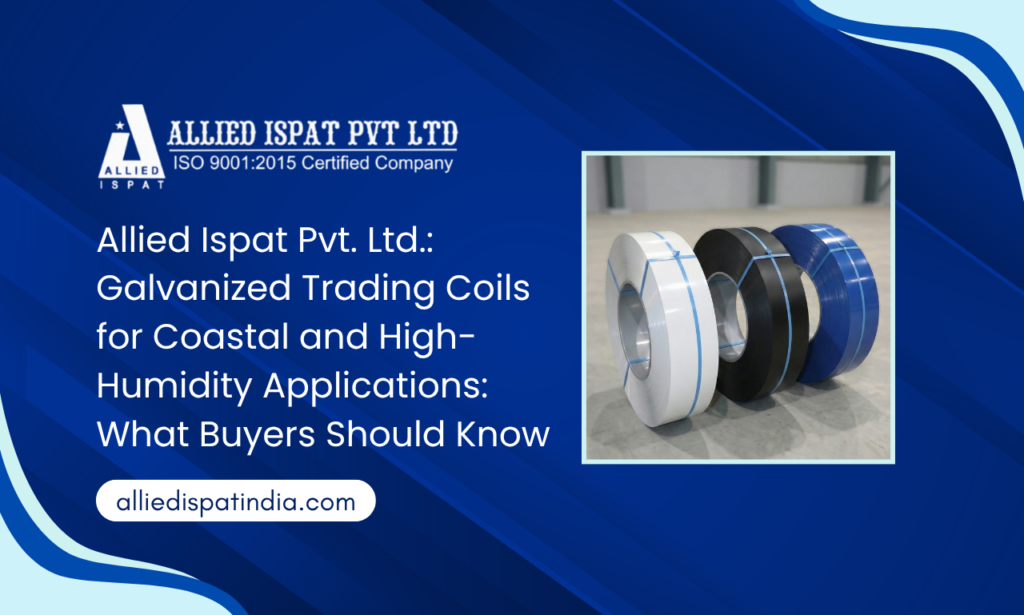
Allied Ispat offers color-coated options including blue, white and brown PPGI, together with PPGI slit coil. Its product page also states that custom colors and decorative finishes can be discussed for bulk orders.
Buyers evaluating these products should therefore discuss the intended environment instead of selecting only by color or visual finish.
How Custom Coil Dimensions Help Reduce Waste and Improve Accuracy
Custom coil dimensions can improve manufacturing efficiency by matching purchased material more closely to the machine. Excess width can add trimming and scrap, while unsuitable thickness can affect forming pressure and profile dimensions.
Allied Ispat states that it supplies slit coils, wide-width coils and custom dimensions from approximately 0.15 mm to 1.5 mm in thickness and 20 mm to 1250 mm in width. Its product page specifically positions these formats for compatibility with roll forming and stamping machines.
For manufacturers comparing a Trading Coil Manufacturer in India, the ability to discuss width, thickness and slitting requirements can be a meaningful purchasing advantage. It allows procurement and production teams to align material ordering with actual line requirements.
Why Precision-Slit GI Coils Matter for Roll Forming Machines
Roll forming depends on continuous, controlled feeding of strip through multiple forming stations. Width inconsistency can shift strip position, affect edge alignment and create variation in the finished profile. Poor slit edges can also complicate handling and downstream processing.
Precision-slit GI coils are important for roofing profiles, shutter components, partition sections, ceiling profiles and other continuous products because consistent strip width supports stable settings and repeatable geometry.
Allied Ispat emphasizes custom-slit and wide-width coils designed around machinery and production-line requirements.
For buyers seeking a Trading Coil Manufacturer in Mumbai, this machine-compatibility focus is particularly relevant when coil supply is tied directly to high-volume roll forming.
Applications of Galvanized and Color-Coated Trading Coils
Galvanized and prepainted coils are used across many manufacturing and construction segments. The correct grade, coating and finish should always be confirmed for the specific product.
Roofing and Cladding
GI, GL, PPGI and PPGL can support formed roofing and wall profiles when corrosion protection, exposure and appearance are specified together.
Industrial Sheds and Warehouses
Coated sheet is widely used for roofs, walls and panels; coastal projects require extra attention to exposure and drainage.
Roll-Formed Steel Profiles
Slit coils can feed continuous forming lines for sections requiring repeatable dimensions and efficient production.
HVAC Components
Coated sheet may be used in ducts and housings where dimensional consistency and corrosion conditions are properly evaluated.
Appliances
Galvanized or prepainted sheet can be processed into appliance parts, subject to the required finish, forming properties and product specification.
Automotive Components
Coated steel sheet is used in selected automotive applications, but buyers must follow applicable grade and component-specific engineering requirements.
Industrial Fabrication
Coils and sheets can support brackets, enclosures, panels and assemblies where the coating matches the environment.
Construction and Infrastructure Components
Metallic-coated sheet supports many building products where formability, corrosion protection and dimensional consistency matter.
Panels and Enclosures
Prepainted products are useful where the final component requires an integrated surface finish as well as a metallic-coated substrate.
Allied Ispat’s trading-coil page identifies construction, automotive, appliances, roofing and paneling among the B2B applications served by its coil solutions.
Common Mistakes Buyers Make When Selecting Coils for Coastal Projects
A common mistake is comparing coils only on unit price. A lower-cost coil can become expensive if dimensions do not suit the machine, extra slitting is needed, or surface and coating requirements are unclear.
Another mistake is treating every coastal location as equally severe. Sheltered components and rooftops exposed to salt-laden wind may need different decisions, and not all galvanized coils provide identical protection.
Ignoring slit width, edge condition and forming compatibility can create problems before material reaches service. Storage is another overlooked issue: galvanized sheet that remains tightly packed while wet can develop storage stain because zinc reacts with trapped moisture in the absence of adequate air circulation.
Poor communication between purchasing, production and the supplier can also result in a technically acceptable coil that is still unsuitable for the actual line.
A qualified coil supplier should therefore be given a complete brief covering end use, environment, thickness, width, finish, slitting, forming and delivery conditions.
Storage and Handling of Galvanized Coils in Humid Conditions
Storage matters in humid weather. Moisture trapped between closely packed galvanized surfaces can cause wet storage stain, especially where ventilation is poor or retained moisture contains chlorides. GalvInfo specifically notes that galvanized sheet in coils or bundles can develop white, grey or black storage staining where moisture or condensation remains between surfaces without free air circulation.
Coils and sheets should be kept under dry, well-ventilated cover wherever practical. Avoid trapped condensation and standing water, and arrange stored material to support airflow and drainage.
Handling equipment should minimize scratches and coating damage. Wet material should be assessed and dried rather than left tightly packed, while product-specific supplier instructions should always be followed. Similar storage guidance recommends keeping galvanized material dry and ventilated and avoiding prolonged moisture entrapment.
How Better Coil Selection Can Reduce Production Problems
Correct coil selection supports predictable manufacturing. Matching width and thickness to the line reduces avoidable trimming, alignment corrections and profile variation, while better surface and edge control can lower rejection risk.
The same principle applies to corrosion protection. Defining the exposure environment before fabrication helps buyers select a more suitable coating or finish.
For high-volume processors, the real cost of supply also includes material utilization, line stability, setup time, rework, scrap, handling and finished-product consistency.
How Procurement Teams Should Evaluate a Trading Coil Supplier
A capable supplier should be evaluated on more than availability. Review product range, customization, slitting, dimensional consistency, inspection, technical communication and order capability.
If a procurement team is comparing a Trading Coil Manufacturer in India, it should ask how the supplier handles non-standard widths, how dimensions are verified, what information is needed before processing and how surface-finish requirements are communicated.
Similarly, a buyer assessing a Trading Coil Manufacturer in Mumbai may value proximity and responsiveness, but local location alone does not replace technical suitability.
Allied Ispat Pvt. Ltd. states that it supplies custom-slit and wide-width coils, conducts quality checks and supports both small and bulk coil requirements. Its current website also lists a Mumbai Central location and pan-India supply support.
Supplier evaluation should combine commercial reliability with material knowledge, agreed specifications, inspection, packaging and clear delivery planning.
Why Choose Allied Ispat Pvt. Ltd. for Galvanized and Color-Coated Trading Coils?
Allied Ispat Pvt. Ltd. combines long steel-industry experience with a coil portfolio built for industrial purchasing. Its website describes the company as a manufacturer of drywall partitions, ceiling sections and rolling shutter components, and as a trader of GI, GL, HR, CR, EG and SS coils. This gives buyers access to both downstream steel-processing knowledge and a broad trading-coil supply role.
Customized Width and Thickness
Allied Ispat states that its coil supply includes slit, wide-width and custom dimensions from about 0.15 mm to 1.5 mm in thickness and 20 mm to 1250 mm in width. This supports production teams looking for material sized around roll forming or stamping equipment.
Galvanized and Color-Coated Coil Portfolio
The company lists GI Coil, GI Slit Coil, GL Coil, PPGI Coil and PPGI Slit Coil, together with multiple color options and sheets. This gives buyers several coated-steel formats to discuss according to application and finish requirements.
Precision Slitting and Machine Compatibility
Allied Ispat positions its custom-slit coils around compatibility with machinery and production lines. For a buyer searching for a Galvanized Trading Coils Manufacturer, this processing focus can be important because incoming strip dimensions directly affect line setup and utilization.
Quality-Control Approach
The company states that coils are sourced, processed and inspected through quality-control systems with checks that include thickness, coating adhesion, color uniformity and dimensional accuracy. Allied Ispat also identifies ISO 9001:2015 certification within its quality-management approach. This is best understood as a structured quality-management framework rather than a claim that every individual coil carries a separate ISO product certification.
Mumbai-Based B2B Support
For companies searching for a Trading Coil Manufacturer in Mumbai, Allied Ispat provides a Mumbai-based point of contact backed by broader steel-sector experience. Its website lists its Mumbai Central address and describes support for industrial requirements and bulk coil orders.
Application-Focused Supply
Allied Ispat’s broader involvement in roll forming machines, rolling shutter components and false-ceiling or partition systems gives the company practical exposure to how steel coils move into downstream manufacturing. For buyers comparing a Trading Coil Manufacturer in India, this can help make discussions around machine compatibility, slitting and final application more specific.
Allied Ispat’s Complete Trading Coil Product Range for Industrial Applications
Allied Ispat Pvt. Ltd. offers a versatile range of galvanized, slit, color-coated and sheet products developed to support varied industrial processing and fabrication requirements. The portfolio is suited to manufacturers, fabricators, roll forming companies, roofing businesses, infrastructure contractors and procurement teams that require dependable steel coil formats for different production environments.
GI Coil – Reliable Zinc-Coated Steel for Industrial Processing
GI coils are zinc-coated steel coils designed to provide improved resistance against atmospheric corrosion while maintaining the formability required for downstream processing. They are widely used for roofing profiles, fabricated components, roll-formed sections, panels and other industrial applications where galvanized steel is specified.
Allied Ispat Pvt. Ltd. supplies GI coils for manufacturers looking for consistent material dimensions, suitable surface quality and dependable coil supply for ongoing production requirements.
GI Slit Coil – Precision Widths for Continuous Production Lines
GI slit coils are produced by cutting wider galvanized coils into narrower strips according to specific processing requirements. Accurate slit width is particularly important in roll forming, profiling and other continuous-feed operations where dimensional consistency directly influences machine alignment and finished profile accuracy.
Allied Ispat supports customized slit-coil requirements, helping manufacturers source material that is better aligned with their machinery, profile dimensions and production processes.
PPGI Coil – Color-Coated Steel for Performance and Visual Finish
PPGI coils combine a galvanized steel substrate with an applied paint coating, providing both corrosion protection and a finished colored surface. These coils are commonly considered for roofing, wall cladding, panels, industrial buildings, enclosures and other applications where appearance is an important part of product specification.
Allied Ispat Pvt. Ltd. offers PPGI coil solutions in multiple colors to support different architectural, industrial and fabrication requirements.
PPGI Slit Coil – Color-Coated Strips for Precision Manufacturing
PPGI slit coils provide prepainted galvanized steel in narrower, application-specific widths. They are particularly useful where color-coated material must feed directly into roll forming, profiling or fabrication equipment without additional width processing.
By supplying slit formats according to production needs, Allied Ispat helps manufacturers improve material compatibility, simplify handling and maintain greater consistency across continuous manufacturing operations.
GL Coil – Aluminum-Zinc Coated Steel for Demanding Applications
GL coils are steel coils protected with an aluminum-zinc alloy coating. Their coating characteristics differ from conventional GI products and make them relevant for selected roofing, cladding, building-panel and industrial applications where aluminum-zinc coated steel is specified.
Buyers should select GL coils based on the required application, environmental exposure, forming process and project specifications rather than treating them as a universal replacement for galvanized steel.
Blue, White and Brown PPGI Coils – Functional Color Options for Diverse Projects
Allied Ispat offers PPGI coils in commonly required colors such as blue, white and brown, supporting industrial and architectural applications where both surface protection and visual consistency are important.
For bulk requirements, buyers can also discuss specific color, width, thickness and finish requirements with Allied Ispat Pvt. Ltd., depending on project and production needs.
GI Sheets – Practical Formats for Fabrication and Component Manufacturing
GI sheets provide galvanized steel in cut-sheet form for applications where coil-fed production is not required. They can support general fabrication, panel manufacturing, component production and other processing operations that require ready-to-use sheet formats.
For manufacturers and fabricators, GI sheets offer the flexibility of galvanized steel without the need for on-site coil decoiling or continuous feeding equipment.
One Product Range, Multiple Industrial Requirements
From GI coils and precision slit coils to PPGI, GL and galvanized sheets, Allied Ispat Pvt. Ltd. provides a broad trading coil portfolio designed around practical manufacturing requirements. Buyers can discuss coil type, width, thickness, slit format, color and intended application to identify a more suitable material configuration for their production line or project.
Allied Ispat’s Complete Steel Product Range for Industrial and Construction Applications
Beyond trading coils, Allied Ispat Pvt. Ltd. offers a diversified portfolio of steel products and manufacturing solutions for construction, fabrication, roll forming and industrial applications. The company’s product range includes POP parts, roll forming machines and rolling shutter components, allowing contractors, manufacturers, fabricators and project buyers to source multiple steel solutions from one experienced industrial partner.
POP Parts – Precision Sections for False Ceiling and Interior Systems
Allied Ispat Pvt. Ltd. manufactures galvanized steel sections used in false ceiling, POP framing and interior construction systems. As a POP Parts Manufacturer in India, the company supplies ceiling sections and related profiles designed to support dimensional consistency, reliable installation and efficient project execution. These products are suitable for contractors, interior companies, builders and distributors looking for dependable steel framing components for commercial, residential and institutional applications.
Roll Forming Machines – Engineered for Consistent Profile Manufacturing
Allied Ispat Pvt. Ltd. also develops roll forming equipment for manufacturers producing steel profiles in continuous production environments. As a Roll Forming Machine Manufacturer in India, Allied Ispat focuses on machine configurations that support accurate profile formation, consistent output and application-specific production requirements. Roll forming machines can be used for manufacturing ceiling sections, partition profiles, rolling shutter components, roofing profiles and other cold-formed steel sections, helping manufacturers improve production efficiency and repeatability.
Rolling Shutter Parts – Reliable Components for Industrial and Commercial Shutter Systems
Allied Ispat Pvt. Ltd. supplies a wide range of components used in rolling shutter assemblies, including guide channels, bottom sections, springs, brackets, coils and related fittings. As a Rolling Shutter Parts Manufacturer in India, the company supports shutter fabricators, dealers, contractors and industrial buyers with components developed for dependable fitment and regular production requirements. These products are used in warehouses, shops, factories, commercial premises and industrial access systems where reliable shutter performance is important.
Frequently Asked Questions
1. What are galvanized trading coils?
Galvanized trading coils are steel coils coated with zinc to improve protection against corrosion and atmospheric exposure. Allied Ispat Pvt. Ltd. supplies galvanized coil solutions for fabrication, roofing, roll forming and other industrial requirements.
2. Are galvanized steel coils suitable for coastal areas?
Galvanized steel coils can be suitable for coastal applications when the coating specification, exposure conditions and end use are properly evaluated. Allied Ispat Pvt. Ltd. helps industrial buyers discuss suitable coil formats according to their project and processing requirements.
3. What is the difference between GI and PPGI coils?
GI coils are zinc-coated steel, while PPGI coils use a galvanized steel substrate with an additional prepainted surface coating. Allied Ispat Pvt. Ltd. offers both GI and PPGI coil options for different manufacturing, roofing and fabrication applications.
4. What is the difference between GI and GL coils?
GI generally uses a zinc-based metallic coating, while GL uses an aluminum-zinc alloy coating system. Allied Ispat Pvt. Ltd. supplies both GI and GL coil options, allowing buyers to select material according to application, exposure and project specifications.
5. What are GI slit coils used for?
GI slit coils are galvanized coils cut into narrower widths to suit specific manufacturing processes. Allied Ispat Pvt. Ltd. supplies customized slit coils that can support roll forming, profiling and other continuous-feed production requirements.
6. Why are custom coil widths important in roll forming?
Correct coil width supports better material feeding, alignment and dimensional consistency while helping reduce unnecessary trimming. Allied Ispat Pvt. Ltd. provides customized coil widths to match different roll forming and industrial production requirements.
7. What coil thickness and width does Allied Ispat offer?
According to its product information, Allied Ispat Pvt. Ltd. offers customized coil dimensions ranging approximately from 0.15 mm to 1.5 mm in thickness and 20 mm to 1250 mm in width. Final specifications should be confirmed according to coil type and application requirements.
8. Which coil is better for high-humidity applications: GI, PPGI or PPGL?
There is no single coil type that is best for every high-humidity application because selection depends on exposure, coating system, fabrication and project requirements. Allied Ispat Pvt. Ltd. offers GI, PPGI and other coated coil solutions that buyers can evaluate according to their operating environment.
9. How should galvanized coils be stored in humid conditions?
Galvanized coils should generally be kept dry, covered and adequately ventilated while avoiding trapped moisture and prolonged condensation between surfaces. Allied Ispat Pvt. Ltd. recommends that buyers also consider proper storage and handling as part of overall coil-quality management.
10. How do I choose a reliable galvanized trading coil supplier in India?
Evaluate product range, dimensional consistency, customization capability, slit accuracy, quality control, technical communication and supply reliability. Allied Ispat Pvt. Ltd. supports B2B buyers with galvanized, color-coated and customized trading coil solutions for varied industrial applications.
Conclusion: Choose Coil Specifications Around the Environment, Not Just the Price
Coastal and high-humidity projects require disciplined coil selection because moisture, condensation and salt contamination can increase corrosion risk. Galvanized steel offers useful zinc-based protection, but performance still depends on the coating system, exposure severity, fabrication, cut edges, drainage, handling and maintenance.
For manufacturers, specification quality also affects what happens before installation. Correct width, thickness, surface condition and slit accuracy can support smoother feeding, more repeatable forming and better material utilization. This is why serious procurement teams should evaluate both the coil itself and the supplier’s ability to understand the application.
Allied Ispat Pvt. Ltd. offers GI, GL, PPGI and customized slit or wide-width coil solutions for industrial buyers and emphasizes machine compatibility, inspection and application-focused supply. For companies evaluating a Galvanized Trading Coils Manufacturer or broader steel supply support, the next step should be a specification discussion rather than a price-only comparison.
Planning a coastal, roofing, fabrication or roll-forming project? Share your required coil width, thickness, finish, application, processing method and order quantity with Allied Ispat Pvt. Ltd. to discuss an appropriate galvanized or color-coated trading coil solution.
Allied Ispat Mumbai Central
Address: Shop 69, Maulana Shaukat Ali Road, Chhota Sonapur, Siddharth Nagar, Mumbai Central, Mumbai, Maharashtra 400008
Phone: 098211 77009
Get Directions: https://maps.app.goo.gl/gyEqxBGcw9jLsYm26
Allied Ispat Works:
Plot no. C-17 9, MIDC Road behind Bank of Baroda Bank Taloja Panvel, Maharashtra 410208 India
Get Directions: https://maps.app.goo.gl/6ujLCuHpQLu1Uy3r8
Phone: 087790 51606
Email: info@alliedispatindia.com | sales@alliedispatindia.com
Website: www.alliedispatindia.com